
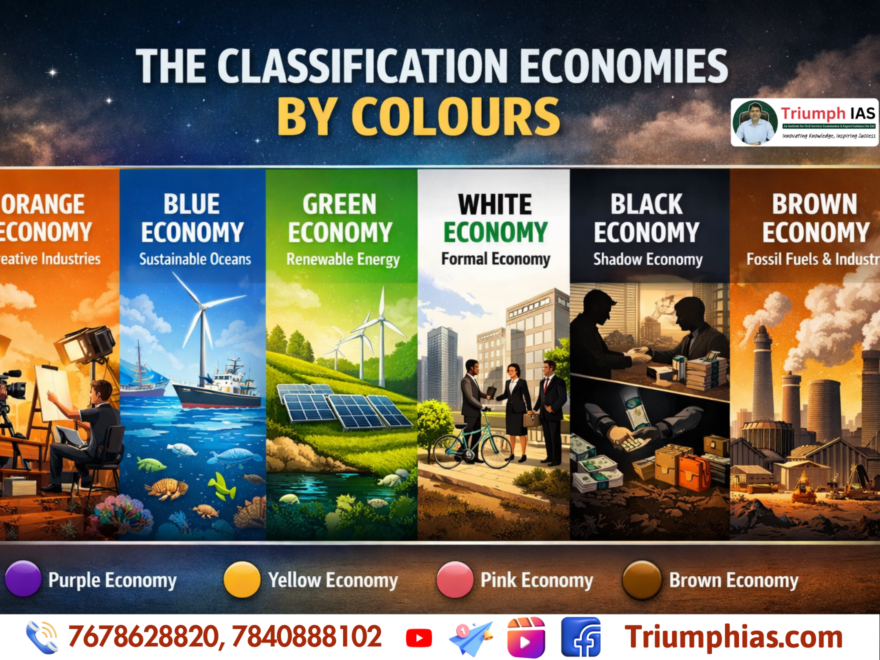
THE CLASSIFICATION ECONOMIES BY COLOURS
(Relevant for General Awareness )
IntroductionThe classification of economies by colors is a contemporary analytical framework used in development discourse, sustainability studies, and policy debates. These “color economies” do not replace traditional typologies like capitalist or socialist systems; rather, they highlight sectoral priorities, sustainability orientations, and socio-cultural dimensions of economic activity. Below is a structured note explaining major types referenced in your image.
Orange Economy refers to the creative economy — industries based on creativity, culture, intellectual property, and innovation. It includes film, music, design, gaming, advertising, digital content, publishing, performing arts, and cultural tourism. The core asset here is human creativity and knowledge capital. The Orange Economy emphasizes intellectual property rights, cultural entrepreneurship, and monetization of ideas. For developing countries, it provides employment generation with relatively low environmental cost and high value addition. Blue Economy focuses on sustainable use of ocean and marine resources for economic growth, livelihoods, and ecosystem health. It includes fisheries, aquaculture, maritime transport, coastal tourism, offshore renewable energy, seabed mining, and marine biotechnology. The central principle is balancing economic utilization of oceans with ecological sustainability. For coastal nations, it is strategically linked to maritime security, trade, and environmental governance.
Green Economy is an economic model aimed at reducing environmental risks and ecological scarcities while promoting sustainable development. It prioritizes renewable energy, sustainable agriculture, clean technology, waste management, circular economy practices, and low-carbon growth. The Green Economy aligns with climate change mitigation, biodiversity conservation, and sustainable consumption patterns.
Black Economy refers to unaccounted, illegal, or informal economic activities that evade taxation and regulatory oversight. It includes tax evasion, corruption, smuggling, and parallel cash transactions. The black economy distorts resource allocation, reduces government revenue, and weakens institutional credibility. It is often discussed in the context of governance reforms and financial transparency. White Economy generally denotes the formal, regulated, and tax-compliant segment of the economy. Transactions are recorded, businesses are legally registered, and activities contribute to GDP and public revenue. The White Economy strengthens institutional accountability and financial transparency. Purple Economy integrates culture into sustainable development. Unlike the Orange Economy, which focuses on creative industries, the Purple Economy emphasizes cultural sensitivity in production and consumption. It promotes respect for cultural diversity in global markets, ethical branding, and socially responsible business practices rooted in local traditions. Yellow Economy is sometimes associated with knowledge-driven sectors, tourism, or in certain contexts, the digital and innovation economy. In some interpretations, it represents human capital development, education, and intellectual services. The precise meaning can vary across policy literature. Pink Economy refers to economic activities linked to the LGBTQ+ community, including targeted marketing, inclusive workplaces, and industries catering to diversity-conscious consumers. It highlights purchasing power, inclusion, and diversity-driven economic participation. Brown Economy describes an economic system heavily dependent on fossil fuels, extractive industries, and carbon-intensive production. It is often contrasted with the Green Economy. Brown economic structures prioritize industrial expansion and growth, sometimes at the cost of environmental sustainability. In conclusion, these color-coded economic categories are analytical tools used in contemporary development discourse to capture emerging sectoral priorities and sustainability challenges. They help policymakers and scholars conceptualize economic diversification, ecological transitions, cultural integration, and governance reforms in a more nuanced and multidimensional way. |

To Read more topics, visit: www.triumphias.com/blogs
Read more Blogs:
Social System Stress in Times of Pandemic and Economic Shocks
2 comments