

Between Custom and Codification: The Politics of Tribal Governance
(Relevant for Sociology Paper 2: Tribal communities in India)
Introduction: Custom and CodificationThe recent protests by members of the Ho tribe in Jharkhand’s Kolhan region over alleged state interference in the Manki-Munda system bring to the fore deeper issues of tribal autonomy, customary governance, and post-colonial state integration. The episode is not an isolated protest but reflects a larger historical and sociological struggle between indigenous self-rule and bureaucratic modernity. Manki-Munda system as a case of tribal governance, contextualizes it within colonial and post-colonial transformations, and analyzes the present tensions through the lenses of tribal sociology, legal pluralism, resistance theory, and cultural autonomy. The Manki-Munda System: An Indigenous Sociopolitical Order
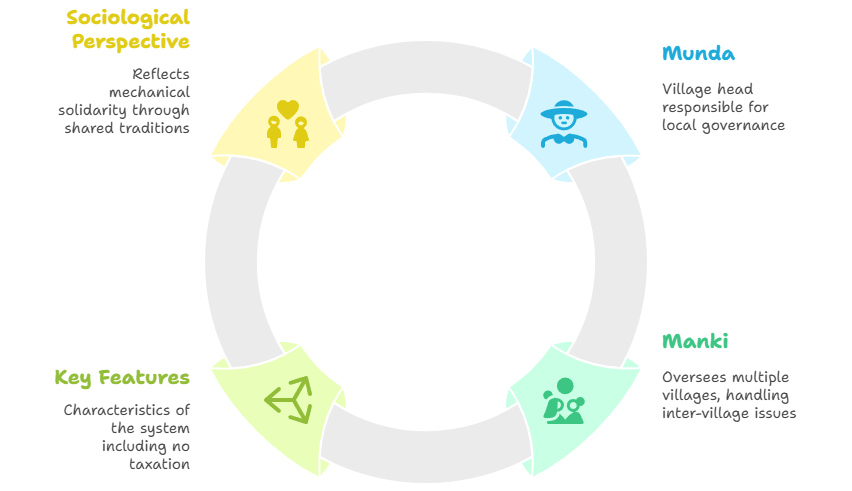
The Manki-Munda system is a centuries-old, hereditary and decentralized tribal governance framework practiced by the Ho tribe in Jharkhand’s Kolhan region.
Key Features:
From a sociological standpoint, this system is an embodiment of mechanical solidarity (Émile Durkheim), where cohesion arises from shared traditions, collective beliefs, and kinship. Colonial Transformation and Codification: The British Co-option of Tribal AuthorityFollowing the East India Company’s takeover post-1764 (Battle of Buxar), colonial intervention in tribal lands began through taxation and Permanent Settlement (1793). This led to:
Rather than eliminating the Manki-Munda system, the British co-opted and codified it in Wilkinson’s Rules (1833), under Captain Thomas Wilkinson. This reflects Antonio Gramsci’s concept of passive revolution—where colonial powers integrated indigenous elites (Mankis/Mundas) to stabilize rule without transformative change. This codification served multiple colonial objectives:
From a Foucauldian lens, this was an instance of governmentality—the art of governing not just through coercion, but by structuring the field of possible action of others, using native institutions. Post-Independence Legal Pluralism and the Question of Customary LawPost-1947, the Indian state largely retained Wilkinson’s Rules in Kolhan, recognizing them as valid customary practices. This is an example of legal pluralism—the coexistence of multiple legal systems (formal law, customary law, religious law). However, the Patna High Court’s judgment in Mora Ho v. State of Bihar (2000) clarified that Wilkinson’s Rules are not statutory law, but customary—thus offering soft recognition, not legal enforceability. Implications:
Sally Falk Moore’s concept of the “semi-autonomous social field” is apt here: the Manki-Munda system operates within the state’s larger legal domain but retains relative autonomy, now increasingly threatened. The Present Protest: Crisis of Legitimacy and Tribal Assertion
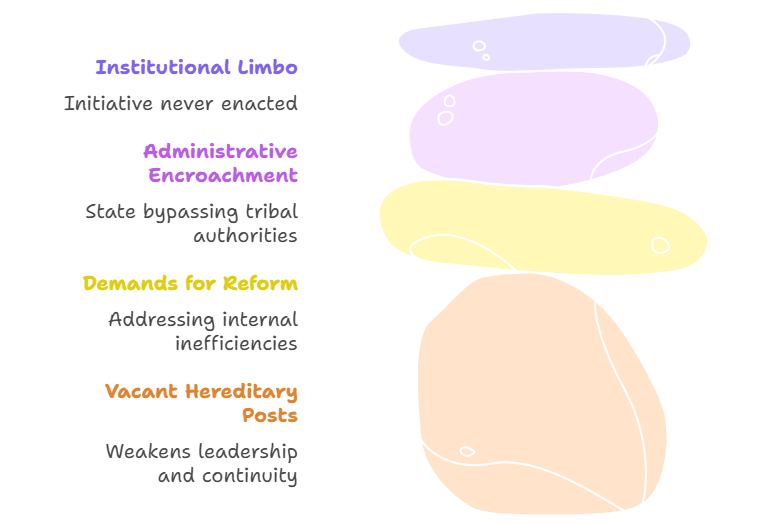
In 2024, tensions have escalated due to:
The Nyay Manch initiative (2021) proposed integrating the system into modern structures but was never enacted. This institutional limbo has frustrated the Ho community, who view the state’s silence or interference as a denial of self-governance rights. Sociological Analysis:
Tribal Identity, Cultural Ecology, and LandFor the Ho people, governance is not just political—it is embedded in their cultural ecology, worldview, and relationship with land.
Clifford Geertz’s interpretive sociology reminds us that systems like Manki-Munda are “webs of meaning.” Administrative reforms that treat them as outdated or inefficient miss their symbolic and moral dimensions. State-Tribe Relations: From Integration to ContestationThe Indian state’s approach toward tribal governance has shifted from integrationist to developmentalist and now increasingly to extractive, especially in mineral-rich areas like Jharkhand. Key Issues:
The Manki-Munda protest thus becomes a site of contestation—between:
Resistance, Identity Politics, and the Assertion of Adivasi ModernityThe Ho protest isn’t anti-modern—it reflects a plural modernity, where indigenous governance structures seek recognition, reform, and relevance.
From a subaltern perspective (Ranajit Guha, Partha Chatterjee), these movements represent the politics of the governed—not merely demanding inclusion, but contesting the very terms of inclusion. Lessons for Sociological Understanding and Policy
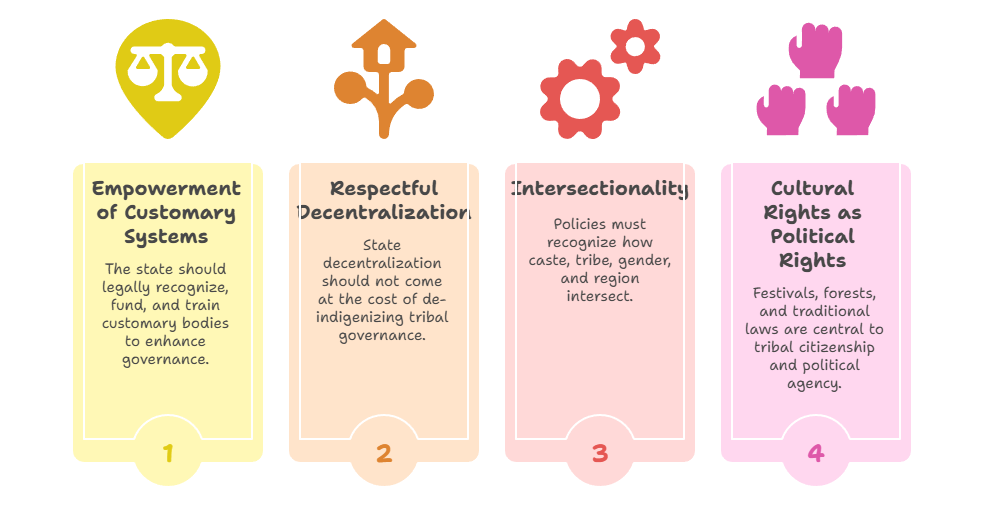
Rather than bypassing or diluting them, the state should legally recognize, fund, and train customary bodies to enhance governance.
State decentralization (via PRIs) should not come at the cost of de-indigenizing tribal governance.
Policies must recognize how caste, tribe, gender, and region intersect to create diverse experiences within Adivasi communities.
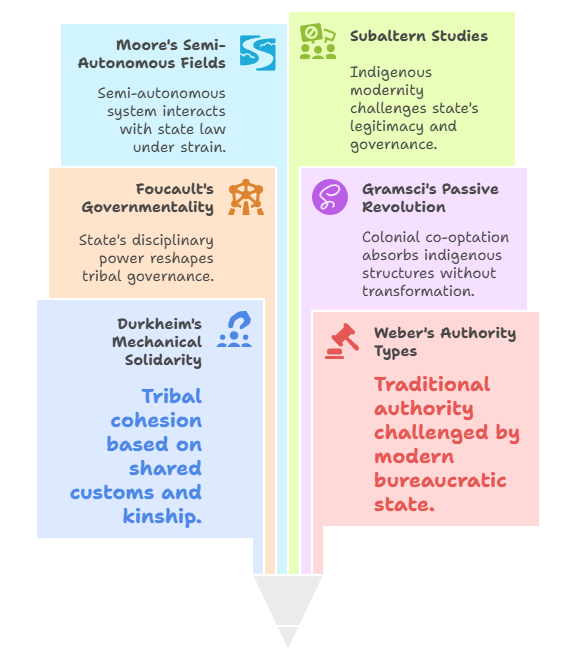
Festivals, forests, and traditional laws are not cultural footnotes; they are central to tribal citizenship and political agency. Sociological Thinkers’ Perspectives on the Manki-Munda System & Adivasi Resistance
Conclusion: Reimagining the Indian State through the Lens of Tribal AutonomyThe Manki-Munda protests are not just about a tribal institution—they are about what kind of democracy India aspires to be. A democracy that includes only codified, state-centric systems cannot accommodate the plural realities of its people. Adivasi systems like that of the Ho are not relics—they are living institutions, adaptable and evolving. Recognizing their value offers not just justice to India’s tribal citizens but also enriches the moral and institutional repertoire of Indian democracy. |
To Read more topics, visit: www.triumphias.com/blogs
Read more Blogs:
Bringing India Northeast into the Sociological Mainstream: A Civilizational Imperative
Reimagining Equality: The Sociology of Reservation beyond the 50% Cap
One comment