Capitalism, as an economic system founded on private ownership, market competition, and profit motive, has been one of the most powerful engines of growth in human history. It has driven industrialisation, technological innovation, and unprecedented increases in productivity and wealth. Yet, despite these achievements, capitalism has also been criticised for generating inequality, social exclusion, and environmental degradation. Consequently, the question “Can capitalism bring inclusive growth?” occupies a central place in contemporary policy debates, especially in developing democracies like India that seek rapid growth alongside social justice.
Inclusive growth implies not merely an increase in aggregate income but a process of economic expansion that creates opportunities for all sections of society and distributes the benefits of growth equitably. Therefore, the issue is not whether capitalism can produce growth—it demonstrably can—but whether it can be shaped to ensure that growth is broad-based, sustainable, and socially just. Addressing this question requires a nuanced examination of capitalism’s strengths, its inherent contradictions, and the institutional frameworks that mediate its outcomes.
MAIN BODY:
To begin with, capitalism’s greatest strength lies in its capacity to mobilise resources efficiently. Through price signals and competition, markets allocate capital and labour towards productive uses, incentivising innovation and entrepreneurship. Historical experience from Western Europe, East Asia, and more recently India and China demonstrates that market-oriented reforms can lift millions out of poverty within a relatively short span of time.
Moreover, capitalism fosters dynamism by rewarding risk-taking and creativity. Technological revolutions in sectors such as information technology, pharmaceuticals, and renewable energy illustrate how profit-driven innovation can generate new industries and employment opportunities. In this sense, capitalism creates the material foundation necessary for inclusive growth by expanding the overall economic pie.
However, while growth is a necessary condition for inclusion, it is not a sufficient one. Left to its own devices, capitalism tends to concentrate wealth and power, thereby raising questions about distribution and access.
Despite its productive potential, capitalism exhibits inherent tendencies that can undermine inclusivity. One such tendency is the unequal distribution of initial endowments. Individuals and groups enter the market with vastly different levels of education, assets, and social capital. Consequently, market outcomes often reproduce and amplify pre-existing inequalities rather than correct them.
Furthermore, capitalism privileges those sectors and regions that offer higher returns, often neglecting socially essential but less profitable activities such as primary education, public health, and rural infrastructure. As a result, large sections of the population may remain excluded from the benefits of growth, even as the economy expands.
From a sociological perspective, Karl Marx viewed capitalism as a system that inherently generates class conflict and exploitation, while later thinkers such as Thomas Piketty have empirically demonstrated capitalism’s tendency towards wealth concentration in the absence of redistributive mechanisms. These critiques highlight the limits of relying solely on market forces to achieve inclusive growth.
Given these structural limitations, the role of the state becomes crucial in determining whether capitalism can be inclusive. The state can intervene through regulation, redistribution, and social investment to correct market failures and promote equity. Welfare states in Scandinavia exemplify how capitalist economies, when combined with progressive taxation and universal social services, can achieve high levels of both growth and inclusion.
In the Indian context, the state has attempted to harness capitalism through a mixed economy model, blending market reforms with social welfare programmes. Schemes related to financial inclusion, rural employment, and food security seek to ensure that the benefits of growth reach the poorest sections. Thus, inclusive growth under capitalism depends not on the absence of state intervention but on its quality and effectiveness.
However, excessive or poorly designed intervention can stifle entrepreneurship and efficiency. Therefore, the challenge lies in striking a balance between market freedom and social regulation.
One of the most critical tests of inclusive growth is employment generation. Capitalism, particularly in its modern, technology-driven form, often produces jobless or job-light growth. Automation, platform economies, and capital-intensive industries can increase output without proportionate increases in employment.
In developing economies, this problem is compounded by the persistence of informality. Large segments of the workforce operate outside formal labour protections, lacking job security, social insurance, and bargaining power. While capitalism creates opportunities, it does not automatically ensure decent work.
Therefore, inclusive capitalism must be accompanied by policies that promote labour-intensive growth, skill development, and formalisation. Without such measures, growth may coexist with unemployment and precarity, undermining social cohesion.
At a philosophical level, the debate over capitalism and inclusion revolves around competing conceptions of justice. Classical liberalism emphasises individual freedom and merit, while egalitarian theories stress fairness and equality of opportunity. John Rawls’ difference principle offers a possible reconciliation by arguing that inequalities are acceptable only if they benefit the least advantaged.
Applied to capitalism, this implies that markets are legitimate instruments of growth provided their outcomes improve the condition of the poorest. Thus, the moral test of capitalism lies not in the wealth it creates for some, but in the opportunities it expands for all.
Furthermore, Amartya Sen’s capability approach reframes inclusive growth as the expansion of human freedoms rather than mere income enhancement. From this viewpoint, capitalism must be evaluated in terms of its impact on education, health, dignity, and participation.
For capitalism to deliver inclusive growth, it must be embedded within strong institutions and ethical norms. First, investment in human capital is essential to enable individuals to participate meaningfully in markets. Second, progressive taxation and social security systems can redistribute gains without undermining incentives.
Third, regulation must prevent monopolies and crony capitalism, ensuring fair competition and innovation. Fourth, environmental sustainability must be integrated into growth strategies, as ecological degradation disproportionately harms the poor and future generations.
Finally, inclusive growth requires democratic accountability, where economic policies are shaped through public deliberation rather than elite consensus. In this sense, inclusive capitalism is as much a political and moral project as an economic one.
CONCLUSION:
In conclusion, capitalism, by itself, does not guarantee inclusive growth, yet neither is it inherently incompatible with it. Capitalism is a powerful instrument that can generate wealth, innovation, and opportunity, but its outcomes depend critically on the social, political, and institutional context in which it operates. Without corrective mechanisms, capitalism tends to concentrate wealth and exclude the vulnerable. With thoughtful regulation, social investment, and ethical governance, however, it can become a vehicle for broad-based and sustainable development.
Thus, the central question is not whether capitalism can bring inclusive growth, but whether societies possess the collective will and institutional capacity to civilise capitalism in the service of human well-being. Only when growth is aligned with justice, dignity, and opportunity can capitalism fulfil its promise of inclusion.
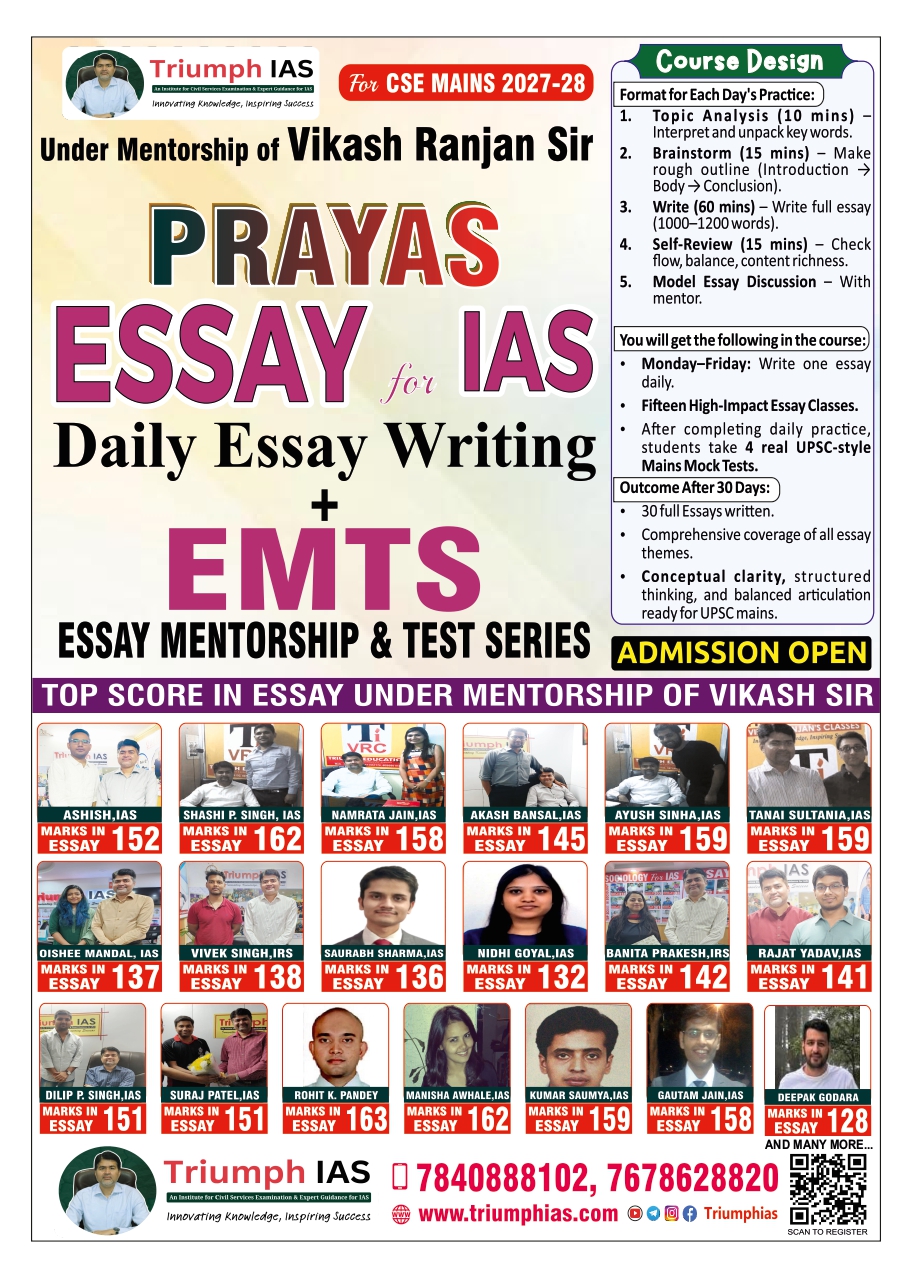
If you’re preparing for the UPSC Civil Services Examination (CSE), one paper that can unlock exceptional scores and a top rank is the Essay Paper. While General Studies and Optional Subjects are structured and syllabus-driven, the Essay writing segment is where individuality, critical thinking, and articulation truly shine.
Among various Essay programs available across India, Triumph IAS, under the expert mentorship of Vikash Ranjan Sir, offers the Best Essay writing Course for UPSC CSE. This comprehensive guide explores what makes this program unparalleled and why it should be part of every serious aspirant’s preparation strategy.



One comment