
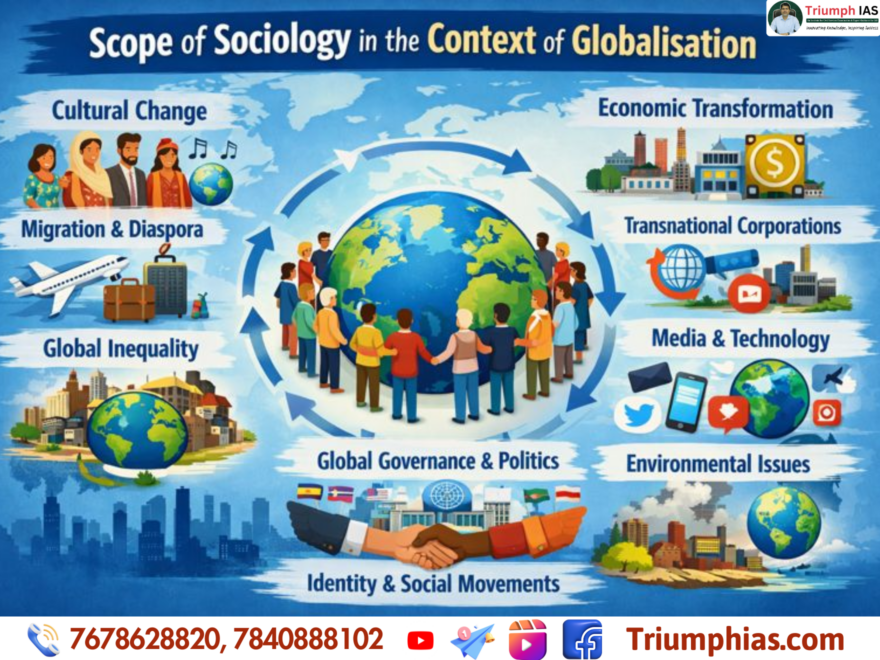
Scope of Sociology in the Context of Globalisation
(Relevant for Sociology Paper 1)
|
Globalisation has fundamentally transformed the nature of societies by intensifying economic, cultural, political, and technological interconnections across the world. Societies are no longer isolated, territorially bounded entities; instead, they are embedded in global networks of capital, information, migration, and governance. In this context, the scope of sociology has expanded significantly, moving beyond the study of static social structures to the analysis of dynamic, transnational, and reflexive social processes. Anthony Giddens defines globalisation as the intensification of worldwide social relations linking distant localities, a definition that underlines the increasing relevance of sociology in understanding contemporary social change. ● One of the most important areas where the scope of sociology has widened is the study of economic globalisation and social inequality. Globalisation has restructured production systems, labour markets, and class relations across the world. From a Marxian perspective , globalisation represents the expansion of capitalism on a world scale, intensifying exploitation and creating a global reserve army of labour. Immanuel Wallerstein’s world-systems theory further explains how global inequality is structurally embedded in the core–periphery hierarchy. In contemporary times, sociologists like Guy Standing have highlighted the emergence of the “precariat,” a class marked by insecure employment and social vulnerability. The expansion of the gig economy, the informalisation of labour, and post-COVID migration crises in India illustrate how sociology now examines inequality not merely within societies, but across global labour markets. ● Closely related to economic globalisation is the expanding scope of sociology in the study of development. Earlier development paradigms equated progress with industrialisation and economic growth; however, contemporary sociology critiques this narrow understanding. Drawing upon dependency and world-system theories, sociologists argue that development in one part of the world often produces underdevelopment elsewhere. Amartya Sen’s capability approach represents a major shift by redefining development as the expansion of human freedoms rather than income alone. Contemporary indicators such as the Multidimensional Poverty Index and Sustainable Development Goals further reflect this sociological turn towards human-centred development. In India, uneven regional development, jobless growth, and persistent social deprivation highlight the need for sociological evaluation of development outcomes. ● Globalisation-led development has also expanded the scope of sociology through the study of displacement, marginalisation, and resistance. Large infrastructure, mining, and energy projects often lead to the displacement of indigenous and rural communities, resulting in the loss of livelihoods, cultural identity, and social networks. Michael Cernea’s Impoverishment Risks and Reconstruction model explains how development-induced displacement produces multiple forms of social impoverishment. Movements such as the Narmada Bachao Andolan and recent land acquisition protests illustrate how sociology analyses development not merely as a technical process, but as a deeply political and social phenomenon involving questions of justice, consent, and participation. ● The scope of sociology has further expanded with the transformation of social institutions under globalisation. The family, for instance, has undergone significant changes due to migration, urbanisation, and women’s participation in the workforce. Traditional joint families are increasingly replaced by nuclear and transnational family forms. While Talcott Parsons viewed the nuclear family as functionally suited to industrial society, feminist sociologists such as Sylvia Walby highlight how global capitalism often reinforces gendered divisions of labour. Contemporary experiences of work-from-home arrangements and the unequal burden of unpaid care work demonstrate sociology’s relevance in analysing family and gender relations in a globalised economy. ● Similarly, education has emerged as a crucial domain within the expanding scope of sociology. In the global knowledge economy, education is both a means of social mobility and a mechanism for reproducing inequality. Pierre Bourdieu’s concept of cultural capital explains why access to education does not automatically translate into equal outcomes. In the Indian context, the privatisation of education, digital divides exposed during the COVID-19 pandemic, and debates surrounding the National Education Policy 2020 show how sociology examines education as a site of power, exclusion, and opportunity. ● Globalisation has also altered the role of the state, democracy, and governance, thereby widening the scope of sociological inquiry. While globalisation is often seen as weakening the nation-state, sociology demonstrates that states continue to play a crucial role in regulation, welfare provision, and social control. Max Weber’s ideas on authority and bureaucracy remain relevant in understanding modern governance, while Antonio Gramsci’s concept of hegemony explains how consent is manufactured in global and national political systems. Contemporary debates around welfare versus fiscal discipline, as well as the global rise of populism and nationalism, illustrate sociology’s importance in analysing power and political legitimacy. ● Cultural processes form another critical dimension of sociology in the age of globalisation. Global flows of media, consumption, and ideas have led to cultural hybridisation rather than uniform homogenisation. Arjun Appadurai’s framework of ethnoscapes and mediascapes helps explain how local cultures reinterpret global influences. At the same time, globalisation has intensified identity-based politics related to religion, caste, ethnicity, and language. Sociology explains this paradox of global integration and local fragmentation by analysing how identities are socially constructed and politically mobilised in times of economic and cultural uncertainty. ● The digital revolution has further expanded the scope of sociology by transforming social interaction, power relations, and modes of communication. Manuel Castells’ concept of the network society captures the shift from hierarchical structures to networked forms of organisation. At the same time, thinkers such as Michel Foucault and Shoshana Zuboff draw attention to new forms of surveillance and data-driven control. Contemporary debates on data privacy, algorithmic governance, online political mobilisation, and the digital divide highlight sociology’s relevance in understanding technology as a social force rather than a neutral tool. ● Environmental challenges have added yet another dimension to the scope of sociology in a globalised world. Climate change, pollution, and resource depletion are not merely ecological issues but deeply social problems shaped by patterns of production, consumption, and inequality. Ulrich Beck’s concept of the risk society explains how modern risks are global in nature yet unevenly distributed. In India, heatwaves, environmental migration, and urban pollution disproportionately affect the poor, reinforcing sociology’s role in linking environmental sustainability with social justice. conclusionGlobalisation has expanded the scope of sociology from the study of isolated social systems to the analysis of interconnected global processes. By examining economic inequality, development, culture, technology, governance, and environment through a human-centred and critical lens, sociology provides indispensable insights into contemporary social change. In a world marked by rapid transformation and deep inequalities, sociology remains essential not only for understanding society but also for shaping more inclusive and sustainable futures. |
To Read more topics, visit: www.triumphias.com/blogs
Read more Blogs:
Potable Water as a Social Right: A Sociological Analysis of India’s Contemporary Water Crisis
China Mega Dam on the Brahmaputra and the Sociology of Environmental Power