Narco-Terrorism

Narco-Terrorism

Narco-Terrorism

(Relevant for Sociology Paper I: Sociological Thinkers – Deviance and crime (Robert Merton’s Anomie Theory) and Sociology Paper II: Social Problems)

Introduction: Narco-Terrorism

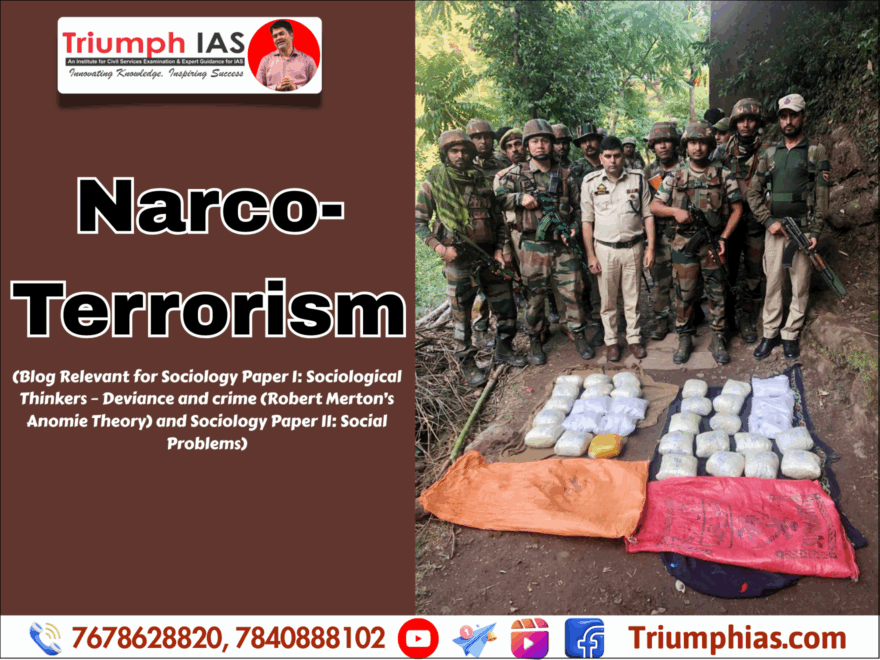
Narco-terrorism in Punjab has emerged as a dangerous nexus between drug trafficking, youth radicalization, and cross-border terrorism, threatening not only national security but also the social fabric of rural and urban Punjab. The alarming rise in drug addiction, cross-border smuggling, and terror funding reflects a deeper sociological crisis. This blog explores the issue through the lens of Robert K. Merton’s Strain Theory, examining the structural roots of deviance in society.

Sociological Analysis:

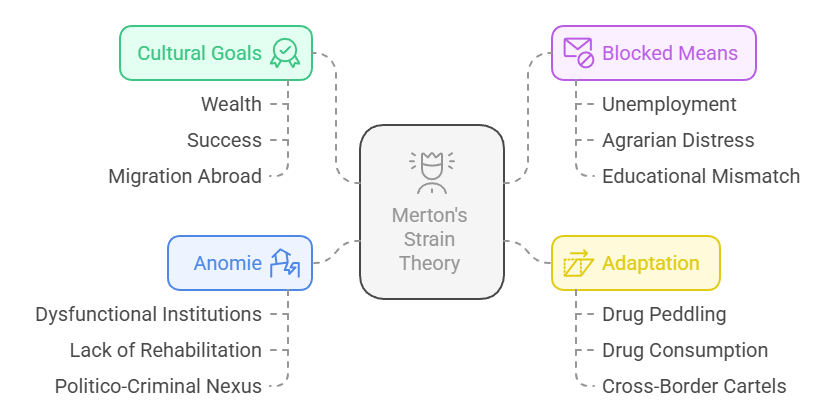
Robert K. Merton’s Strain Theory explains deviance as a response to the disjunction between culturally approved goals and institutionalized means. In the context of Punjab:

  • Cultural Goal: Aspirations for wealth, success, migration abroad (notably Canada or UK).
  • Blocked Means: Unemployment, agrarian distress, and educational mismatch have hindered legitimate means.
  • Adaptation: Many youth turn to drug peddling, consumption, or working with cross-border cartels as an innovative but deviant solution.

Merton classifies this as “innovation”, where individuals accept societal goals but use illegitimate means to achieve them.

This phenomenon also represents a state of “anomie”, where normlessness arises due to the breakdown of societal regulations and expectations. Punjab, with its dysfunctional institutions, lack of rehabilitation infrastructure, and politico-criminal nexus, exemplifies this breakdown.

Major Dimensions of the Issue

Major Dimensions of the Issue

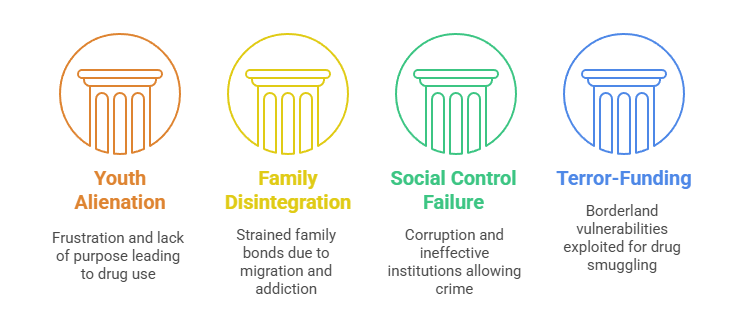
  • Youth Alienation and Identity Crisis: Unemployment, broken aspirations of foreign migration, and agrarian distress have led to frustration among Punjab’s youth. Lacking purpose and support, many are drawn into drug use and trafficking, reflecting Merton’s idea of deviance as an adaptive response to blocked opportunities.
  • Family and Kinship Disintegration: Drug abuse has strained Punjab’s family structures. Migration-led separation and addiction-related issues like domestic violence and financial burden have weakened kinship bonds, reducing the family’s role in social control.
  • Social Control Failure: Formal institutions like police and judiciary are often compromised due to corruption. At the same time, informal bodies like panchayats and religious groups are failing to check deviant behavior, allowing drug networks to grow unchecked.
  • Terror-Funding and Borderland: Punjab’s border location makes it a hotspot for cross-border drug smuggling, which often funds terror activities. Economic vulnerabilities in these regions are exploited by traffickers, linking drug trade with national security threats.

Conclusion

Narco-terrorism in Punjab is not merely a law-and-order issue—it is a sociological emergency that demands holistic policy interventions, informed by theoretical insights such as Merton’s strain theory. Addressing youth aspirations, rehabilitating addicts, dismantling drug-political networks, and strengthening social institutions are critical to reclaiming Punjab’s future. As sociologists and policymakers alike must recognize, crime is often a symptom, not the disease.

PYQs

Paper I

  • Discuss the applicability of Merton’s strain theory in understanding deviant behavior in contemporary Indian society. (2015)
  • Explain how youth in India respond to structural marginalization through deviant subcultures. (2020)
  • Critically examine the role of informal social control in regulating deviant behavior. (2018)

Paper II

  • Terrorism and drug trafficking are interlinked problems in borderland societies of India. Discuss with sociological insights. (2023)

To Read more topicsvisit: www.triumphias.com/blogs

Read more Blogs:

IAS, KATTA RAVI TEJA | The end of law is not to abolish or restrain, but to preserve and enlarge freedom |Triumph IAS

Lineage and Descent | Sociology Optional Coaching | Vikash Ranjan Classes | Triumph IAS | UPSC Sociology Optional


Leave a Reply

Your email address will not be published. Required fields are marked *