
World Inequality Report 2026: A Sociological Reading of Global and Indian Inequalities
(Relevant for Sociology Paper 1: Stratification and Mobility)
|
The World Inequality Report 2026 (WIR 2026), released by the World Inequality Lab, presents a stark picture of the contemporary world: extreme concentration of wealth, widening income gaps, persistent gender inequality, climate injustice, and deep territorial divides. While economists often approach inequality through numbers and growth metrics, sociology compels us to ask deeper questions: Who benefits? Who bears the costs? And how are power and privilege reproduced across generations? This blog interprets the findings of WIR 2026 through classical and modern sociological theories, situating inequality not as a natural outcome of markets but as a structural and institutional phenomenon. Inequality as a Structural Feature: Karl Marx Revisited
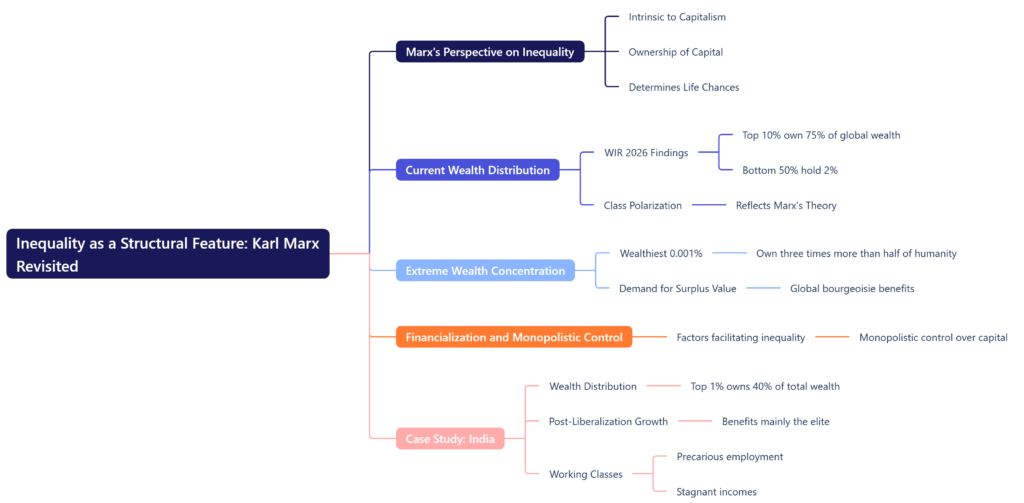
Karl Marx viewed inequality as intrinsic to capitalist modes of production, where ownership of capital determines life chances. The WIR 2026 finding that the top 10% own 75% of global wealth, while the bottom 50% hold only 2%, strongly echoes Marx’s theory of class polarization. Even more striking is the statistic that the wealthiest 0.001% own three times more wealth than half of humanity combined. From a Marxian lens, this reflects the concentration of surplus value in the hands of a global bourgeoisie, facilitated by financialization, inheritance, and monopolistic control over capital. In India, the pattern is no different. The top 1% owning 40% of total wealth indicates that post-liberalization growth has largely benefited the elite, while the working classes experience precarious employment and stagnant incomes. This reinforces Marx’s argument that economic growth under capitalism does not automatically translate into social justice. Weber and the Institutionalization of InequalityMax Weber expands the analysis beyond class by introducing status and power. According to Weber, inequality is sustained not only by ownership of wealth but also through bureaucratic institutions, credentials, and legal-rational authority. The WIR 2026 highlights massive disparities in human capital investment: education spending per child in Sub-Saharan Africa is 40 times lower than in Europe or North America. This disparity institutionalizes inequality by shaping life chances from birth. Weber would argue that education functions as a status-conferring mechanism, allowing privileged groups to monopolize high-paying occupations. In India, unequal access to quality education under schemes like Samagra Shiksha reflects similar stratification. While policies exist, the bureaucratic delivery system often advantages urban, upper-caste, and middle-class populations, reinforcing Weberian hierarchies. Pierre Bourdieu: Capital Beyond MoneyPierre Bourdieu’s theory of economic, social, and cultural capital offers a powerful framework to understand why inequality persists despite welfare policies. WIR 2026’s gender findings reveal that women work 53 hours per week compared to 43 for men, yet earn only 32% of men’s income when unpaid work is included. This reflects women’s disproportionate burden of unpaid care labor, which is economically invisible but socially essential. Bourdieu would interpret this as a deficit in recognized capital. Women possess labor and skills, but these are not converted into economic capital due to patriarchal norms. In India, initiatives like the Lakhpati Didi program attempt to convert women’s social capital into economic capital, but structural constraints—mobility restrictions, unpaid care work, and informal employment—remain significant. Feminist Sociology and Gendered InequalityFeminist sociologists such as Sylvia Walby argue that capitalism and patriarchy operate together, creating a system of structural gender inequality. The WIR 2026 confirms this by showing that gender inequality is not confined to wages but embedded in time use, labor markets, and social norms. India’s female labor force participation rate of just 15.7% is not merely an economic failure but a sociological one. Cultural expectations around marriage, caregiving, and honor systematically exclude women from paid work. Feminist sociology emphasizes that without redistributing unpaid care work, economic equality remains impossible. Climate Inequality and Ulrich Beck’s Risk Society
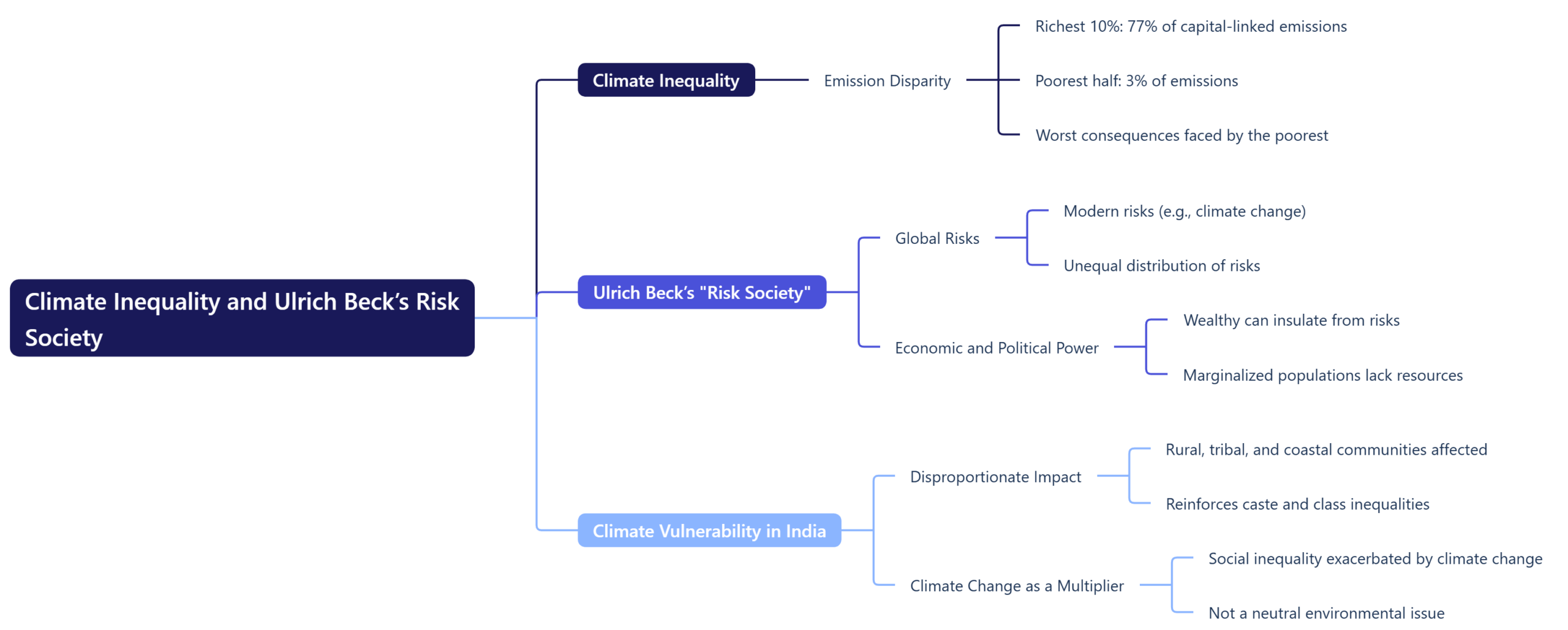
One of the most sociologically significant contributions of WIR 2026 is its analysis of climate inequality. The richest 10% are responsible for 77% of capital-linked emissions, while the poorest half contributes only 3%, yet suffers the worst consequences. Ulrich Beck’s concept of the “risk society” explains this paradox: modern risks (climate change) are globally produced but unequally distributed. Those with economic and political power can insulate themselves from risk, while marginalized populations face climate shocks without resources to adapt. In India, climate vulnerability disproportionately affects rural, tribal, and coastal communities, reinforcing existing caste and class inequalities. Climate change thus becomes a multiplier of social inequality, not a neutral environmental issue. World Systems Theory and Global Financial InequalityImmanuel Wallerstein’s World Systems Theory helps explain why inequality persists at the global level. According to WIR 2026, poorer countries experience a net financial outflow equal to 1% of global GDP due to capital moving toward US and European sovereign bonds. This reflects a core–periphery relationship, where wealth flows from the Global South to the Global North, undermining development despite foreign aid. For India, participation in the global financial system brings growth but also structural dependency, limiting fiscal autonomy and redistributive capacity. Amartya Sen and the Capability ApproachWhile classical sociology diagnoses inequality, Amartya Sen’s Capability Approach offers a normative solution. Sen argues that development should be measured by people’s freedom to live meaningful lives, not merely income. The policy recommendations of WIR 2026—investment in education, healthcare, social protection, and gender equality—align closely with this approach. Indian initiatives like MGNREGA, PMJDY, DAY-NULM, and PMEGP aim to expand capabilities by providing employment, financial inclusion, and social security. However, Sen would caution that implementation quality and access matter as much as policy intent. Without addressing caste, gender, and regional disparities, capabilities remain unevenly distributed. Conclusion: Inequality as a Political ChoiceThe World Inequality Report 2026 makes one sociological truth unmistakably clear: inequality is not inevitable. It is produced through policies, institutions, and power relations. From Marx’s class conflict to Bourdieu’s symbolic power, from feminist critiques to world-systems analysis, sociology reveals that inequality is deeply embedded in social structures. For India and the world, the path forward lies not just in economic growth but in redistributive justice, gender equality, climate responsibility, and democratic accountability. As the report rightly suggests, inequality is a political choice—and so is equality. |
To Read more topics, visit: www.triumphias.com/blogs
Read more Blogs:
Protection of Plant Varieties and Farmers’ Rights (PPV&FRA) Act, 2001
Competitive Federalism: India’s Emerging Model of State Rivalry
One comment