
Relevant for Sociology Optional Paper 1, Paper 2, and GS Paper I (Indian Society)
IntroductionThe rapid expansion of Work-from-Home (WFH) arrangements, particularly after the COVID-19 pandemic, has fundamentally transformed the relationship between work and family life. From a sociological perspective, this shift has blurred the traditional boundaries that once separated the public sphere of work from the private sphere of family. While technological advancements have enabled greater flexibility and efficiency, they have also produced new forms of social negotiation within households.
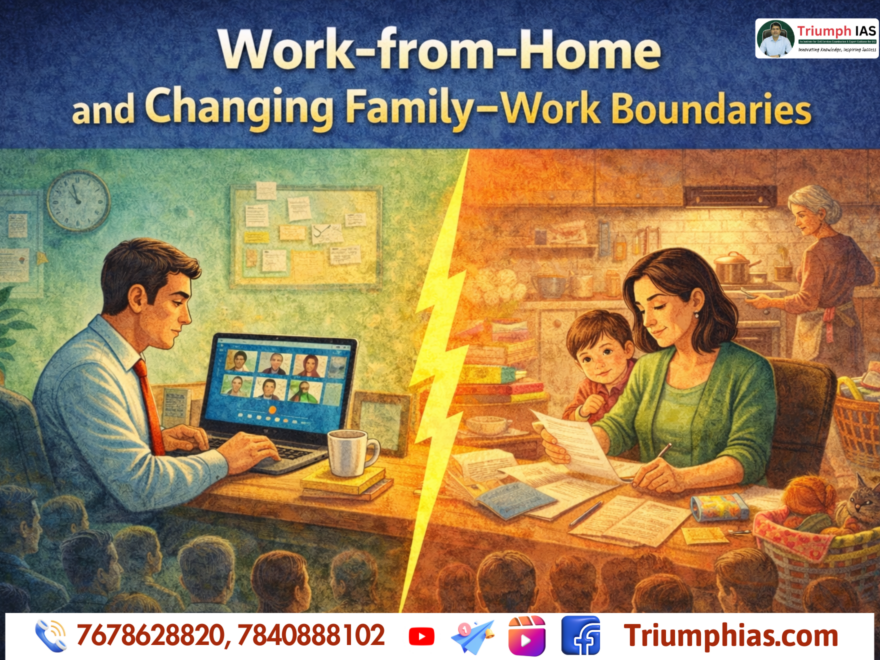
Historically, industrial society created a clear spatial and functional distinction between work and home. The workplace represented economic production, while the household was largely associated with reproduction, caregiving, and emotional support. Sociologists have often analyzed this division through the framework of structural functionalism, where different institutions perform specialized roles to maintain social order. However, the emergence of digital technology and flexible employment structures has increasingly challenged this traditional arrangement. The Work-from-Home model collapses the spatial separation between the office and the household. The dining table becomes a workspace, and domestic spaces turn into hybrid environments where professional and personal roles coexist simultaneously. As a result, individuals frequently experience role conflict, a sociological concept referring to the tension that arises when expectations from different social roles clash. Employees may find themselves managing professional deadlines while simultaneously fulfilling family responsibilities such as childcare, eldercare, or household tasks. One of the most significant sociological implications of WFH is its impact on gender relations within the family. While remote work initially appeared to offer greater flexibility for both men and women, studies suggest that women often continue to shoulder a disproportionate share of domestic labor. The home environment can reinforce traditional gender norms, where women are expected to balance professional commitments with household duties. This phenomenon reflects what sociologists describe as the “double burden” or “second shift”, where women engage in both paid work and unpaid domestic labor. At the same time, Work-from-Home has also created opportunities for redefining family roles. In some households, men have become more actively involved in caregiving and domestic tasks due to increased presence at home. This gradual renegotiation of responsibilities can contribute to more egalitarian gender relations, though the extent of such changes varies across social classes, cultural contexts, and family structures. Another dimension of WFH relates to work intensification and surveillance. Digital communication tools such as video meetings, messaging platforms, and productivity monitoring software have extended the reach of the workplace into personal time. Sociologically, this can be understood through the lens of boundary theory, which examines how individuals manage the boundaries between different life domains. Many workers struggle to disconnect from professional obligations, leading to longer working hours and reduced leisure time. Work-from-Home has also reshaped family interactions and socialization patterns. On one hand, increased time spent at home can strengthen familial bonds and allow parents to spend more time with children. On the other hand, constant digital engagement may reduce meaningful interaction and create emotional strain within households. The home thus becomes a site where economic production, family life, and digital connectivity intersect. Class and occupational differences also shape the experience of WFH. Professionals in knowledge-based sectors are more likely to benefit from remote work opportunities, while workers in manufacturing, service, and informal sectors often lack this flexibility. This disparity highlights the persistence of social inequality in the digital economy.
In sociological terms, Work-from-Home represents a broader transformation in the organization of work and family institutions in late modern societies. It illustrates how technological change, economic restructuring, and cultural norms interact to reshape everyday life. As societies adapt to hybrid work models, the challenge lies in developing institutional arrangements and social norms that support both productive work and healthy family relationships. Ultimately, the sociological significance of Work-from-Home lies not merely in where work takes place, but in how it redefines roles, relationships, and social structures in contemporary society. |


UPSC Civil Services (Mains) Question
Q. “The expansion of Work-from-Home arrangements has blurred the boundaries between family and work institutions.” Discuss the sociological implications of this transformation. (250 words)
To Read more topics, visit: www.triumphias.com/blogs
Read more Blogs: