
Women Political Participation in India
(Relevant for Sociology Paper 1 Stratification and Mobility)
IntroductionWomen political participation is a vital dimension of democratic inclusion and social justice. Globally, the rise of women in political institutions marks progress towards gender equality and responsive governance. However, India, despite being the world’s largest democracy, lags behind in women’s representation in legislative bodies. According to UN Women, women hold about 14.7% of seats in the Lok Sabha — less than the global average of 26.5%. This disparity reflects deep-rooted social structures, gender norms, and institutional barriers. This blog explores the sociological dimensions of women’s political participation in India, drawing on sociological theories, thinkers, government initiatives, and comparative global experiences to provide a nuanced understanding and suggest pathways forward. Current Landscape of Women Political Participation in IndiaThe data is stark. Women’s representation in India’s lower house of parliament is approximately 14.7%, well below the global average. State assemblies display vast heterogeneity, with Chhattisgarh leading (19 women MLAs), while states like Mizoram and Himachal Pradesh report negligible or no female legislators. India ranks 148th among 193 countries on women’s political participation, lagging behind even many South Asian nations. In the 2024 general elections, only 74 women won seats in Lok Sabha, a decline from 78 in 2019, highlighting the persistent structural challenges. Sociological Dimensions: Explaining the Low Women Political Participation
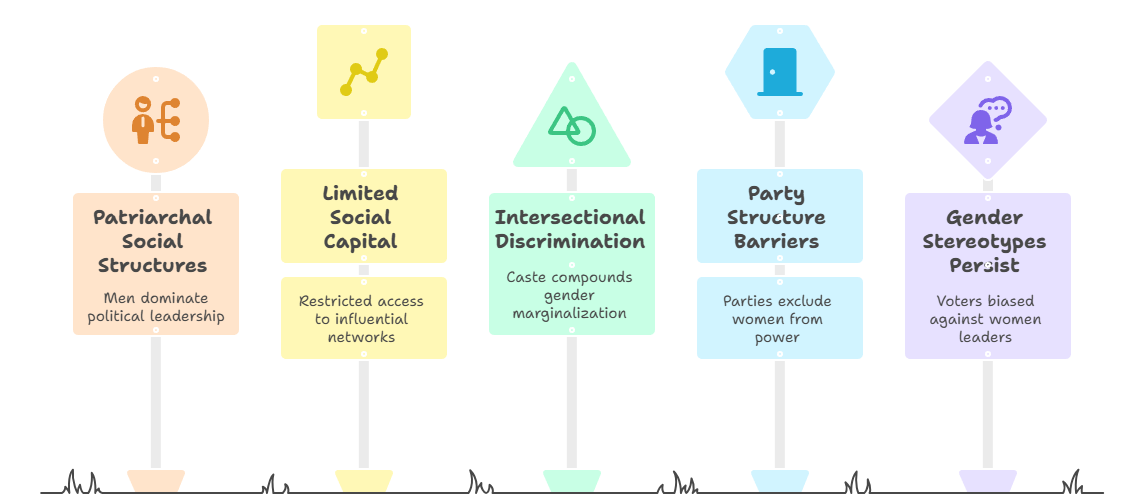
The foundational sociological explanation for low women political participation is patriarchy — a system where men hold primary power and predominate in political leadership roles. Feminist sociologists such as Sylvia Walby argue that patriarchy is embedded in social institutions, norms, and roles that restrict women’s agency. In India, politics is culturally constructed as a male domain; women are expected to focus on domestic duties and familial responsibilities, which limits their public engagement. Gender socialization through family, education, and media perpetuates stereotypes that politics is ‘unfeminine’. This echoes Simone de Beauvoir’s concept of “the Other” — women’s subordinate status as the ‘second sex’ entrenched in social relations.
Political participation often depends on access to social capital — networks, connections, and resources. Pierre Bourdieu’s theory of social capital highlights how privileged groups monopolize access to valuable networks. In India, male-dominated political parties and patronage systems restrict women’s access to influential circles, resources, and mentorship. Women candidates often lack the political grooming and party support enjoyed by male counterparts, weakening their chances of nomination and election success.
Intersectionality provides a critical lens to understand how overlapping identities — caste, class, religion — compound women’s political marginalization. For example, Dalit and tribal women face both gender discrimination and caste oppression, limiting their political visibility and influence. The intersectional framework emphasizes that policies must go beyond gender and account for multiple axes of inequality to be effective. It explains why some women’s political participation improves (upper-caste urban women) while others remain excluded.
Political parties in India are often patriarchal and hierarchical organizations. Organizational sociology points out that without internal democracy, women’s representation suffers. Parties rarely field women candidates in winnable seats, marginalize women’s wings, and exclude women from decision-making roles. This aligns with the theory of bureaucratic inertia, where established power structures resist change, perpetuating gender inequality in politics.
Symbolic interactionism helps explain how everyday interactions reinforce gender roles. Political participation is shaped by societal expectations and perceptions of women as less competent leaders. Voters’ biases and media portrayal influence electoral outcomes, discouraging women from contesting elections. The “role congruity theory” from social psychology posits that perceived incongruity between female gender roles and leadership roles results in prejudice against women politicians. Government Initiatives and Policy Measures: Sociological Perspectives
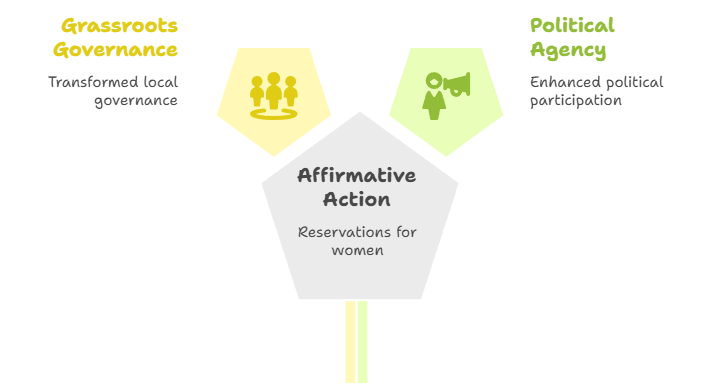
India has implemented several reforms to boost women’s political participation:
These policies serve as structural interventions to disrupt gender hierarchies. However, without accompanying social and cultural change, their impact remains limited. Comparative Global PerspectivesExamining international examples provides insight:
India’s lower ranking suggests the need for both systemic reforms and socio-cultural transformation. The Way Forward: Sociological Suggestions for Enhancing Women Political Participation
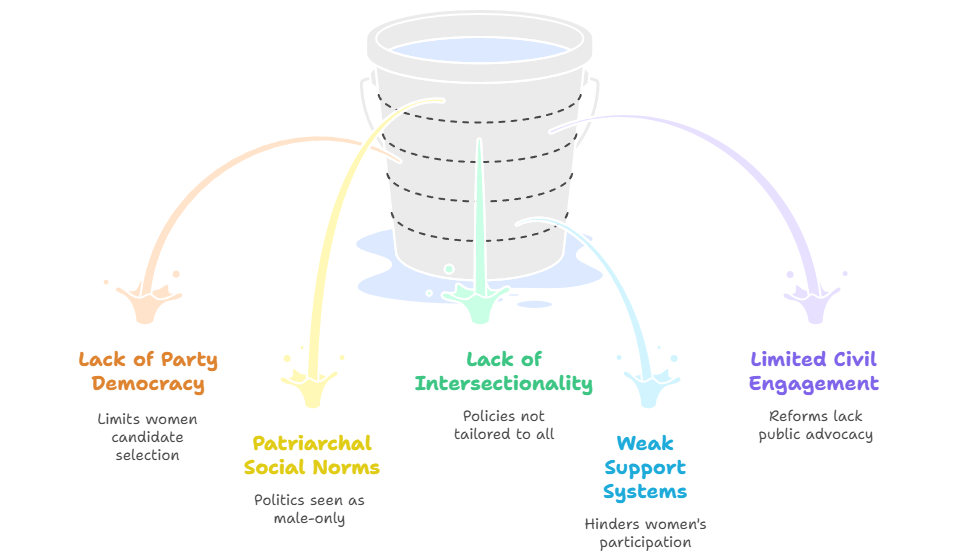
Political parties must democratize candidate selection, institute transparent gender quotas, and strengthen women’s leadership roles within organizations. Institutional reforms can break the “glass ceiling” within party hierarchies.
Civic education campaigns and media must challenge gender stereotypes portraying politics as male-only. Role models and positive representation can shift public attitudes, enhancing women’s political legitimacy.
Policies should be tailored to address multiple forms of oppression. For example, targeted leadership programs for Dalit, Adivasi, and Muslim women can enhance inclusivity.
Improving women’s safety, mobility, and financial independence facilitates political participation. Expanding digital literacy and economic empowerment aligns with a holistic approach to gender equality.
Non-governmental organizations, women’s collectives, and the media can play a pivotal role in advocating for reforms, supporting women candidates, and changing narratives around women in politics. ConclusionWomen’s political participation in India remains low due to intertwined structural, cultural, and institutional factors rooted in patriarchy, social capital inequalities, and intersectional discrimination. While legal reforms and reservations at the grassroots level mark significant progress, transformative change requires sociological insight — addressing underlying social norms, democratizing party politics, and ensuring intersectional inclusivity. Only by combining policy reforms with cultural change and empowerment efforts can India move towards genuine gender equality in its political landscape, thereby strengthening its democratic fabric and social justice. |
To Read more topics, visit: www.triumphias.com/blogs
Read more Blogs:
Gyan Bharatam: Digitising the Soul of India’s Civilisational Wisdom
2 comments