Introduction
The participation of women in the workforce has been a key indicator of gender equality, economic development, and social transformation. In India, women’s engagement in both white-collar jobs (professional, managerial, and administrative roles) and blue-collar jobs (manual labour, skilled and unskilled work) reflects broader patterns of gender division of labour, patriarchy, and social stratification.
The distinction between white-collar and blue-collar jobs is not just about skill and pay scale but also about status, social mobility, and cultural perceptions. While women have made significant inroads into white-collar sectors such as IT, banking, education, and healthcare, their representation in blue-collar sectors such as manufacturing, construction, and transport remains low and often precarious.
Defining White-Collar and Blue-Collar Jobs
- White-Collar Jobs: Professional, managerial, or administrative work, often in offices or corporate environments. Examples: IT professionals, bank managers, teachers, engineers, doctors.
- Blue-Collar Jobs: Manual labour or trade-related occupations, often requiring physical work. Examples: factory workers, construction labourers, drivers, garment workers.
Current Trends in Women’s Workforce Participation
According to PLFS (Periodic Labour Force Survey) 2023, India’s Female Labour Force Participation Rate (FLFPR) stood at around 37%, showing an improvement compared to a decade ago. However, this growth is largely concentrated in low-paid and informal work.
- White-Collar Sector: Women constitute a significant proportion in healthcare, education, and IT-enabled services. However, glass ceiling effects and wage gaps persist.
- Blue-Collar Sector: Women are overrepresented in informal, low-paying, and insecure work, such as domestic work, textile factories, and agriculture-linked manufacturing.
Sociological Analysis
- Feminist Perspective
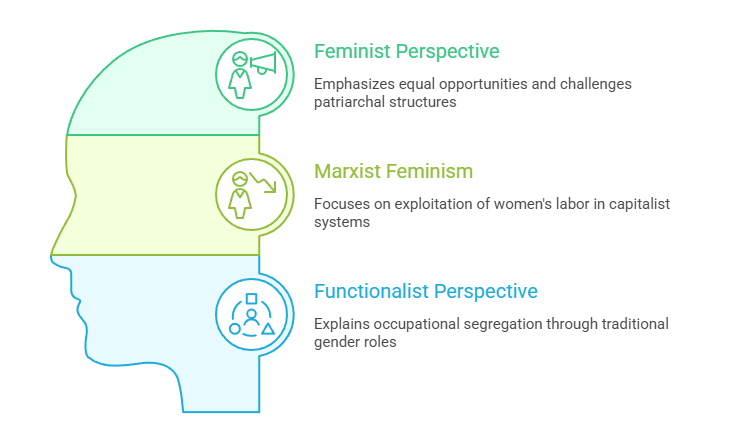
From a feminist viewpoint, women’s participation in both white-collar and blue-collar jobs is shaped by historical gender inequalities. Liberal feminists emphasise equal opportunities, arguing that women should have the same access to education, training, and career advancement as men. Radical feminists focus on the sexual division of labour, pointing out that patriarchal structures assign women to less-valued, care-related roles, whether in corporate offices or manual labour sectors.
- Marxist Feminism
Marxist feminists see women workers—especially in blue-collar jobs—as part of the reserve army of labour, hired in times of economic need and discarded when demand falls. They argue that capitalism exploits women’s labour, both paid and unpaid, with domestic work subsidising capitalist production. In white-collar sectors, women may enjoy better wages but still face wage gaps and are concentrated in lower managerial tiers.
- Functionalist Perspective
Functionalists explain occupational segregation through traditional gender roles, suggesting that certain jobs are “naturally” suited to women because of their nurturing roles in the family. While this helps maintain social stability in their view, critics point out that such assumptions reinforce stereotypes and limit women’s occupational mobility.
Relevant Sociological Theories
- Emile Durkheim’s Division of Labour: Specialisation in modern societies reflects functional interdependence but can also lead to occupational segregation.
- Max Weber’s Status Groups: White-collar jobs carry higher prestige and symbolic capital compared to blue-collar work.
- N. Srinivas’s Sanskritisation: Access to white-collar jobs often facilitates upward caste mobility.
Historical Shifts: From Agrarian to Industrial and Post-Industrial Employment
Historically, Indian women worked predominantly in agriculture and household industries. With industrialisation and urbanisation, opportunities in factories (blue-collar) and offices (white-collar) emerged, but patriarchal norms restricted women’s entry.
In the post-liberalisation era (1991 onwards), service sector growth created more white-collar opportunities, especially in IT, banking, and education, drawing women from middle-class and urban backgrounds.
White-Collar Jobs:
Opportunities
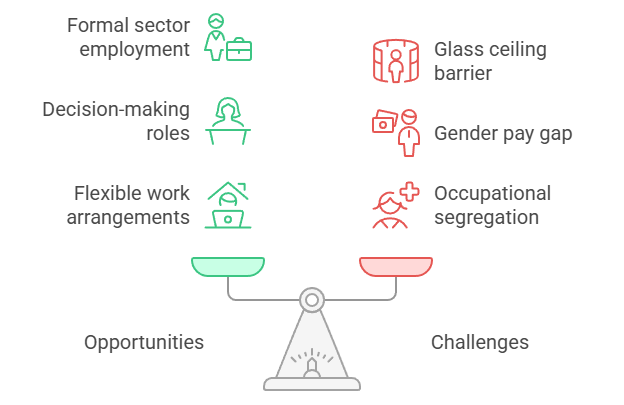
- Greater access to formal sector employment with benefits such as maternity leave, health insurance, and career progression.
- Increased representation in decision-making positions in corporate and administrative spheres.
- Remote work and flexible arrangements benefiting women post-COVID-19.
Challenges
- Glass ceiling: Women often hit an invisible barrier preventing advancement into senior management.
- Gender pay gap: Women in India earn approximately 20% less than men for the same roles.
- Occupational segregation — women are clustered in “care” roles like teaching, nursing, and HR.
Blue-Collar Jobs:
Opportunities
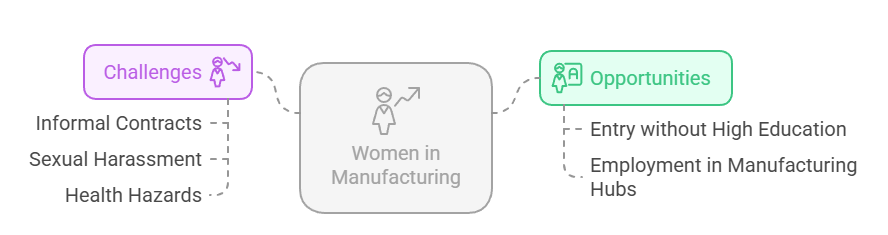
- Entry without high educational qualifications, making it accessible to women from rural and marginalised backgrounds.
- Employment in manufacturing hubs (garments, electronics assembly, food processing) provides income for women with limited formal skills.
Challenges
- High prevalence of informal contracts, lack of social security, and unsafe working conditions.
- Sexual harassment, wage theft, and absence of grievance redressal mechanisms.
- Physical strain and health hazards without adequate workplace safety.
Intersectionality in Women’s Work
Caste, class, and region intersect with gender to shape women’s access to white- or blue-collar jobs:
- Upper-caste urban women are more likely to access white-collar employment due to higher education levels.
- Dalit and Adivasi women are often relegated to low-paying blue-collar or informal jobs due to historical marginalisation.
- Regional disparities: Southern states like Kerala and Tamil Nadu have higher female participation in formal jobs compared to northern states.
Government Policies and Initiatives
- Maternity Benefit (Amendment) Act, 2017 – Extended maternity leave to 26 weeks.
- Sexual Harassment of Women at Workplace Act, 2013 – Protects women in both white- and blue-collar sectors.
- Skill India Mission – Provides vocational training to women for blue-collar skill development.
- Beti Bachao Beti Padhao – Aims to increase educational attainment, indirectly boosting white-collar job participation.
Globalisation and Technological Change
- White-Collar Impact: Expansion of IT and BPO sectors has created large-scale employment for urban, English-speaking women.
- Blue-Collar Impact: Automation and mechanisation have reduced women’s share in certain factory jobs but increased opportunities in e-commerce packaging, delivery, and assembly work.
Sociological Implications
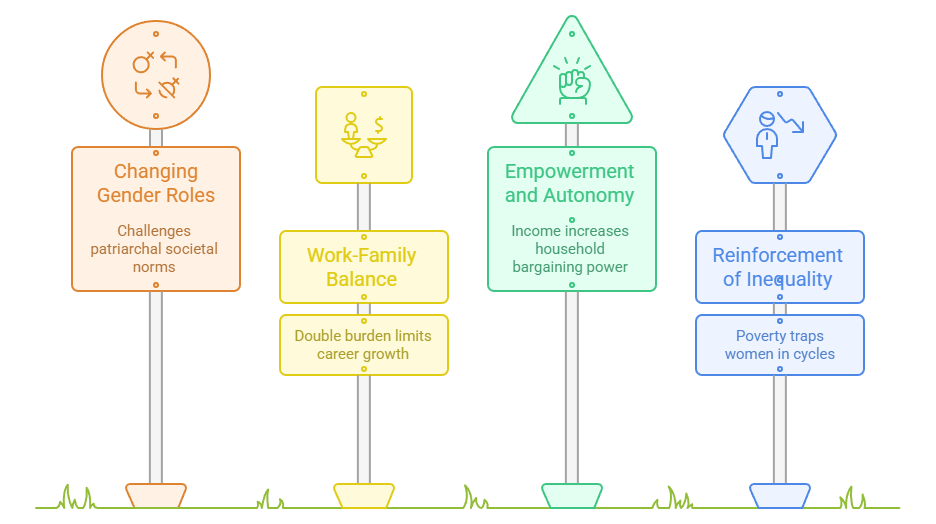
- Changing Gender Roles – Entry into formal jobs challenges traditional patriarchal norms.
- Work–Family Balance – Women in white-collar jobs face the “double burden” of career and domestic responsibilities.
- Empowerment and Autonomy – Earning an income increases bargaining power within households, particularly for blue-collar women from marginalised communities.
- Reinforcement of Inequality – While white-collar jobs offer upward mobility, blue-collar jobs often trap women in cycles of poverty.
Way Forward
- Policy Reforms – Stronger enforcement of equal pay, maternity benefits, and workplace safety.
- Skill Development – Vocational training for blue-collar jobs and digital literacy for white-collar roles.
- Cultural Change – Media and education campaigns to challenge occupational gender stereotypes.
- Collective Bargaining – Encouraging women’s unions and self-help groups for better wage negotiation and safety standards.
Conclusion
Women’s participation in both white- and blue-collar jobs reflects the broader dynamics of gender, economy, and society in India. While progress has been made in breaking barriers, structural inequalities persist. For India to achieve inclusive development, it must ensure that women in both sectors have access to safe, fair, and empowering work environments. The real measure of progress will be when occupational choices are determined not by gendered constraints but by individual aspirations and capabilities.
PYQs
Paper 1
- Explain the concept of sexual division of labour and discuss how it shapes women’s participation in the workforce. (2014)
- Critically examine the concept of glass ceiling in the context of women in the corporate sector. (2016)
- Discuss the sociological significance of women’s work in the informal sector in India. (2017)
- How do Marxist and Feminist perspectives explain the exploitation of women’s labour in capitalist societies? (2018)
- Examine the impact of globalisation on women’s employment patterns in India. (2019)
- Discuss the concept of occupational segregation by gender with suitable examples from Indian society. (2020)
- How does intersectionality influence women’s access to different categories of jobs in India? (2021)
- Examine the role of education in bridging the gender gap in employment in modern societies. (2022)
- Discuss how technological changes have altered opportunities and challenges for women in the workforce. (2023)
- Analyse the sociological implications of work–family balance for working women in contemporary societies. (2024)
Paper 2
- Analyse the patterns of female labour force participation in India in the context of regional and caste-based disparities. (2015)
- Discuss the role of government policies in promoting women’s employment in India, with reference to the white-collar and blue-collar divide. (2016)
- Examine the impact of economic liberalisation on women’s employment opportunities in India. (2017)
- Explain how patriarchal norms influence women’s participation in skilled and unskilled labour in India. (2018)
- Discuss the role of self-help groups and cooperatives in improving the working conditions of women in the informal sector. (2019)
- Analyse the problems faced by women in manufacturing and construction industries in India. (2020)
- Discuss the role of labour laws in safeguarding the rights of women workers in India. (2021)
- Examine the challenges of workplace safety and sexual harassment faced by women in both organised and unorganised sectors. (2022)
- Analyse the sociological impact of digital platforms on women’s employment in India. (2023)
- Discuss the implications of gender pay gap in India for achieving social justice. (2024)
|


One comment