Introduction
Sociologist Ulrich Beck in his landmark 1986 book Risk Society: Towards a New Modernity, Coined the term Risk Society refers to a world increasingly shaped by man-made risks such as nuclear accidents, pandemics, environmental degradation, and technological disruption. In this society, women, particularly in developing nations like India, disproportionately bear the burden of these emerging risks—creating a critical intersection of gender, environment, and social inequality.
Understanding Risk Society:
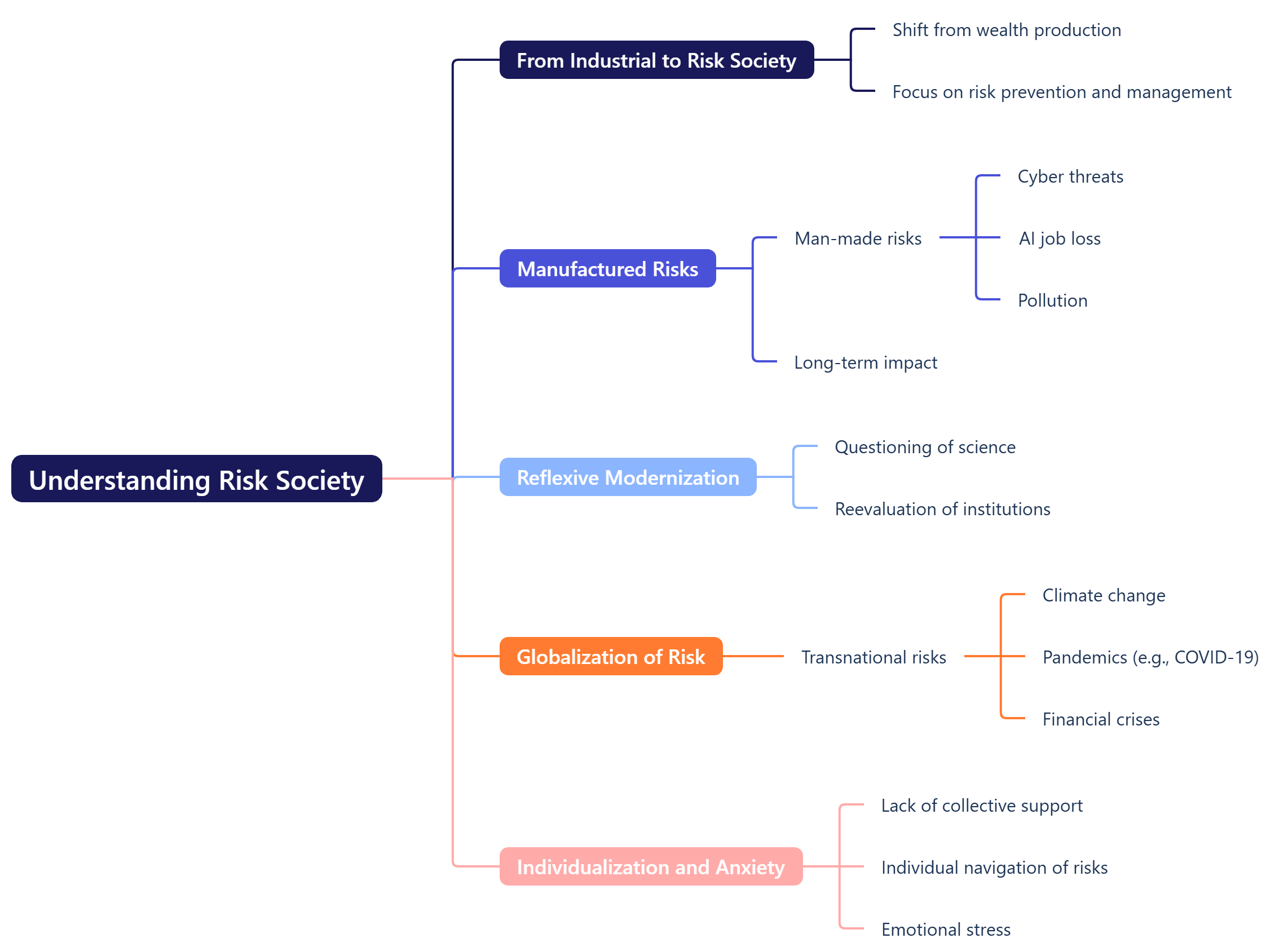
- From Industrial to Risk Society: Modernization has shifted societal focus from wealth production to risk prevention and management.
- Manufactured Risks: Unlike natural disasters, these risks (e.g., cyber threats, AI job loss, and pollution) are man-made and long-term.
- Reflexive Modernization: Society begins to question science and institutions once seen as progressive.
- Globalization of Risk: Climate change, pandemics (like COVID-19), and financial crises showcase how risks are transnational.
- Individualization and Anxiety: In the absence of collective support, individuals must navigate risks alone, leading to emotional stress.
Gender and Risk Society:
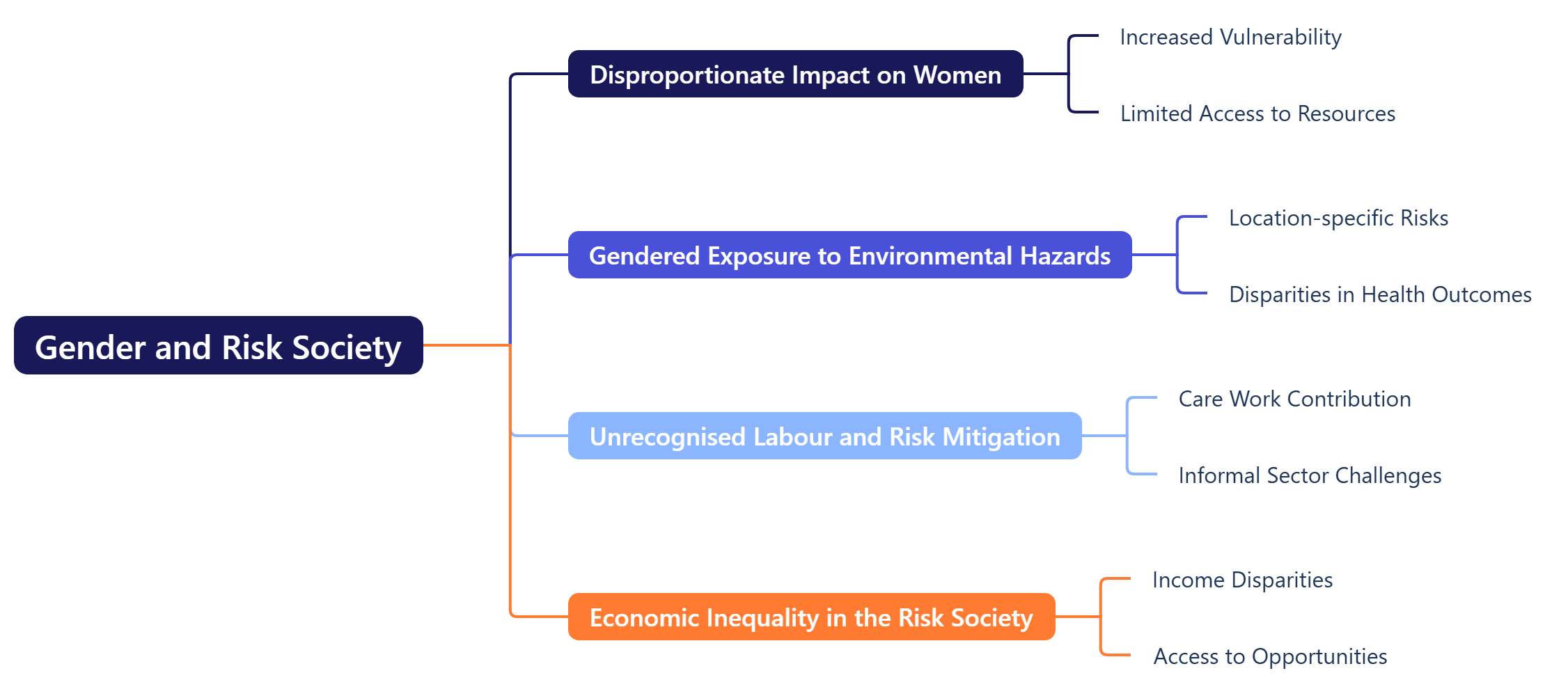
Disproportionate Impact on Women:
- Chernobyl (1986) and Fukushima (2011) showed how nuclear risks affected reproductive health.
- The COVID-19 pandemic (2020) disproportionately affected women as unpaid care work soared and job losses rose in female-dominated sectors like health and education.
Gendered Exposure to Environmental Hazards
- In many regions, women collect water and cook using solid fuels, exposing them to contaminated resources and respiratory hazards.
- Gender norms often mean women eat last and least, worsening malnutrition.
- NFHS-5 (2019–21): 57% of women in India are anaemic vs 25% of men.
Unrecognised Labour and Risk Mitigation
- Women are frontline managers of risk within households yet receive no economic or institutional recognition.
- Health risks from indoor air pollution, unsafe sanitation, and ecological imbalance affect women first.
Economic Inequality in the Risk Society
- Women lack access to land, property, and finance, reducing their ability to recover from disasters like floods or droughts.
- Caregiving roles (children, elderly, sick) are unpaid and unsupported, adding to emotional burnout.
- In rural India, climate-induced crop failure affects women farmers more due to landlessness and food insecurity.
Sociological Analysis:
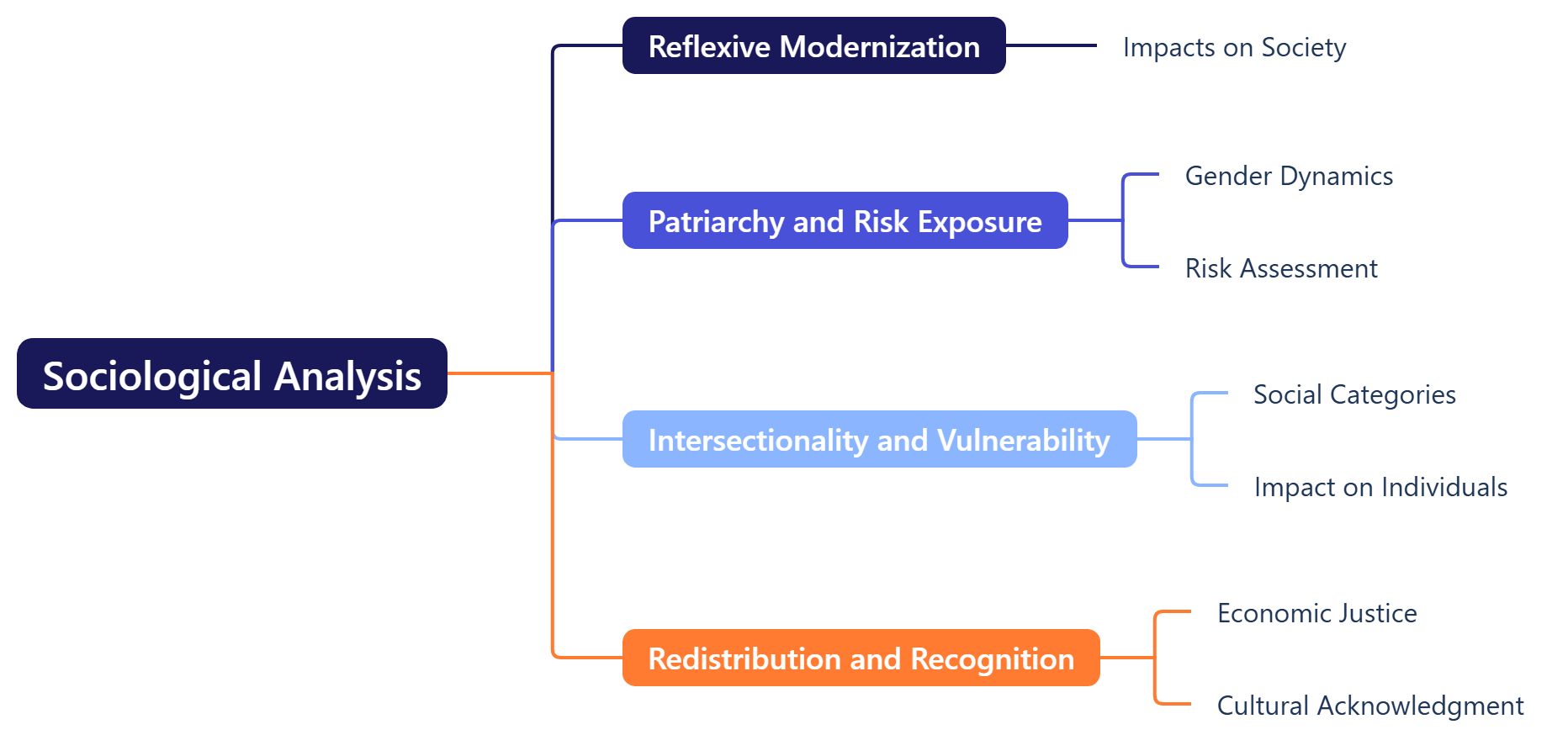
- Reflexive Modernization: Ulrich Beck’s concept of reflexive modernization highlights how modern society must critically evaluate the unintended consequences of its own progress. He argues that risks are no longer external threats but are now created by the very institutions meant to bring development—such as science, industry, and technology. From a gender perspective, this means society must reflect on how modernization has failed to account for the disproportionate burden it places on women, especially in managing household risks, health hazards, and environmental vulnerabilities without institutional support.
- Patriarchy and Risk Exposure: Feminist sociologist Sylvia Walby emphasizes how patriarchal structures continue to shape women’s social experiences, making them more susceptible to the risks of a modern, globalized world. Whether in formal employment or unpaid domestic roles, women are systematically undervalued and underprotected. For example, in a risk society, women often perform caregiving tasks in high-risk environments (e.g., during pandemics or natural disasters) without recognition or adequate safety measures, exposing them more directly to physical and emotional harm.
- Intersectionality and Vulnerability: Kimberlé Crenshaw’s theory of intersectionality explains how overlapping social identities—such as gender, caste, class, and ethnicity—interact to produce compounded disadvantages. In the context of risk society, Dalit, Adivasi, and poor rural women face multiple layers of vulnerability. These women often lack access to clean water, healthcare, legal protection, and economic resources, meaning that when disasters strike—be it climate change, health pandemics, or displacement—they suffer disproportionately due to structural exclusions.
- Redistribution and Recognition: Nancy Fraser proposes a dual approach to social justice that includes both redistribution (economic equality) and recognition (cultural and social value). She argues that women’s unpaid labor—especially in caregiving and household risk management—is both economically unrecognized and socially devalued. In a risk society, Fraser’s analysis underlines the importance of not just compensating women for their economic roles but also elevating their societal status by acknowledging their contributions to collective survival and risk mitigation.
Conclusion:
Beck’s Risk Society framework provides a powerful lens to understand how modernization and global risks disproportionately affect women, especially in low-resource settings. While technological and economic advancements continue, they often do so at the cost of gendered safety, health, and dignity. As we navigate pandemics, climate change, and digital disruption, women’s roles in risk mitigation must be recognized, supported, and made central to policy making in both India and globally.
PYQs
Paper I –
- Discuss the relevance of intersectionality in understanding social inequality. (2023)
- Discuss the contributions of feminist thinkers in understanding the dynamics of power and inequality. (2022)
- Explain how social institutions perpetuate gender inequality in modern societies. (2021)
- Discuss the concept of reflexive modernity in the context of global risk society. (2020)
- How do you relate the concept of individualization with contemporary social risks? (2019)
- Evaluate the impact of globalization on gender roles in modern society. (2017)
- Critically examine Ulrich Beck’s thesis of Risk Society. (2016)
- What is patriarchy? How does it manifest in different institutions in society? (2015)
Paper II –
- Evaluate the intersection of caste, gender, and class in the context of manual scavenging and sanitation workers. (2023)
- Discuss the feminization of poverty in India and its social implications. (2022)
- Discuss the implications of the COVID-19 pandemic for the unorganized and informal sector workers, especially women. (2021)
- Examine the impact of environmental degradation and climate change on women in rural India. (2020)
- Explain how social inequality affects disaster management and rehabilitation, with reference to recent events. (2017)
- Analyze the impact of globalization on traditional gender roles in Indian society. (2018)
- How do government schemes and policies address the vulnerabilities of marginalized women? Illustrate with examples. (2016)
- Examine the role of women in environmental movements in India. (2015)
- Analyze the social impact of development-induced displacement on tribal and marginalized women. (2014)
|



One comment