
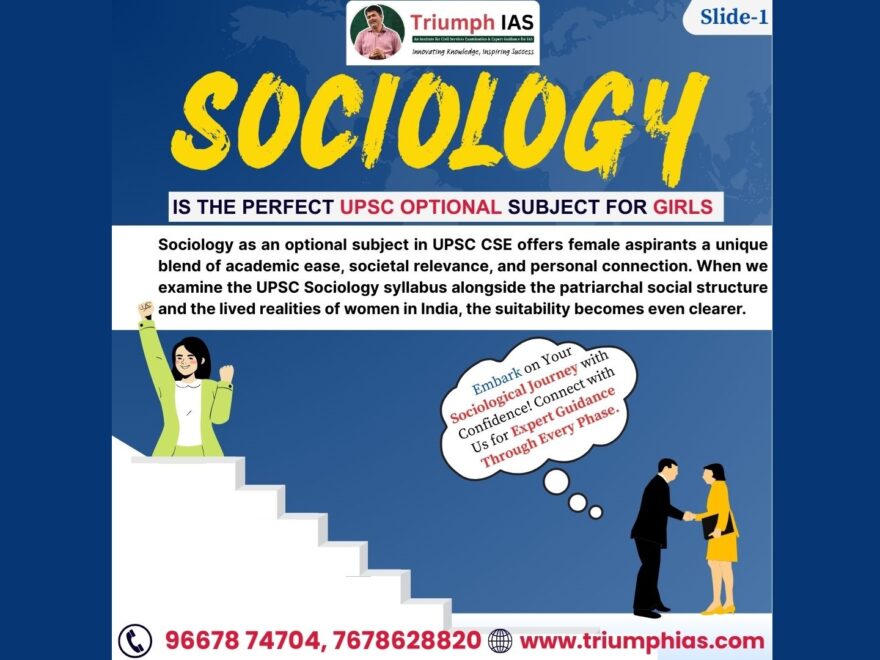
Why Sociology is the Perfect UPSC Optional Subject for Girls
Preparing for the UPSC Civil Services Examination (CSE) is one of the most challenging journeys in India. The choice of an optional subject plays a decisive role in determining success in the UPSC Mains. Among all the available optionals, Sociology has emerged as one of the most popular and result-oriented subjects.
For female aspirants in particular, Sociology offers a unique blend of academic ease, societal relevance, and personal connection. When we examine the UPSC Sociology syllabus alongside the patriarchal social structure and lived realities of women in India, its suitability for women candidates becomes even clearer.
At Triumph IAS, under the guidance of Vikash Ranjan Sir, hundreds of aspirants – especially women – have successfully cracked UPSC with Sociology as their optional subject. Let us explore why Sociology is truly the perfect optional for women aspirants.
1. Direct Connection with Women’s Lived Experiences
One of the strongest reasons Sociology resonates with women aspirants is its direct connection with their personal and social experiences.
Key Topics in Paper I
-
Major Theoretical Strands: Feminist Theory, Waves of Feminism
-
Family, Marriage, Kinship – Patriarchy and Sexual Division of Labour
-
Social Stratification – Gender, Caste, and Class Intersection
-
Work and Economic Life – Feminization of Labour
-
Politics and Society – Citizenship, Women as Second-Class Citizens
-
Ideology – Patriarchal Ideology, Women Movements
-
Religion and Society – Feminist Perspectives on Religion
-
Social Change – Shifts in Women’s Status and Roles
Why it Matters
These topics align naturally with the patriarchal institutions, norms, and gender-based inequalities faced by women in India. For instance:
-
Studying “Patriarchy” under Social Stratification
-
Understanding “Sexual Division of Labour” under Family & Marriage
-
Analyzing Women’s Economic Participation
This dual advantage of academic theory + personal experience makes Sociology easier to understand, retain, and write effectively in exams.
2. Insight into Patriarchal Social Structure
The UPSC Sociology syllabus equips aspirants to analyze patriarchal norms deeply embedded in everyday life — from gendered upbringing to occupational segregation.
Conceptual Tools Provided
-
Values and Norms of Society
-
Culture and Socialization
-
Social Control
Feminist scholars like Sylvia Walby, Simone de Beauvoir, and Vandana Shiva provide perspectives that resonate strongly with women aspirants, offering critical insights into dismantling patriarchy.
Thus, Sociology is not just a subject but a tool of empowerment for women.
3. Strong Overlap with Women-Centric Issues in GS & Essay
A major advantage of Sociology is its strong overlap with the General Studies (GS) syllabus and Essay Paper.
Paper II Topics Related to Women
-
Family, Marriage & Kinship in India – Patriarchy, Sexual Division of Labour, Entitlement
-
Social Stratification of Caste & Women (SC/ST Women Issues)
-
Agrarian Class Women, Middle-Class Women
-
Tribes in India – Tribal Women, Religious Minority Women
-
Women’s Movement in India
-
Population Issues – Sex Ratio, Reproductive Health, Problems of the Aged Women
-
Violence Against Women, Women Workforce Participation
Overlap with GS Papers
-
GS Paper I – Role of Women, Women’s Organisations, Social Empowerment
-
GS Paper II – Women-related legislation and policies
-
GS Paper III – Feminization of Agriculture, Disaster Impact on Women, Internal Security Threats
-
GS Paper IV – Ethics, Value System, and Women in Family/Workplace
Overlap with Essay
Themes like gender justice, equality, and empowerment are frequently asked. For instance:
👉 Essay Topic: “Gender Inequality in Labour Market”
This can be answered using Sociology Paper I (Gender Stratification) and Paper II (Indian Society, Women Workforce Participation).
This direct overlap reduces preparation burden while increasing scoring potential.
4. Analysis of Inequality & Discrimination through Theory + Indian Context
Sociology allows aspirants to examine structural inequalities and discrimination faced by women in real life:
-
Low wages
-
Wage gaps
-
Domestic violence
-
Under-representation in politics
Feminist Theory in Paper I
Gives aspirants analytical tools to interpret inequality.
Paper II – Policies of Empowerment
Topics like Beti Bachao Beti Padhao, Women’s Reservation in Panchayats, and grassroots governance link theory to practice, making answers more holistic.
5. Relevance to Administrative Roles
Women officers in the IAS, IPS, IRS, IFS, and other services often work in sectors like:
-
Education
-
Health
-
Women & Child Development
-
Rural Livelihood Schemes
Here, sociological insights into values, norms, and institutions provide a practical edge in policymaking and empathy-driven governance.
By understanding Social Institutions and Change Mechanisms, women officers can implement welfare schemes more effectively.
6. Manageable, High-Scoring Syllabus
Sociology is also one of the most compact and high-scoring optional subjects.
-
Paper I is conceptual and theoretical.
-
Paper II is applied and focused on Indian Society.
-
Many questions (especially women-related) are predictable and recurring.
-
Themes like patriarchy, social movements, inequality, and development regularly appear.
This makes Sociology not just manageable but also a strategic optional choice.
Triumph IAS – A Launchpad for Women Aspirants
At Triumph IAS, Sociology has empowered countless women aspirants to crack UPSC. The subject serves as a mirror reflecting women’s realities while transforming personal experiences of inequality into analytical strength.
👉 In a patriarchal society, Sociology equips women aspirants not only to crack UPSC but also to challenge and change the very structures they study.

UPSC Toppers – Women Power at Triumph IAS
The success stories speak for themselves. Triumph IAS has mentored several women achievers in Civil Services:
-
Riya Saini, IAS
-
Lavanya Gaur, IAS
-
Medha Anand, IAS
-
Swati Sharma, IAS
-
Gunjita Agrawal, IAS
-
Aditi Varshney, IAS
-
Jagriti Awasthi, IAS
-
Abhilasha Abhinav, IAS
-
Namrata Jain, IAS
-
Saloni Rai, IAS
-
SwaDha Dev Singh, IAS
-
Jandeep Kaur, IPS
-
Kajal Singh, IPS
-
Areeba Nomaan, IPS
-
Mahi Sharma, IPS
-
Shahnaz Illyas, IPS
-
Aparna Gautam, IPS
-
Diksha Bhoria, IPS
-
Banita Parakesh, IRS
-
Nancy Singh, IRS
-
Riju Shrivastava, IRS
-
Rubika Goyal, IRS
-
Kajal Jaiswal, DSP
-
Sadhana Bharti, LEO
…and many more rising stars.
These achievers prove that Sociology is not just an academic subject but a career-defining choice when guided by the right mentorship.
Conclusion
Choosing an optional subject in UPSC is both an academic and strategic decision. For women aspirants, Sociology is more than just an optional – it is a subject that reflects their lived realities, aligns seamlessly with the GS syllabus, and strengthens their analytical skills.
At Triumph IAS, hundreds of women have proven that Sociology can be a game-changer. With its manageable syllabus, scoring potential, and relevance to women’s empowerment, Sociology truly is the perfect optional subject for girls in UPSC.
If you are a woman aspirant aiming for success in UPSC, Sociology & Triumph IAS may be the perfect match for you.
Interesting perspective! IBlog comment creation agree that Sociology connects deeply with real-life issues, especially topics like gender, inequality, and social change, which often overlap with GS and essay papers. At the same time, I think it’s worth noting that its analytical frameworks can benefit any aspirant—male or female—since understanding social structures is crucial for effective administration.