
What’s the Best Age Gap in a Relationship?
(Relevant for Sociology Paper I: Systems of Kinship and Sociology Paper II: Systems of Kinship in India; Social Changes in India; Population Dynamics)
Introduction
“How much of an age gap is too much in a relationship?”
It’s a question that continues to fuel social debates, personal dilemmas, and academic curiosity. From the infamous “half your age plus seven” rule to research linking age gap with divorce rates and life expectancy, the topic remains highly relevant in both personal and societal contexts.
In India, where arranged marriages, patriarchal norms, and social sanctions shape marriage choices, age difference often reflects deeper gender dynamics, power hierarchies, and social norms.
Understanding the “Half Your Age Plus Seven” Rule
This old heuristic suggests that a socially acceptable minimum age for a partner is half your age plus seven. For instance, a 30-year-old dating someone younger than 22 would be deemed inappropriate. While not based on empirical science, this rule echoes societal discomfort with large age differences, especially when they involve power imbalance or generational mismatch.
While the rule is arbitrary, its persistence reflects cultural conditioning about what’s considered “normal,” especially regarding gender and age roles in partnerships.
What Does Research Say about Ideal Age Gap?
Divorce Rates and Age Gap
A 2014 study by Andrew Francis-Tan and Hugo M. Mialon (Emory University) analyzed over 3,000 people and found:
- Couples with 0–1 year age gap had the lowest divorce rates.
- A 5-year age gap makes couples 18% more likely to divorce.
- A 10-year age gap increases divorce likelihood by 39%.
- A 20-year age gap results in a 95% higher chance of divorce.
Thus, larger age differences statistically correlate with higher relationship instability, especially in the early years of marriage.
Life Expectancy and Relationship Health
Data from longitudinal studies suggests that men married to younger women live slightly longer, while women married to significantly older or younger men have lower life expectancy. This could be due to:
- Stress from caregiving roles.
- Mismatch in energy levels and life goals.
- Unequal emotional support.
Sociological Dimensions of Age Gap in a Relationship
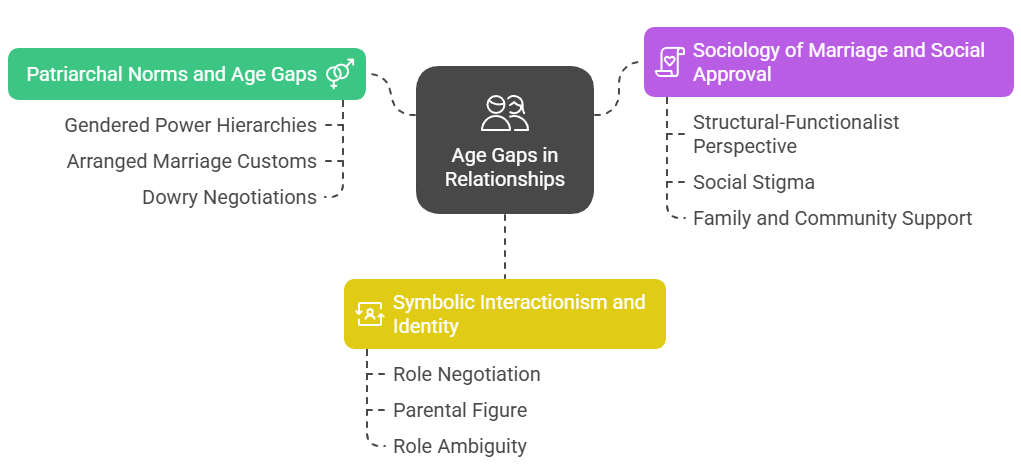
To understand age-gap relationships beyond psychology and numbers, we must explore sociological themes like marriage patterns, gender roles, social sanctions, and power relations.
- Patriarchal Norms and Age Gaps
In patriarchal societies like India, age differences often reflect gendered power hierarchies. Men are expected to be older, economically stable, and socially dominant. Women are encouraged to be younger, more submissive, and family-oriented.
This dynamic is institutionalized through:
- Arranged marriage customs.
- Parental age preferences in matrimonial ads.
- Dowry negotiations influenced by the groom’s age/income.
This age gap enforces asymmetry in decision-making and emotional labour in relationships.
- Sociology of Marriage and Social Approval
From a structural-functionalist perspective, age-conforming marriages are seen as stabilizing institutions that align with societal norms, reducing social conflict.
- Age-similar marriages attract greater family and community support.
- Partners are more likely to share life experiences, media references, and cultural touchpoints.
In contrast, significant age-gap couples face social stigma, which adds stress to the relationship, affecting stability.
- Symbolic Interactionism and Identity
According to this framework:
- Relationship roles are negotiated through daily interactions.
- When there’s a wide age gap, one partner may act as a parental figure, creating role ambiguity.
- This can impact self-perception and identity, especially for the younger partner.
Cultural Variations in Age Gap Norms

India
- Average age gap in urban Indian marriages: 5–7 years, favoring older men.
- Child marriages (illegal but practiced) reflect extreme age gaps with socio-economic coercion.
- Bollywood and spiritual gurus often reinforce the image of older men with younger women, normalizing patriarchal dominance.
Western Societies
- Greater acceptance of age-equal or woman-older relationships.
- Yet, in public discourse, “sugar daddy” or “cougar” stereotypes
- Power and class still mediate perceptions of acceptability.
Same-Sex Couples and Age Gap Trends
In same-sex relationships:
- Age gap tends to be less stigmatized.
- The absence of traditional gender roles allows for more flexible relational dynamics.
- However, economic and emotional asymmetry may still arise, especially in closeted relationships.
This indicates that age is less of a predictor of power when gender norms are disrupted.
Sociological Theories Applied
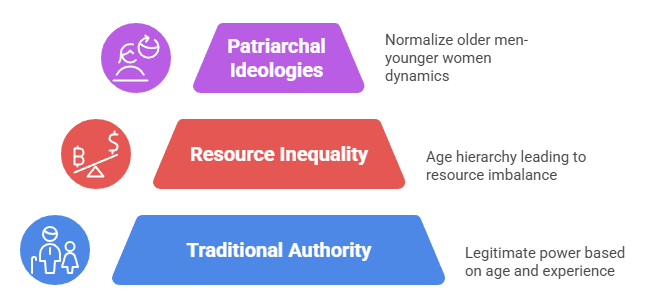
- Max Weber’s Theory of Authority: In age-gap relationships, especially with older men, traditional authority often dominates, where one partner exerts legitimate power based on age and experience.
- Conflict Theory: Suggests that age hierarchy can result in resource inequality—economic, emotional, and social—especially disadvantaging the younger partner.
- Feminist Perspective: Highlights how patriarchal ideologies normalize older men–younger women dynamics while devaluing women’s autonomy and sexual agency as they age.
The Flip Side: Benefits of Age Gap in a Relationship
Not all age-gap relationships are dysfunctional. Sociologically, relationships are shaped by negotiated meanings and individual experiences. Many couples report:
- Emotional maturity in older partners.
- Fresh perspectives and energy in younger partners.
- Shared goals that override age considerations.
The success of such relationships depends on:
- Mutual respect and communication.
- Socio-economic parity.
- Supportive social environment.
Conclusion:
There is no universally perfect age gap. The “best” age difference is context-specific, influenced by individual maturity, life goals, gender roles, and cultural expectations.
However, data suggest that smaller age gaps (0–3 years) may be more stable, equitable, and socially accepted, particularly when both partners are emotionally and financially mature.
In an evolving society like India, relationship norms are in flux. Sociologists must continue examining how age gap, gender, and culture interact to shape love, power, and companionship.
PYQs
Paper I
- “Discuss the sociological implications of age gap in marriage using symbolic interactionism.” (2021)
- “How do power relations operate within patriarchal family structures?” (2018)
Paper II
- “Examine how traditional norms continue to influence contemporary marital practices in India.” (2020)
- “Changing patterns of marriage in urban India—Challenges and implications.” (2017)
To Read more topics, visit: www.triumphias.com/blogs
One comment