|
India’s entirely domestic, automated air defense system, Akashteer, accurately intercepts and eliminates incoming aerial threats in real time.
India’s sophisticated air defense system, Akashteer, proved to be a silent warrior during Pakistan’s most deadly strike on Indian military and civilian targets on the evening of May 9 and 10. It was able to detect, track, and neutralize a flurry of drones and missiles.
It didn’t flare like a missile or roar like a fighter jet. It paid attention. It made a calculation. It hit. The defense ministry released a statement saying, “This invisible shield, Akashteer, is no longer a concept confined to defense journals.”
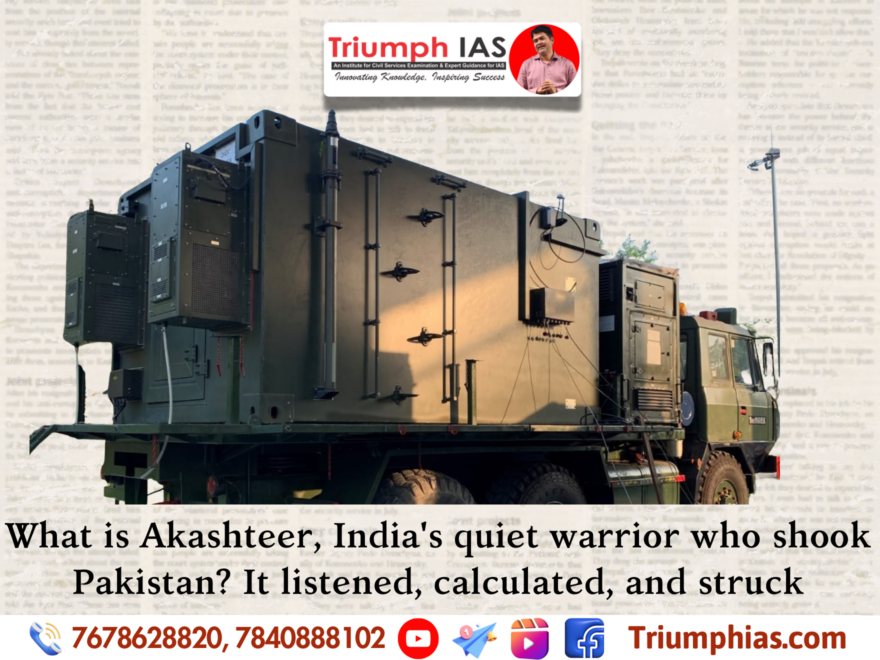
India’s fully automated and domestic Air Defence Control and Reporting System, Akashteer, is made to precisely intercept and eliminate incoming aerial threats.
In addition to state-of-the-art equipment, what stood between the oncoming missiles and their intended targets was evidence of years of dedication under the Atmanirbhar Bharat effort.
India’s superiority over Pakistan’s imported air defense systems is demonstrated by Akashteer
Akashteer showed India’s technological independence and dominance in real-time, automated air defense combat, while Pakistan relied on imported HQ-9 and HQ-16 systems that were unable to identify and stop Indian strikes.
The air defense warfare system Akashteer “sees, decides, and strikes faster than anything the world has fielded,” according to the ministry of defense, which has praised it as a breakthrough.
Akashteer, which combines several radar systems to produce a smooth, automated shield, is made for real-time threat response. According to the ministry, this integration not only improves precision and coordination but also drastically lowers the possibility of friendly fire, allowing friendly aircraft to be protected in contested airspace while enabling quick engagement of enemy targets.
Unmatched situational awareness and response capability are provided by the system’s sensors, which include the Tactical Control Radar REPORTER, 3D Tactical Control Radars, Low-Level Lightweight Radar, and the radar of the Akash Weapon System.
Designed to identify, monitor, and destroy hostile aircraft, missiles, and drones
According to the defense ministry, Akashteer is about intellectual warfare rather than using force. Coordination of air defense operations is made possible by the system, which gives the control room, radars, and defense gun a shared, real-time air view.
Its purpose is to automatically detect, track, and engage enemy drones, missiles, and planes. Several radar systems, sensors, and communication technologies are combined under one operating framework by Akashteer. It collects and analyzes data from various sources and enables automatic, in-the-moment engagement decisions.
Working in tandem with other systems, Akashteer is a component of the larger C4ISR (Command, Control, Communications, Computers, Intelligence, Surveillance, and Reconnaissance) structure. In hostile circumstances, the vehicle-based system is more manageable and mobile.
Akashteer makes it possible for autonomous monitoring of low-level airspace in combat zones and effective control of Ground-Based Air Defence Weapon Systems, in contrast to conventional air defence models that rely on ground-based radars and manual decision-making.
India’s strategy has clearly changed from passive defense to proactive reprisal as a result of this. The Army, Navy, and Air Force can work together in unprecedented harmony thanks to its smooth integration with India’s broader C4ISR ecosystem.
India’s domestic air defense superpower
Additionally, the defence ministry emphasised that Akashteer is only a component of a rapidly growing ecosystem of domestic military platforms that are revolutionising India’s capacity to wage wars.
In addition to naval assets like destroyers, indigenous aircraft carriers, submarines, frigates, corvettes, fast patrol vessels, fast attack craft, and offshore patrol vessels, the Made in India initiative has fueled this growth, resulting in the development of advanced military systems like the Dhanush Artillery Gun System, Advanced Towed Artillery Gun System (ATAGS), Main Battle Tank (MBT) Arjun, Light Specialist Vehicles, High Mobility Vehicles, Light Combat Aircraft (LCA) Tejas, Advanced Light Helicopter (ALH), Light Utility Helicopter (LUH), Weapon Locating Radar, 3D Tactical Control Radar, and Software Defined Radio (SDR).
|


Interesting how Akashteer blends automation with real-time decision-making. It seems like it could be a model for future systems, especially given the increasing reliance on unmanned and automated warfare.