Introduction: West Asia conflict
West Asia, often referred to as the Middle East, is one of the most volatile yet strategically crucial regions in the world. Known for its abundant energy resources, religious significance, and complex geopolitics, the region frequently witnesses conflicts that have far-reaching global consequences. For India, West Asia is not a distant land but a vital part of its extended neighborhood—deeply intertwined with its energy needs, economic interests, national security, and the well-being of over 9 million Indian citizens living there.
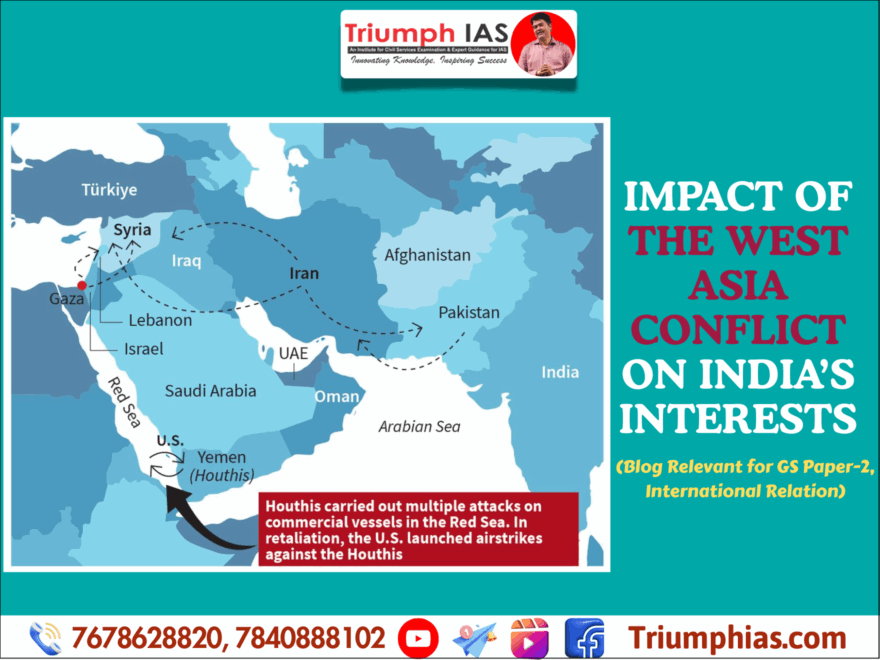
Recent escalations—such as the Israel-Hamas war, Iran-Israel tensions, and maritime disruptions in the Red Sea by Houthi rebels—have highlighted the fragility of regional peace. These developments pose both challenges and opportunities for India, compelling it to balance its traditional non-alignment with evolving strategic partnerships. As India aspires to play a larger role on the global stage, its engagement with West Asia remains critical for securing national interests, maintaining regional stability, and shaping a multipolar global order.
Energy Security
- India imports nearly 84% of its crude oil, with about 55–60% coming from West Asia (especially Iraq, Saudi Arabia, UAE, and Kuwait).
- Disruptions in the Strait of Hormuz or Red Sea could directly impact India’s oil imports and increase shipping and insurance costs.
Indian Diaspora
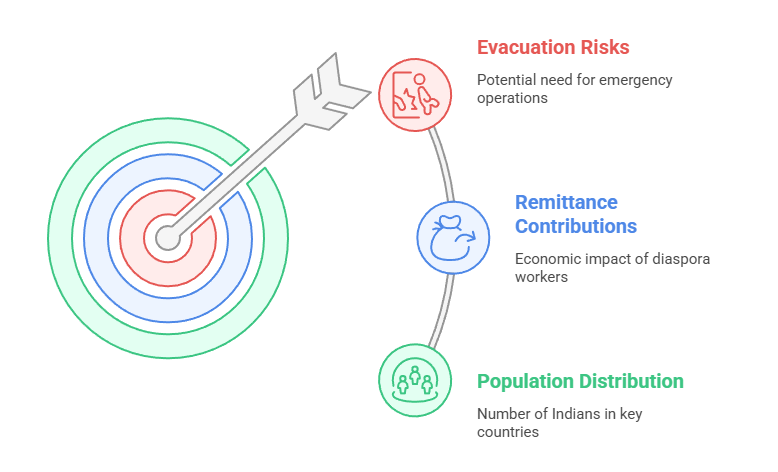
- Over 9 million Indians reside in West Asia, with the largest populations in UAE (3.5 million), Saudi Arabia (2.6 million), and Qatar (0.7 million).
- These workers contribute significantly to India’s economy, remitting over $40 billion annually from the region.
- Political instability, war, or regime changes pose risks to their safety and livelihoods, potentially necessitating evacuations like Operation Kaveri (Sudan, 2023) or Operation Rahat (Yemen, 2015).
Trade and Economic Ties
- India’s trade with West Asia exceeded $240 billion in 2023–24, with UAE, Saudi Arabia, and Iraq being major partners.
- Key FTAs such as the India-UAE Comprehensive Economic Partnership Agreement (CEPA) signed in 2022 are boosting bilateral investments and trade.
- India is also working on rupee-dirham and rupee-rial trade mechanisms to reduce dependence on the US dollar.
Strategic and Security Engagements
- India conducts regular defence exercises with regional partners (e.g., Desert Flag, Zayed Talwar, Al-Mohed Al-Hindi).
- The India-UAE-France trilateral cooperation and the I2U2 grouping (India, Israel, UAE, US) are helping India expand its strategic footprint.
Challenges for India Amid Regional Instability
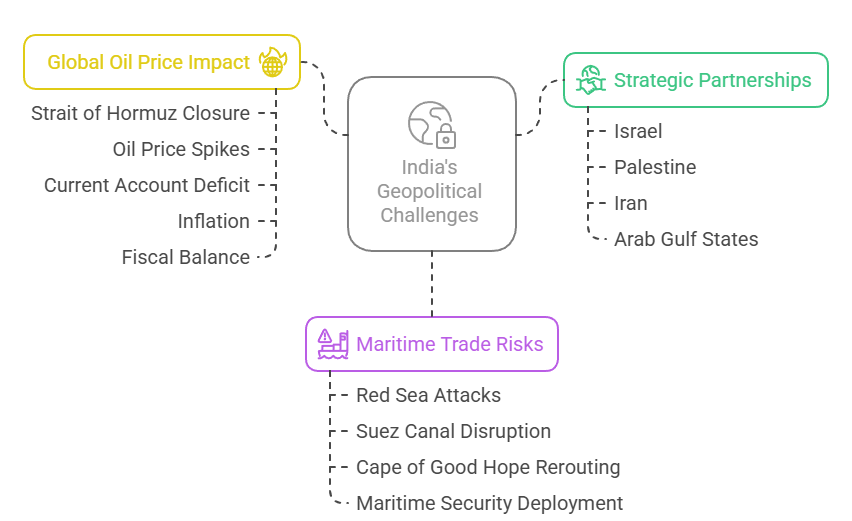
- Balancing Strategic Partnerships
India maintains strong ties with both Israel and Palestine, as well as with Iran and Arab Gulf states. Balancing these relationships amid heightened tensions is diplomatically challenging.
- India has condemned terrorism (as in the case of Hamas) but also called for a two-state solution and restraint from all parties.
- Iran remains crucial for Chabahar Port and access to Central Asia, but US sanctions and its tensions with Israel pose complications.
- Risk to Maritime Trade
- The Red Sea attacks by Houthis have disrupted trade routes to Europe via the Suez Canal.
- Indian shipping lines are incurring higher costs and delays by rerouting via the Cape of Good Hope.
- India has deployed INS Kolkata and INS Chennai for patrolling the Arabian Sea and enhancing maritime security.
- Impact on Global Oil Prices
- Any prolonged conflict or closure of critical chokepoints like the Strait of Hormuz could lead to oil price spikes, affecting India’s current account deficit, inflation, and fiscal balance.
India’s Response and Strategic Approach
- Diplomatic Balancing
India continues to adopt a multi-aligned approach, engaging with all key players in West Asia. Prime Minister Narendra Modi has visited UAE, Saudi Arabia, Israel, and Qatar in recent years, reflecting deepening ties.
- Humanitarian Support
India has been vocal on humanitarian concerns in Gaza and has dispatched medical and relief aid through Operation Ajay.
- Infrastructure and Connectivity
- India is pushing ahead with the India-Middle East-Europe Economic Corridor (IMEC) launched at the G20 Summit 2023. It aims to rival China’s BRI and strengthen India’s trade links through rail and port connectivity across West Asia.
- Projects like the Chabahar Port (Iran) and potential linkage with INSTC (International North-South Transport Corridor) offer India strategic depth.
Way Forward
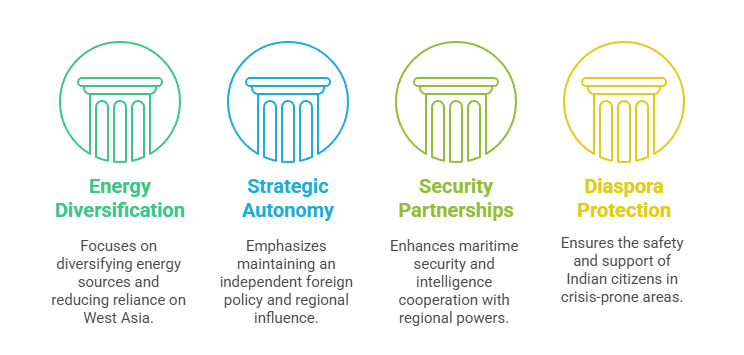
- Strengthen Energy Alternatives: Accelerate investment in renewables and diversify crude imports by engaging countries like Russia, the US, and Brazil to reduce overdependence on West Asia.
- Boost Strategic Autonomy: Maintain an independent and balanced foreign policy by avoiding overt alignment with any bloc while ensuring strategic depth in regional affairs.
- Deepen Security Partnerships: Enhance maritime domain awareness, defence diplomacy, and intelligence-sharing mechanisms with regional powers to secure the Indian Ocean region.
- Diaspora Protection Mechanism: Create robust frameworks for emergency evacuation, legal aid, and consular protection for Indian citizens in volatile zones.
Conclusion
West Asia will continue to be a complex theatre of geopolitical contestation and conflict. For India, the region is not merely about oil and diaspora—it is integral to its economic resilience, energy security, and global strategic aspirations. Navigating these turbulent waters requires a nuanced and proactive foreign policy anchored in national interest, diplomacy, and regional cooperation. As India rises on the global stage, a stable and cooperative West Asia will be vital to its journey |


One comment