Introduction
The history of feminism is often described as unfolding in “waves”—each wave representing a distinct phase in women’s struggle for equality, rights, and recognition. From the early fight for suffrage to the contemporary debates around intersectionality and digital activism, feminism has continuously reshaped society. Understanding the waves of feminism is essential because it links historical struggles with current affairs, gender debates, patriarchy, social movements, and state policies.
This blog explores the four major waves of feminism, their relevance in India, and their sociological significance.
First Waves of Feminism (19th–early 20th century):
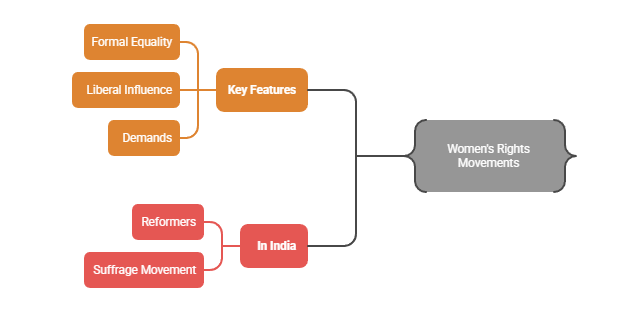
The first wave of feminism emerged in Europe and North America during the 19th and early 20th centuries. Its focus was on legal and political rights—primarily women’s right to vote, property ownership, and access to education.
- Key Features:
- Focused on formal equality with men.
- Influenced by liberalism (John Stuart Mill’s The Subjection of Women).
- Demand for suffrage, education, property rights, and participation in the public sphere.
- In India:
- Reformers like Raja Ram Mohan Roy, Ishwar Chandra Vidyasagar, and later Savitribai Phule campaigned for widow remarriage, women’s education, and against child marriage and Sati.
- The Indian suffrage movement before independence was deeply tied to the nationalist struggle.
Second Waves of Feminism (1960s–1980s):
The second wave of feminism broadened the agenda beyond legal rights to include issues of sexuality, reproductive rights, domestic violence, workplace discrimination, and patriarchy.
- Key Features:
- Popularized the slogan: “The personal is political.”
- Feminist literature (Simone de Beauvoir’s The Second Sex, Betty Friedan’s The Feminine Mystique).
- Rise of radical feminism, socialist feminism, and psychoanalytic feminism.
- In India:
- The 1970s witnessed the Autonomous Women’s Movements, with protests against dowry deaths, rape cases (Mathura rape case, 1972), and unequal personal laws.
- The Towards Equality Report (1974) exposed gender-based inequalities in India.
- Organizations like Self-Employed Women’s Association (SEWA) highlighted economic struggles of women in the informal sector.
Third Waves of Feminism (1990s–2000s):
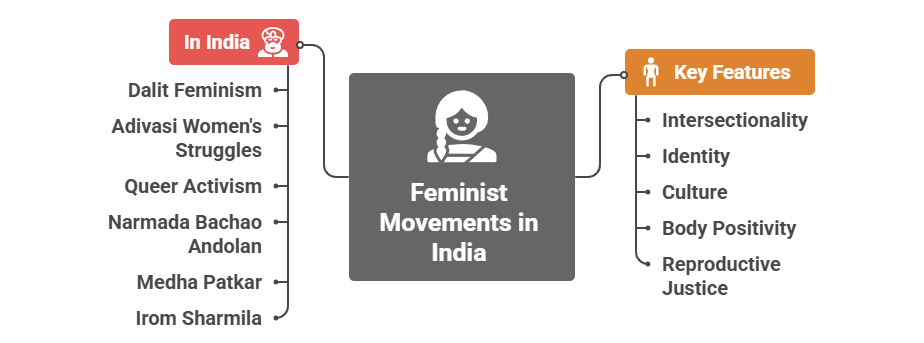
By the 1990s, feminists realized that earlier movements largely reflected the experiences of white, middle-class women. The third wave of feminism sought to include women of diverse races, ethnicities, classes, and sexual orientations.
- Key Features:
- Emphasis on intersectionality (coined by Kimberlé Crenshaw).
- Focus on identity, culture, body positivity, and reproductive justice.
- Critique of essentialist views of “womanhood.”
- In India:
- Dalit feminism, Adivasi women’s struggles, and queer activism gained prominence.
- Movements like the Narmada Bachao Andolan included women’s voices against displacement.
- Women leaders like Medha Patkar and Irom Sharmila became symbols of resistance.
Fourth Waves of Feminism (2010s–present):
The fourth wave is ongoing and shaped by the rise of technology, social media, and global campaigns against sexual harassment and gender violence.
- Key Features:
- Use of digital platforms (#MeToo, #TimesUp, #PinjraTod).
- Focus on sexual harassment, online abuse, body shaming, LGBTQ+ rights.
- Push for inclusive policies on reproductive rights and workplace safety.
- In India:
- The 2012 Nirbhaya case triggered mass protests demanding stricter laws on rape.
- Campaigns like #MeTooIndia, Pinjra Tod, and Students’ protests against sexist hostels rules gained momentum.
- Legal reforms like the Criminal Law Amendment Act (2013) and debates on criminalizing marital rape reflect this wave’s influence.
Sociological Analysis
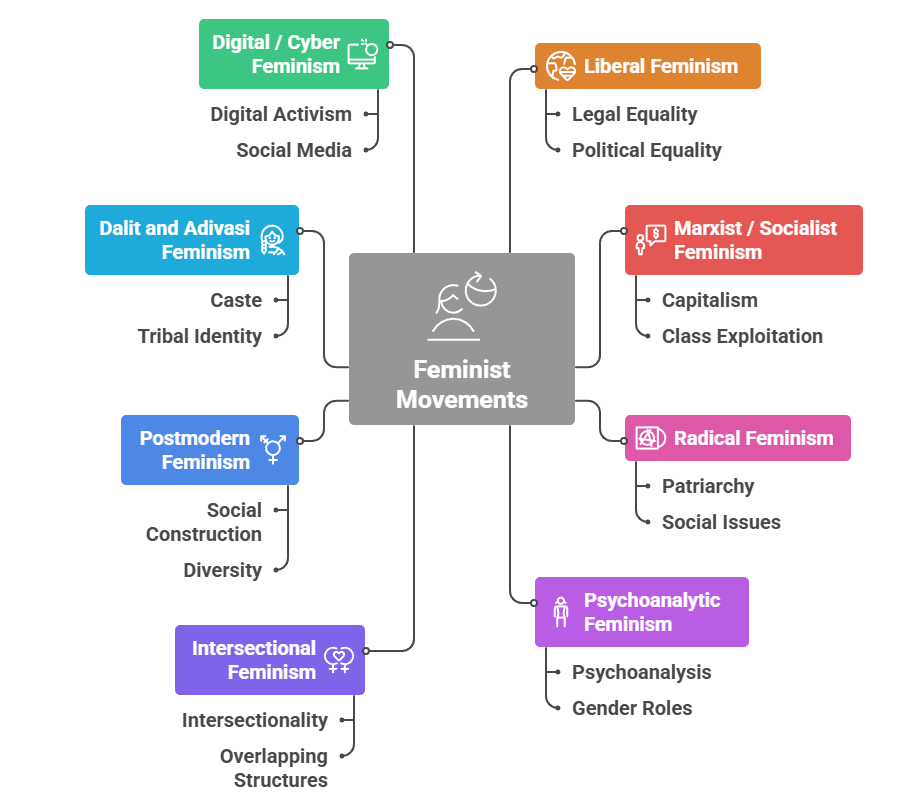
- Liberal Feminism (First Wave): Liberal feminism, which emerged during the first wave, focused on women’s demand for legal and political equality, particularly the right to vote, access to education, and ownership of property. It believed that gradual reform within existing democratic and legal frameworks would be enough to dismantle gender inequality. Thinkers such as Mary Wollstonecraft and John Stuart Mill provided the philosophical foundation for this perspective.
- Marxist / Socialist Feminism (Second Wave): Marxist and socialist feminists argued that women’s oppression was deeply tied to capitalism and class exploitation. They highlighted how women’s unpaid domestic labour and economic dependence reinforced inequality, while capitalism benefited from their subordination. Thinkers like Friedrich Engels (Origin of the Family, Private Property and the State) and Juliet Mitchell explained how the economic system reproduces patriarchy alongside class hierarchies.
- Radical Feminism (Second Wave): Radical feminism located the root of women’s subordination in patriarchy rather than capitalism, arguing that male domination pervades all aspects of life. It drew attention to issues often silenced in public discourse—domestic violence, sexual harassment, and reproductive rights—insisting that women’s liberation required dismantling patriarchal structures. Shulamith Firestone and Kate Millett were central voices of this strand.
- Psychoanalytic Feminism (Second Wave): Psychoanalytic feminism used insights from psychoanalysis to explain how gender roles and patriarchal norms are unconsciously internalized during childhood. By analyzing family dynamics, it showed how daughters and sons reproduce gender expectations and maintain inequality through socialization. Nancy Chodorow and Juliet Mitchell developed this perspective, linking early experiences in family life to the persistence of patriarchal ideology.
- Intersectional Feminism (Third Wave): Intersectional feminism emphasized that women’s experiences cannot be explained by gender alone; they are shaped by overlapping structures of caste, class, race, sexuality, and ethnicity. It critiqued the assumption of a universal woman’s experience, highlighting that oppression is complex and layered. The framework of intersectionality, developed by Kimberlé Crenshaw and enriched by Patricia Hill Collins, became central to this perspective.
- Postmodern Feminism (Third Wave): Postmodern feminists challenged the idea of a fixed or essential definition of “woman.” They argued that gender is socially constructed and should be understood through discourses, symbols, and power relations rather than biology. Stressing diversity and multiple realities, this perspective moved away from universal claims. Judith Butler, especially through her work Gender Trouble, is a key thinker in this tradition.
- Dalit and Adivasi Feminism (Indian Context, Third Wave): In India, Dalit and Adivasi feminists exposed how mainstream feminism often ignored the realities of marginalized women. They highlighted the “difference within difference”, where caste and tribal identity intersect with gender to create unique forms of oppression. This perspective insisted that upper-caste feminism could not represent all women’s experiences. Gopal Guru and Sharmila Rege are among the leading voices of this school.
- Digital / Cyber Feminism (Fourth Wave): The fourth wave is marked by digital activism, where social media platforms are used to challenge gender inequality and mobilize collective action. Movements like #MeToo and Pinjra Tod in India show how online spaces amplify women’s voices against harassment and patriarchal restrictions. This perspective links to broader sociological ideas such as Manuel Castells’ network society and Zygmunt Bauman’s liquid modernity, which explain how technology reshapes activism.
Waves of Feminism and Indian Society
Rather than isolated phases, the waves of feminism in India often overlap. For instance, while digital feminism is gaining strength, dowry violence and patriarchal norms (second-wave issues) still persist. Similarly, caste and class continue to shape women’s struggles (third-wave issues).
This layered nature of feminism shows how social change in India is paradoxical—progressive in some areas yet stagnant in others.
Conclusion
The waves of feminism tell us that gender equality is not a destination but an ongoing journey. Each wave has built upon the struggles of the previous one, addressing new challenges and broadening the scope of women’s rights.
In India, feminism has moved from legal reforms to tackling patriarchy, then to acknowledging caste and class dimensions, and now to digital mobilization for gender justice.
PYQs
Paper I
- “Feminism has challenged the dichotomy of private and public spheres.” Discuss. (2015)
- Explain the feminist critique of sociological theory. (2016)
- How is gender linked with the process of socialization? Illustrate with suitable examples. (2017)
- Examine the concept of patriarchy as an ideology and a system of social structures. (2018)
- Discuss the feminist perspective on family and household. (2019)
- Examine the significance of intersectionality in understanding gender inequality. (2020)
- How do feminist theories explain the sexual division of labour? (2021)
- Explain Judith Butler’s idea of gender performativity in the context of postmodern feminism. (2022)
- How do contemporary feminist movements reflect the changing nature of patriarchy? (2023)
- Is the social stratification theory gender-blind? Elucidate. (2025)
Paper II
- Examine the linkage between patriarchy and honour killings in India. (2014)
- Comment on the recent trends in the women’s movement in India. (2015)
- Discuss how caste and gender intersect to shape women’s experiences in Indian society. (2016)
- Write a short note on the women’s movement in post-Independent India. (2017)
- Critically examine the role of autonomous women’s organizations in addressing issues of dowry and rape. (2018)
- How do Dalit and Adivasi women’s struggles highlight “difference within difference” in Indian feminism? (2019)
- Discuss the impact of globalization on women’s employment in India. (2020)
- Examine the role of social media movements like #MeToo and Pinjra Tod in shaping gender discourse in India. (2021)
- How far has the Indian State been successful in addressing issues of gender violence and reproductive rights? (2022)
- Examine the challenges to women’s labour force participation in contemporary India. (2023)
- According to you, which social reform movement has played the most effective role in uplifting the status of women? Explain. (2025)
|


One comment