Introduction
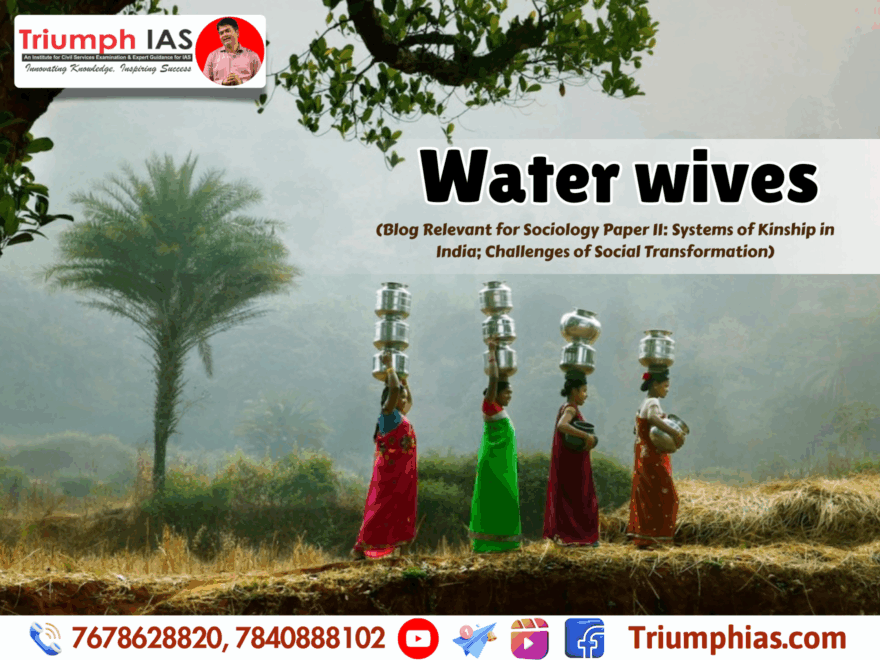
In the drought-prone regions of India—such as Maharashtra’s Marathwada, Bundelkhand, and parts of Rajasthan—the term “Water Wives” (पानी की पत्नियाँ) refers to the practice where a man marries more than one woman so that the household can fetch enough water for daily survival. This practice of polyandry driven by acute water scarcity has brought global attention to the intersection of gender inequality, climate change, and rural distress in India.
The Practice: Why Do “Water Wives” Exist?

- Water Scarcity: Many villages experience severe droughts, forcing women to walk 5–10 km daily to fetch water.
- Household Survival: With only one wife, it is impossible to meet the daily water needs; marrying again becomes a survival strategy.
- Informal Polyandry: Unlike traditional polyandry in the Himalayas (e.g., among the Toda or in Ladakh), this is poly-marriage out of necessity, not tradition.
- Marginalized Women: Second or third wives are often widows, abandoned women, or women from marginalized castes.
Sociological Analysis
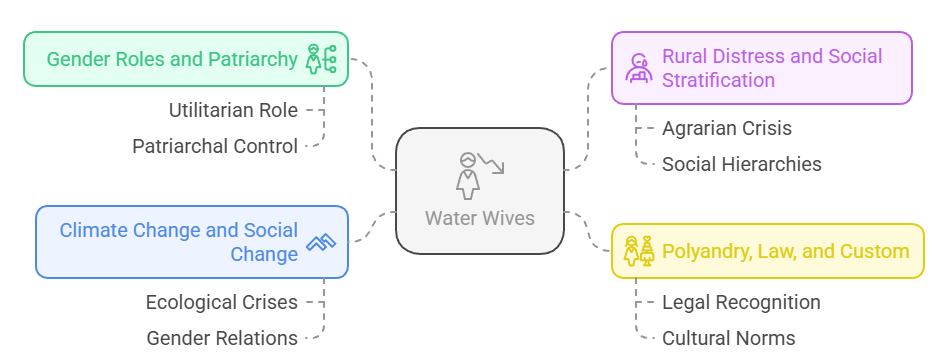
- Gender Roles and Patriarchy: In drought-hit rural India, women’s identities are often reduced to their ability to fetch water, making them a vital “resource” for household survival. Their marital value becomes tied to this utilitarian role, deepening patriarchal control over their bodies and labor. Drawing from Ann Oakley’s feminist perspective, the gendered division of labor intensifies under environmental stress, turning women into commodities to address water scarcity. This not only reinforces patriarchy but also amplifies women’s marginalization, especially in resource-poor households.
- Rural Distress and Social Stratification: Chronic water scarcity is both a symptom and driver of the larger agrarian crisis, disproportionately affecting landless laborers and small farmers. Instead of promoting social mobility or empowerment, the practice of marrying “water wives” consolidates existing social hierarchies and inequalities. Women in such marriages face double marginalization—first by gender and then by their lack of power in the household and community—thereby perpetuating the cycle of rural distress and social stratification.
- Polyandry, Law, and Custom: Most “water wife” arrangements are informal and lack legal recognition, leaving these women with no rights to inheritance or marital protection. This creates a vulnerable class of women with little legal recourse if abandoned or mistreated. From a sociological lens, Robert Merton’s concept of ‘innovation’ explains how families adapt to extreme deprivation by creating unconventional social norms—like polyandry out of necessity—challenging but not dismantling established legal and cultural structures.
- Climate Change and Social Change: The rise of “water wives” is a stark example of how climate change acts as a catalyst for transforming social structures. As water sources dry up and men migrate for work, women bear increased responsibilities and social burdens. Environmental sociology highlights this phenomenon as evidence that ecological crises do not just threaten livelihoods—they also reshape gender relations and family institutions, often in ways that reinforce existing social vulnerabilities in rural India.
Conclusion
The existence of “water wives” is a tragic reminder of the human cost of water scarcity and the resilience (and vulnerability) of women in rural India. Policy interventions must address the root causes—water conservation, women’s empowerment, and rural infrastructure. Sociologically, the phenomenon reflects how environmental crises magnify existing social inequalities and social issues in India.
PYQs
Paper 1:
- How does climate change contribute to social change? Illustrate with examples.(2022)
- Discuss the consequences of environmental degradation and ecological imbalances for the marginalized sections of society.(2022)
- How do patriarchal values affect the status of women in rural India?(2020)
- Examine the sociological significance of polyandry in contemporary India.(2016)
- How do social problems like drought, water scarcity, and unemployment influence marriage and kinship patterns in rural India?(2015)
- Discuss the role of women in resource management in rural societies.(2014)
Paper 2:
- Discuss the impact of climate change and environmental degradation on rural women in India.(2022)
- How do agrarian crises and water scarcity affect the structure and dynamics of rural families(2021)
- Evaluate the effectiveness of government schemes in addressing the issues of water scarcity and women’s empowerment in rural India.(2020)
- Explain how environmental movements in India address the challenges faced by marginalized and women communities.(2019)
- Critically examine the relationship between social change and the emergence of new forms of marriage and kinship in rural India.(2016)
- Discuss the linkages between rural poverty, resource scarcity, and the feminization of labour(2015)
|


One comment