Introduction
Urban exclusion is one of the most pressing socio-economic issues in contemporary India. As urbanization accelerates, driven by globalization, industrialization, and migration, cities have become epicenters of both opportunity and deprivation. Urban exclusion refers to the systematic denial of access to essential services, resources, and opportunities for certain groups in urban spaces, often based on class, caste, gender, religion, and legal identity. This blog explores the concept of urban exclusion, its causes, dimensions, and consequences, particularly in the Indian context.
What is Urban Exclusion?
Urban exclusion is a process where certain individuals or social groups are denied full participation in urban life, including access to:
- Affordable housing
- Clean water and sanitation
- Healthcare and education
- Employment opportunities
- Public transportation
- Legal rights and identity
It creates an urban underclass, characterized by precarious living conditions and lack of agency in decision-making processes.
Dimensions of Urban Exclusion in India
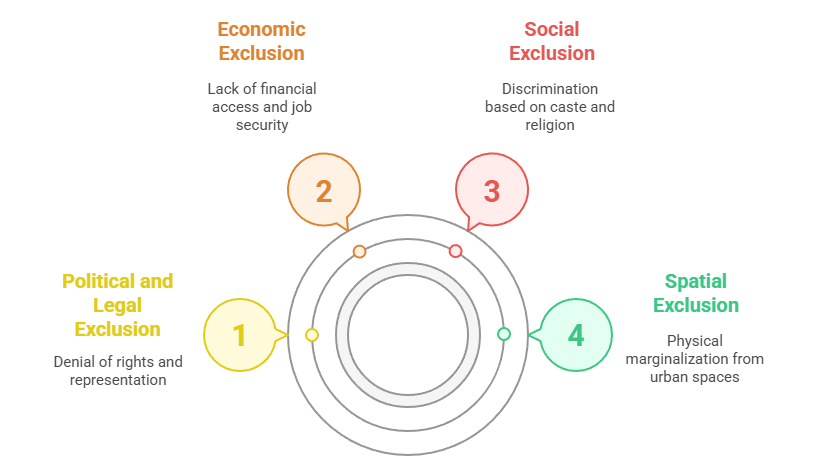
- Spatial Exclusion: Spatial exclusion refers to the physical marginalization of certain groups from mainstream urban spaces. In Indian cities, this is evident in the emergence of gated communities, luxury zones, and business districts that contrast sharply with neglected slums and unauthorized settlements. Poor and marginalized populations are often pushed to city peripheries lacking proper infrastructure, public transport, or municipal services, thereby excluding them from urban growth benefits.
- Social Exclusion: Social exclusion in urban India is deeply rooted in caste, religion, and ethnicity. Marginalized groups such as Dalits and Muslims face housing discrimination and are often denied rentals in “upper-caste” or “upper-class” neighborhoods. This results in ghettoization, where communities are forced to live in segregated, often stigmatized areas, are lacking safety, education, and social capital.
- Economic Exclusion: Economic exclusion manifests when urban poor, especially informal workers like vendors, domestic workers, and construction laborers, are denied stable employment, social security, and financial access. Development projects frequently lead to forced evictions without fair compensation, leaving them homeless or jobless. Lack of skills training and credit access also restricts upward mobility.
- Political and Legal Exclusion: Large sections of the urban poor, especially migrants and slum dwellers, are denied political representation and basic legal recognition. Without voter ID, ration cards, or Aadhaar, they cannot access welfare schemes, vote, or claim their rights. Moreover, they are often left out of urban planning processes, reinforcing their political invisibility.
Sociological Analysis
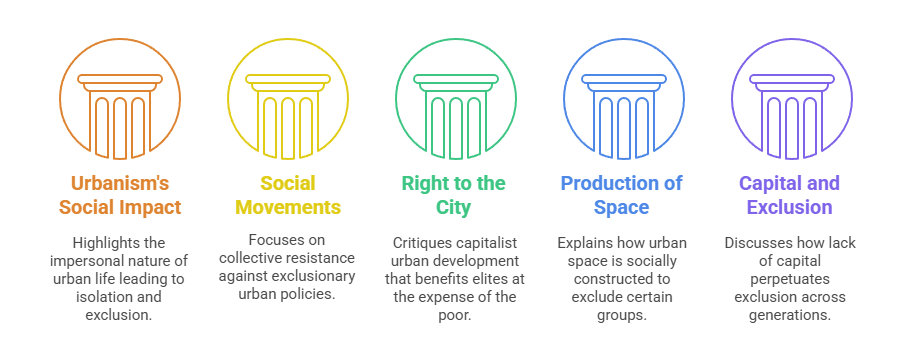
- Urbanism as a Way of Life: Louis Wirth highlighted how urban life fosters impersonal relationships and social distance, contributing to isolation and exclusion. In modern Indian cities, this is visible in the fragmentation of social bonds, where the urban poor are alienated from both the middle-class lifestyle and governance structures.
- Urban Social Movements: Manuel Castells emphasized that exclusion in cities leads to social movements that demand housing, services, and democratic rights. Movements by slum dwellers, hawkers, or housing rights activists in Indian cities represent collective resistance to exclusionary urban planning and neoliberal policies.
- Right to the City: David Harvey’s concept of “right to the city” critiques how capitalist urban development benefits elites while excluding the poor. In India, smart cities and gentrification serve the interests of corporate capital, displacing the informal economy and depriving the marginalized of their urban rights.
- Production of Space: Henri Lefebvre argued that urban space is not neutral; it is socially constructed and controlled. In India, municipal bodies and private developers shape urban space to exclude slums and lower-income groups from prime locations, thus reproducing inequality through spatial planning.
- Capital and Exclusion: Pierre Bourdieu‘s concept of capital—economic, social, and cultural—explains why certain groups remain excluded. The urban poor lack the necessary capital to negotiate urban systems, access quality education, or participate in formal employment, which perpetuates exclusion across generations.
Who Are the Excluded?
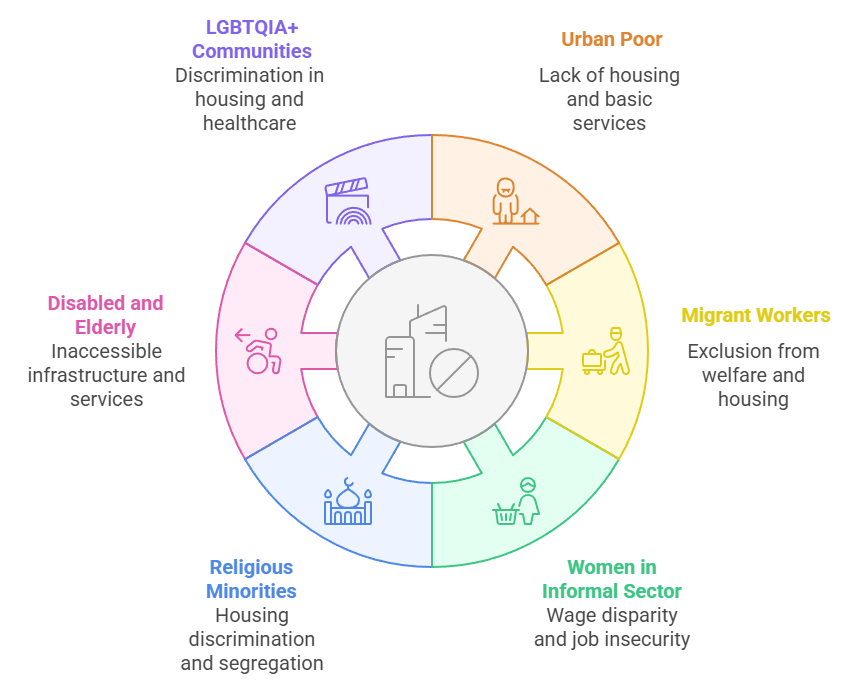
- Urban Poor and Slum Dwellers: They lack access to housing, sanitation, and basic services, and face frequent evictions without rehabilitation. Urban planning often overlooks their presence and needs.
- Migrant Workers: Working in informal sectors, they lack local IDs and access to welfare schemes. They are excluded from housing, healthcare, and political participation.
- Women in the Informal Sector: They face wage disparity, job insecurity, and lack of social protection. Unsafe public spaces and unpaid care burdens add to their exclusion.
- Religious Minorities: Muslims often face housing discrimination and live in segregated, underdeveloped areas. This leads to limited access to education, jobs, and services.
- Disabled and Elderly: Urban infrastructure is largely inaccessible, limiting their mobility. They are excluded from active participation in urban life and services.
- Transgender and LGBTQIA+ Communities: They face discrimination in housing, employment, and healthcare. Social stigma and lack of legal protection compound their urban marginalization.
Urban Exclusion and Urban Planning in India
Master Plans and Smart Cities
- Focus on beautification and elite infrastructure while neglecting the urban poor.
- Evictions of slums in the name of development (e.g., Yamuna Pushta demolition in Delhi).
Public Housing Schemes
- Pradhan Mantri Awas Yojana (PMAY) often excludes informal workers due to documentation and eligibility criteria.
Lack of Participatory Governance
- Ward committees and resident welfare associations rarely include slum dwellers or informal sector representatives.
Consequences of Urban Exclusion
- Social unrest and protests (e.g., Shaheen Bagh, slum evictions).
- Rise in urban poverty and unemployment.
- Criminalization of poverty (e.g., anti-encroachment drives).
- Weakening of urban democracy and social cohesion.
Case Studies
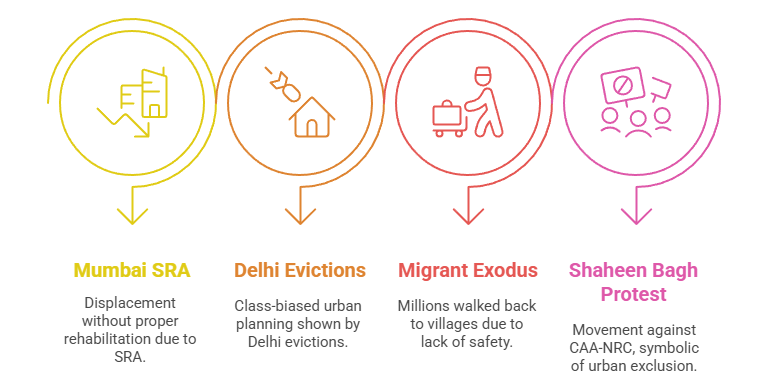
- Mumbai’s Slum Redevelopment Authority (SRA): Led to the displacement of thousands without proper rehabilitation.
- Delhi’s Jahangirpuri and Yamuna Floodplain Evictions: Showcases the class-biased nature of urban planning.
- COVID-19 and Migrant Exodus (2020): Exposed deep-rooted urban exclusion where millions walked back to villages due to lack of urban safety nets.
- Shaheen Bagh Protest (2020): A movement not just against CAA-NRC but also symbolic of urban exclusion and spatial marginalization.
Policy Framework and Recommendations
- Ensure slum dwellers, migrants, and women are part of city master plans.
- Enforce policies that ensure decent living conditions for urban poor.
- Make Aadhaar, ration cards, and voter IDs accessible to the homeless and migrants.
- Promote participatory governance through ward committees and social audits.
- Like MGNREGA, a similar urban employment program is needed (e.g., Tamil Nadu’s urban job scheme).
Conclusion
Urban exclusion is not merely an administrative lapse—it is a socially produced phenomenon rooted in class, caste, and political neglect. Sociologically, it represents the deep contradictions of urban development—cities that promise growth yet marginalize the most vulnerable. A just and inclusive urban policy must address structural inequalities, empower the excluded, and democratize access to the city.
PYQs
Paper I
- How does urbanism as a way of life impact social relationships? (2014)
- Discuss the functional and conflict perspectives on social stratification in the urban context. (2016)
- Explain the concept of ‘marginalization’ in urban sociology with examples from developing societies. (2017)
- Describe the nature of social mobility and exclusion in urban informal sectors. (2018)
- Examine how caste and class intersect in urban social structures. (2019)
- Explain the concept of spatial segregation in urban areas and its sociological implications. (2020)
- Discuss Bourdieu’s theory of capital in explaining urban exclusion. (2022)
- Elaborate on the role of urban space in reproducing gender-based exclusion. (2023)
Paper II
- Discuss the growth of slums in urban India and the major challenges associated with them. (2014)
- Examine the impact of urbanization on the marginalized sections of Indian society. (2015)
- Analyze how caste and religion contribute to spatial segregation in Indian cities. (2016)
- Describe the problems faced by migrants in urban areas in the context of employment and identity. (2017)
- Examine the consequences of forced evictions and slum clearance in Indian cities. (2018)
- Discuss the intersectionality of class, caste, and gender in the urban informal sector. (2019)
- How has the COVID-19 pandemic highlighted structural inequalities and urban exclusion in India? (2020)
- Evaluate the effectiveness of government housing schemes in addressing urban exclusion. (2021)
- Critically analyze the impact of smart cities on inclusive urban development. (2022)
- Discuss the sociological significance of the “Right to the City” in the Indian urban context. (2023)
|


One comment