Introduction: Cisgender identity
In contemporary sociological and gender studies discourse, cisgender refers to individuals whose gender identity aligns with the sex assigned to them at birth. For example, a person assigned female at birth and who identifies as a woman is considered cisgender.
In contrast to transgender individuals, whose gender identity does not align with their assigned sex at birth, cisgender people often experience societal privilege due to conformity with normative gender expectations. Understanding this distinction is crucial for building inclusive social policies and analyzing identity politics—a key theme in the UPSC Sociology Syllabus (Paper I & II).
Sociological Analysis
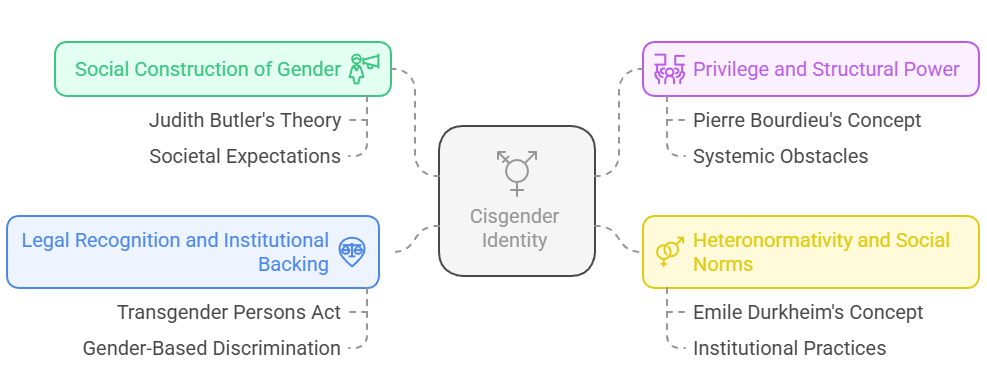
- The Social Construction of Gender: Cisgender identity, like all gender identities, is a product of the social construction of gender. Judith Butler’s theory of gender performativity explains that gender is not an innate or biologically determined trait but rather a repeated performance shaped by societal norms and expectations. In this context, cisgender individuals are those whose gender performance aligns with societal expectations based on their assigned sex at birth. This alignment grants them a degree of acceptance and invisibility, reinforcing the binary view of gender and contributing to the marginalization of those who do not conform, such as transgender and non-binary individuals.
- Privilege and Structural Power: Sociologist Pierre Bourdieu’s concept of symbolic power helps us understand how cisgender identity is normalized and privileged within social structures. This symbolic power allows cisgender individuals to navigate institutions like education, healthcare, legal systems, and employment without questioning or resistance. The privileges accorded to cisgender individuals are often invisible to them but manifest clearly when compared to the systemic obstacles faced by transgender people. This creates a structural hierarchy in which cisgender experiences are the default, and all others are marked as deviant or ‘other.’
- Heteronormativity and Social Norms: The dominance of cisgender identity is further reinforced by heteronormativity—the belief that heterosexuality and cisgender identities are the norm. Emile Durkheim’s concept of social facts is useful in analyzing how such norms become embedded in collective consciousness and institutional practices. From schools and media to legal documents and family structures, the assumption that everyone is cisgender and heterosexual pervades daily life. This marginalizes those who exist outside of these norms and legitimizes both subtle and overt forms of discrimination against them.
- Legal Recognition and Institutional Backing: Despite the legal recognition of transgender individuals in India through the Transgender Persons (Protection of Rights) Act, 2019, the law has been criticized for failing to address the everyday realities of gender-based discrimination. Sociologically, this demonstrates the persistence of cisnormativity even within legal frameworks that aim for inclusion. Institutions continue to cater to cisgender identities as the default, leaving transgender individuals to fight for legitimacy, dignity, and equal treatment. This reflects the broader conflict between formal legal rights and lived social realities—a key issue in Indian society and governance.
Contemporary Case Studies
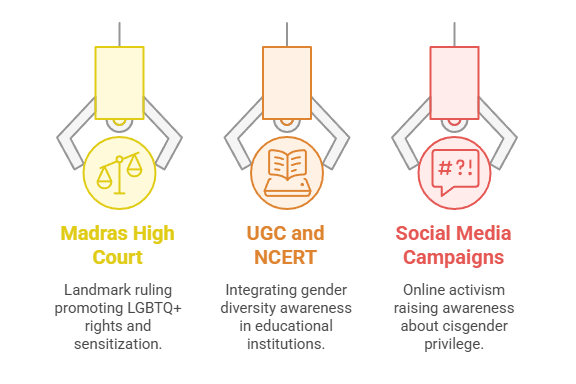
- Madras High Court ruling (2021): A judge underwent sensitization training and acknowledged systemic discrimination against LGBTQ+ persons, recognizing the role of family and education in upholding cisnormative structures.
- UGC and NCERT Guidelines: Institutions are slowly integrating gender diversity awareness, yet cisgender-centric curricula prevail in most educational setups.
- Social Media Campaigns: #TransLivesMatter, #StopTransBill2019 have sparked debates around cisgender privilege and gender rights.
Challenges
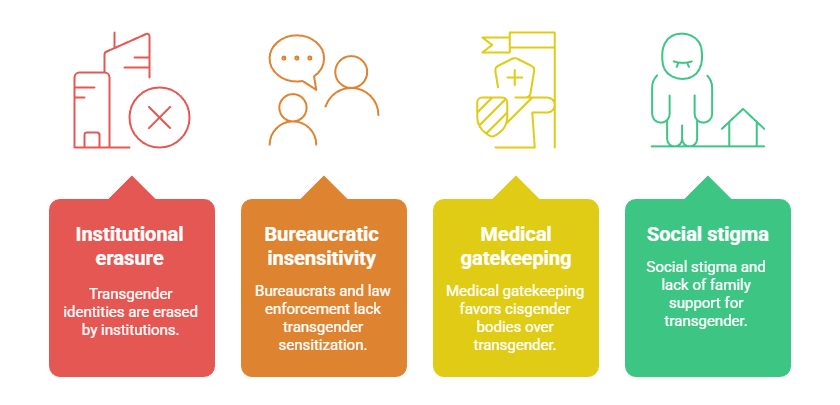
- Institutional erasure of transgender identities
- Lack of sensitization among bureaucrats and law enforcement
- Medical gatekeeping that favors cisgender bodies
- Social stigma and lack of family support
Way Forward
- Gender-inclusive education policies
- Strengthening the Transgender Act based on community feedback
- Promoting intersectional feminism
- Recognizing non-binary identities in official documents
Conclusion
The concept of cisgender identity is essential to understanding modern gender debates, legal reforms, and the dynamics of social inclusion and exclusion. Cisgender identity reflects how social norms privilege conformity to assigned gender roles. Recognizing this helps us understand systemic inequalities faced by transgender and non-binary individuals. For sociology, it offers critical insights into gender, power, and inclusion in Indian society.
PYQs
Paper I
Discuss how the concept of “cisgender privilege” reveals the structural inequalities in gender relations.
Paper II
Examine the impact of recent legal reforms on transgender rights in India. |