Introduction:
Gender equality is not only a fundamental human right but also a necessary foundation for a peaceful, prosperous, and sustainable world. In 2025, the United Nations released its latest report on Gender Equality, underlining both progress and persistent disparities across the globe. While strides have been made in education and health, gender-based violence, economic inequality, political underrepresentation, and unpaid care work continue to hinder full equality.
This blog will analyze the findings of the UN Report from a sociological lens, focusing on implications for India and aligning it with topics such as social stratification, gender and society, social change, and development.
Key Highlights from the UN Report on Gender Equality (2025)

- Gender Development Index (GDI) Rankings
- Globally, only 15 countries have achieved near gender parity.
- India ranks 125 out of 193 countries on the GDI, indicating persistent structural inequalities.
- Political Representation
- Only 26% of parliamentary seats worldwide are held by women.
- In India, women’s representation in Parliament is around 15%, despite the passing of the Women’s Reservation Bill.
- Economic Participation
- Women globally earn 77 cents for every dollar earned by men.
- In India, the female labor force participation rate is below 25%, one of the lowest globally.
- Unpaid Care Work
- Women perform 2% of total unpaid care work globally.
- In India, women spend 352 minutes daily on unpaid domestic work compared to 52 minutes by men (NSSO Time Use Survey 2019).
- Gender-Based Violence
- 1 in 3 women worldwide has experienced physical or sexual violence.
- In India, crimes against women increased by 26% from 2021 to 2023 (NCRB 2024 data).
Sociological Analysis:
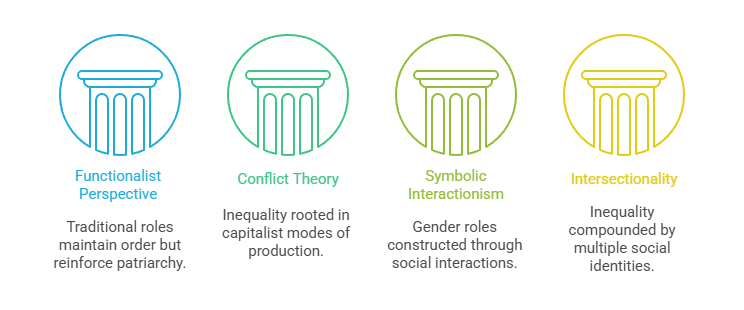
- Functionalist Perspective: According to Talcott Parsons, traditional gender roles were functional for maintaining social order. However, critics argue that this view reinforces patriarchy and overlooks structural discrimination. The persistence of gender pay gaps and underrepresentation in decision-making reflects this systemic imbalance.
- Conflict Theory: Friedrich Engels argued that gender inequality is rooted in capitalist modes of production. Women’s unpaid domestic labor contributes to the reproduction of labor power without remuneration, which benefits capitalist economies. The UN Report’s insights on economic inequality directly support this analysis.
- Symbolic Interactionism: This perspective focuses on how gender roles are socially constructed and reinforced through everyday interactions. Media representation, educational institutions, and family expectations perpetuate stereotypical roles, limiting women’s aspirations and opportunities.
- Intersectionality: Coined by Kimberlé Crenshaw, intersectionality emphasizes that gender inequality is compounded by caste, class, race, ethnicity, and disability. In India, Dalit and Adivasi women face higher levels of violence and exclusion, a reality echoed in the UN’s call for disaggregated gender data.
Gender Equality in India: Reality vs. Commitment
Legal Commitments
- Article 15 & 16 of the Indian Constitution guarantee equality before the law and non-discrimination based on sex.
- Acts like POSH Act (2013), Maternity Benefit Act (2017), and Domestic Violence Act (2005) exist on paper but face weak enforcement.
Gaps in Implementation
- Women’s Reservation Bill (2023) promises 33% representation in Lok Sabha and State Assemblies, but its implementation is pending.
- Lack of infrastructure (e.g., safe public transport, clean toilets) deters women’s full participation.
Socio-cultural Factors
- Son preference, dowry system, and honor killings reflect deep-rooted patriarchal norms.
- In rural India, girl child education is still secondary to household labor.
Gender Equality and Sustainable Development Goals (SDG 5)
SDG 5 aims to achieve gender equality and empower all women and girls by 2030. The UN Report points out that at the current pace, gender parity will take another 300 years.
SDG 5 Targets Include:
- Ending all forms of discrimination and violence
- Ensuring equal participation in leadership
- Recognizing unpaid care and domestic work
- Ensuring access to sexual and reproductive rights
India’s policies like Beti Bachao Beti Padhao, Ujjwala Yojana, and One Stop Centres align with SDG 5 but require more robust implementation and monitoring mechanisms.
Way Forward
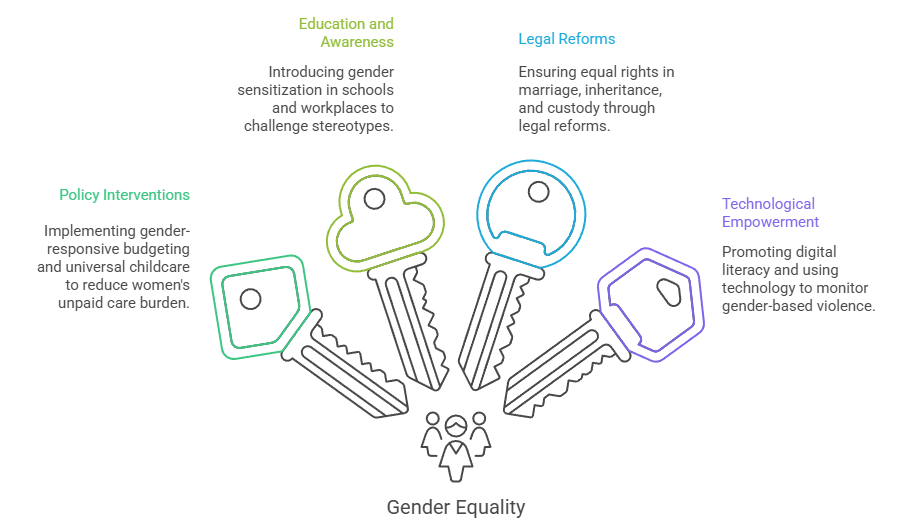
- Policy-Level Interventions: Governments should adopt gender-responsive budgeting and provide universal childcare and maternity support to reduce the unpaid care burden on women.
- Education and Awareness: Introduce gender sensitization in schools and workplaces, and include gender studies in curricula to challenge stereotypes and promote equality early on.
- Legal Reforms: Ensure the implementation of the Women’s Reservation Bill and reform personal laws to guarantee equal rights in marriage, inheritance, and custody.
- Technological Empowerment: Promote digital literacy for women, especially in rural areas, and use technology and AI to monitor gender-based violence and improve data-driven policy.
Conclusion:
The UN Report on Gender Equality (2025) is both a wake-up call and a roadmap. While global and national efforts have yielded some success, deep-seated structural barriers remain. One that goes beyond statistics to analyze patriarchy, power relations, and systemic exclusions—is crucial for real change. For UPSC aspirants, the UN report offers an excellent case study to integrate current affairs with theoretical insights. Gender equality is no longer just a goal—it is the litmus test for inclusive, just, and sustainable development.
PYQs
Paper 1
- Feminist methodology is crucial for the study of gender in sociology. Discuss. (2021)
- Examine the relationship between gender and power with reference to the work of any feminist theorist. (2022)
Paper 2
- Critically analyze the impact of new economic policies on women’s employment in India. (2015)
- Explain the relevance of the women’s movement in India in addressing gender inequality. (2016)
- Explain how far Indian laws and judiciary contributed towards women’s empowerment have. (2020)
- Discuss the sociological reasons behind the low female labor force participation rate in India. (2021)
- Analyze the impact of digital technology on women’s empowerment in rural India. (2022)
- Discuss the implications of the Women’s Reservation Bill on gender equality in Indian politics. (2023)
|


2 comments