Introduction
The World Social Report 2025, released by the United Nations, signals a troubling reality: trust is collapsing, and job fears are escalating globally. Despite higher education levels and greater technological connectivity, billions feel more vulnerable than ever. This trend highlights critical sociological concerns, offering deep insights into social change, inequality, work and economy, social stratification, and political processes.
Key Highlights of the UN World Social Report 2025
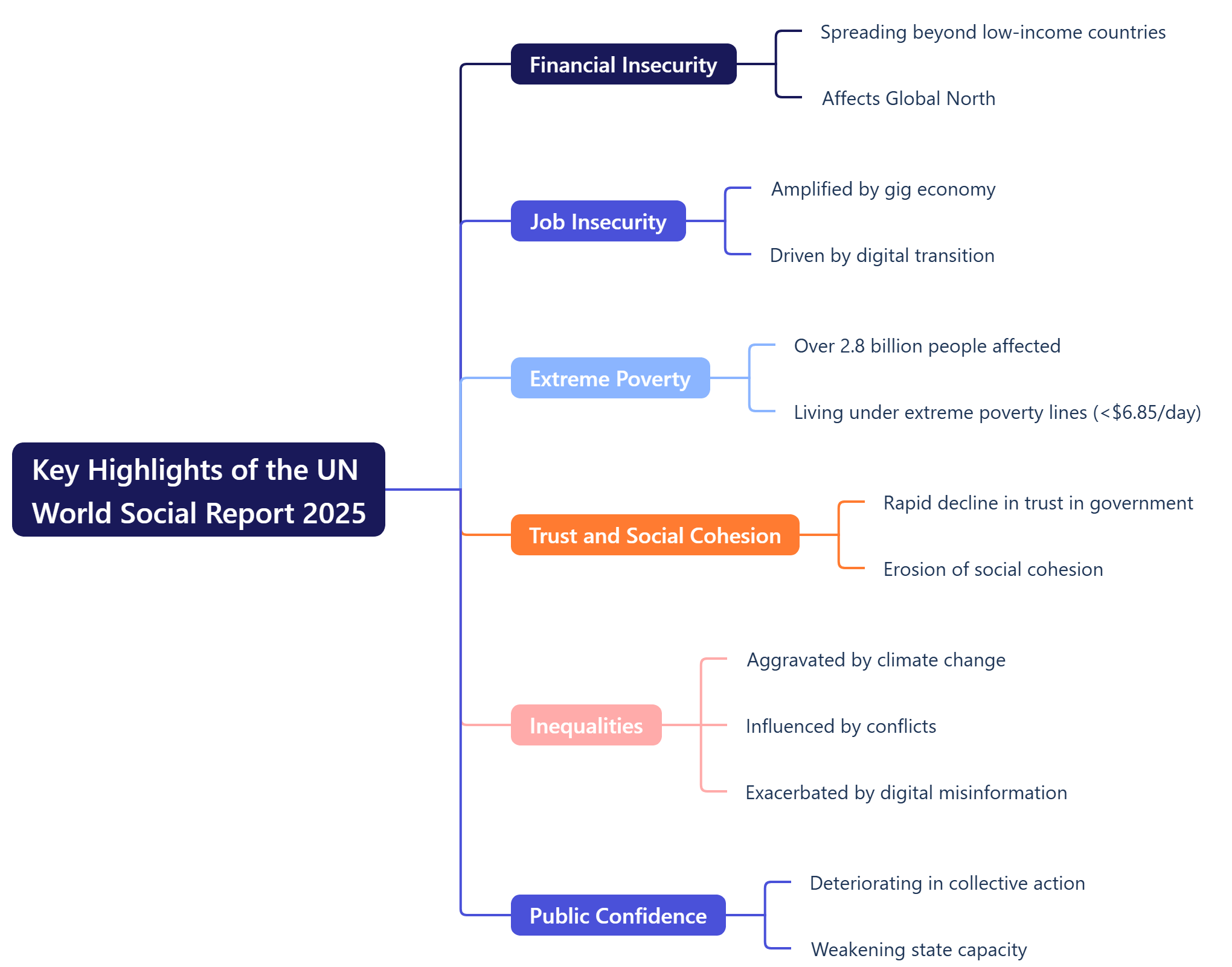
- Financial insecurity is spreading beyond low-income countries to the Global North.
- Gig economy and digital transition are amplifying job insecurity.
- Over 2.8 billion people live under extreme poverty lines (<$6.85/day).
- Trust in government institutions and social cohesion is rapidly declining.
- Climate change, conflicts, and digital misinformation are aggravating inequalities.
- Public confidence in collective action and state capacity is deteriorating.
Sociological Analysis
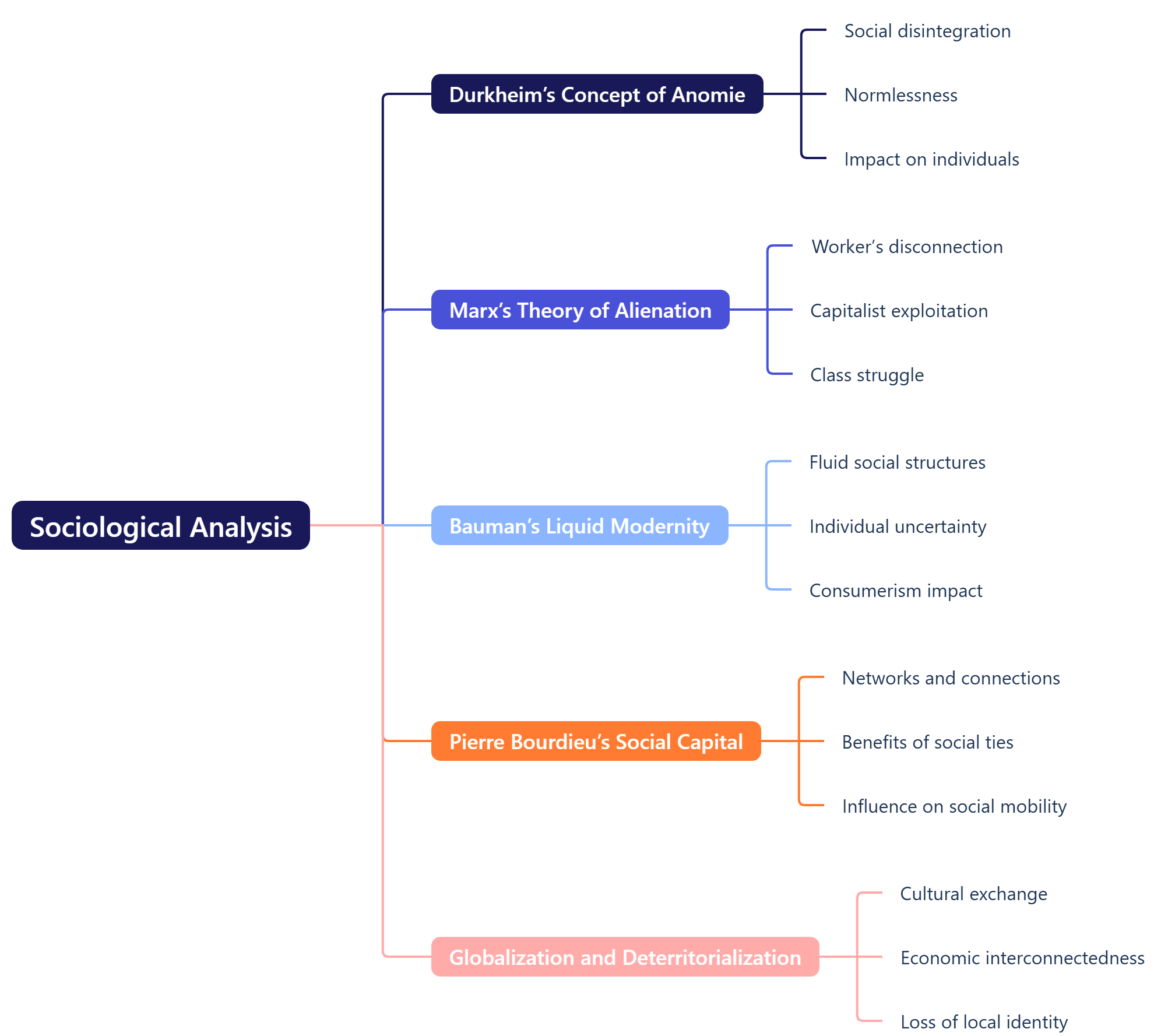
- Durkheim’s Concept of Anomie: Durkheim’s idea of anomie – a breakdown of social norms – fits well. Economic instability, the gig economy’s precariousness, and weakening social ties reflect a state of normlessness where individuals feel disconnected from society.
- Marx’s Theory of Alienation: Marx’s alienation of labour is visible as workers, especially gig workers, lose control over their work conditions, becoming commodities in the digital marketplace, leading to social frustration and disillusionment.
- Bauman’s Liquid Modernity: Zygmunt Bauman’s concept of liquid modernity explains the flexible yet insecure jobs of today. People have no stable employment relationships, leading to anxiety, mistrust, and political disengagement.
- Pierre Bourdieu’s Social Capital: Bourdieu emphasized that social capital (trust networks, mutual recognition) is critical for social cohesion. As trust collapses globally, social capital erosion intensifies inequality and hinders collective progress.
- Globalization and Deterritorialization: Globalization, while connecting economies, has also led to de-territorialization of labour, causing disembeddedness (Karl Polanyi) – the removal of work from traditional protective social institutions, making workers vulnerable.
Indian Context
- India’s Informal Sector: Over 90% of India’s workforce is in the informal economy, without social security, as per the Periodic Labour Force Survey (PLFS 2022-23).
- Gig Economy: Platforms like Swiggy, Zomato, and Uber dominate urban employment, but workers face job instability, low pay, and no legal protection.
- Climate Vulnerability: Farmers in India are heavily impacted by erratic monsoons and climate shocks, deepening rural distress and fueling agrarian unemployment.
- Youth Disillusionment: Rising unemployment among educated youth (over 42% unemployment among degree holders according to CMIE 2024 data) is leading to declining trust in government schemes and increasing frustration.
- Misinformation and Polarization: Social media platforms create echo chambers that amplify divisions (e.g., communal polarization, farmer protests disinformation campaigns).
- Collapse of Trust in Institutions: Scams, corruption, and governance failures (like mismanagement during the COVID-19 pandemic) have eroded people’s faith in state institutions.
Thus, the Indian society mirrors the global trends highlighted in the UN report, with some aspects (like informalization and climate vulnerability) being even more acute.
Conclusion
The World Social Report 2025 paints a stark picture of job fears, financial insecurity, and trust collapse. These issues are deeply intertwined with the core themes of Sociology like social change, economic insecurity, political instability, globalization, and trust. For Sociology aspirants, understanding these dynamics through the lens of classical and contemporary sociology theories provides an invaluable analytical framework.
Previous Year Questions
Paper I:
- “How has globalization affected the nature of work and employment? Discuss.” (2018)
- “Explain the concept of alienation. How is alienation experienced in the gig economy?” (2021)
- “Analyse the impact of digital technologies on work culture in modern societies.” (2023)
Paper II:
- “Discuss the informalization of labour in India. What are its implications for economic development?” (2020)
- “Critically examine the role of globalization in increasing socio-economic inequalities in India.” (2019)
|



One comment