Introduction: Transforming India Nutrition
India stands at a critical juncture in its journey toward improving public health and human development. Despite rapid economic growth, malnutrition continues to be one of India’s most pressing challenges. However, recent years have witnessed a paradigm shift, with the country initiating a “nutrition revolution” to combat hunger, undernutrition, micronutrient deficiencies, and obesity through comprehensive, multi-sectoral approaches. This blog explores the current status of nutrition in India, key government initiatives, and the path forward for building a healthier, more productive nation.
Current Status of Nutrition in India

According to the National Family Health Survey (NFHS-5, 2019-21), malnutrition indicators in India have seen mixed progress:
- Stunting (low height for age) among children under five has declined from 38.4% (NFHS-4) to 35.5%.
- Wasting (low weight for height) remains alarmingly high at 19.3%.
- Underweight children have marginally reduced from 35.8% to 32.1%.
- Anaemia has increased significantly, affecting 67% of children under five and 57% of women aged 15-49.
- Simultaneously, India faces rising levels of childhood obesity and lifestyle diseases linked to poor nutrition.
India’s nutritional challenges are characterized by the “triple burden” of malnutrition: undernutrition, hidden hunger (micronutrient deficiencies), and overnutrition. This complex problem directly impacts national development by affecting educational outcomes, workforce productivity, and health expenditure.
Government Initiatives Driving the Nutrition Revolution
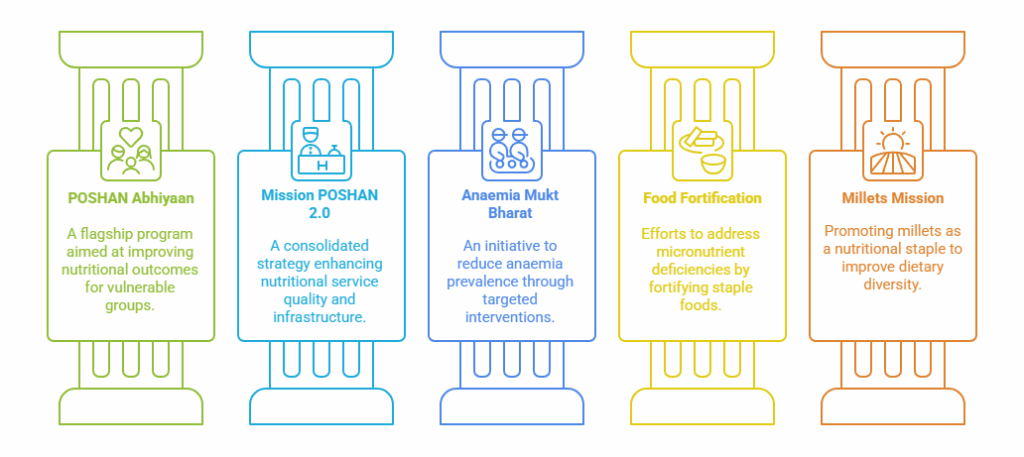
- POSHAN Abhiyaan (National Nutrition Mission)
Launched in 2018, POSHAN Abhiyaan is India’s flagship programme to improve nutritional outcomes for children, adolescents, pregnant women, and lactating mothers.
- Objectives: Reduce stunting, undernutrition, anaemia, and low birth weight in a time-bound manner.
- Technological Integration: Uses the Poshan Tracker App to monitor real-time delivery of nutrition services.
- Jan Andolan (People’s Movement): Focuses on community participation through awareness campaigns like Poshan Maah (September) and Poshan Pakhwada (March).
- Convergence Approach: Integrates services of Anganwadi Workers, health personnel, education sector, and panchayats.
- Mission POSHAN 2.0
In 2021, the Government consolidated existing nutrition schemes under Mission POSHAN 2.0, bringing together:
- Integrated Child Development Services (ICDS),
- POSHAN Abhiyaan,
- Supplementary Nutrition Programme,
- Scheme for Adolescent Girls, and
- National Creche Scheme.
This comprehensive strategy focuses on enhancing the quality of nutritional services, capacity building of frontline workers, and improving infrastructure.
- Anaemia Mukt Bharat (AMB)
Launched in 2018, AMB aims to reduce anaemia prevalence by 3% per year through a 6x6x6 strategy:
- 6 Target Beneficiaries: Children, adolescents, pregnant women, lactating mothers, women of reproductive age, and men.
- 6 Interventions: Including prophylactic iron-folic acid supplementation, deworming, behavioural change communication, etc.
- 6 Institutional Mechanisms: Including convergence of ministries, intensified monitoring, and capacity building.
- Food Fortification Initiatives
To address micronutrient deficiencies, India is aggressively pursuing fortification of staple foods:
- Fortified rice distribution through the Public Distribution System (PDS), targeted to be universalized by 2027.
- Edible oil, salt (with iodine and iron), and milk are also being fortified under FSSAI’s Food Fortification programme.
- Fortified Mid-Day Meals (now PM POSHAN Scheme) in schools target school-age children.
- Millets Mission and International Year of Millets 2023
India celebrated 2023 as the International Year of Millets, positioning itself as the global hub for “nutri-cereals.”
- The Shree Anna Campaign promotes millets like ragi, bajra, jowar to improve dietary diversity and nutrition.
- Millets are integrated into ICDS, Mid-Day Meals, and PDS across several states.
Recent Developments (2024-2025)
- National Nutrition Strategy 2025-30 is being drafted with an increased focus on adolescent nutrition, pre-conception care, and urban malnutrition.
- WHO Global Nutrition Targets (2030): India is aligning its targets with WHO’s 2030 goals, particularly reducing stunting by 50%.
- National Institute of Nutrition (ICMR-NIN) released updated Dietary Guidelines (2024) emphasizing local foods, reduced sugar-salt intake, and traditional diets.
- Digital Innovations: Expansion of e-Sanjeevani Tele-Nutrition Services to provide diet counselling in rural areas.
- One Nation, One Ration Card (ONORC): Ensuring nutritional security to migrant populations.
Challenges to Overcome
- Persistent regional disparities, with higher malnutrition in states like Bihar, Jharkhand, and Uttar Pradesh.
- Poor dietary diversity among women and children.
- Supply chain issues in the PDS and ICDS.
- Rising cases of child and adolescent obesity in urban India.
- Inadequate last-mile awareness regarding balanced nutrition.
Way Forward
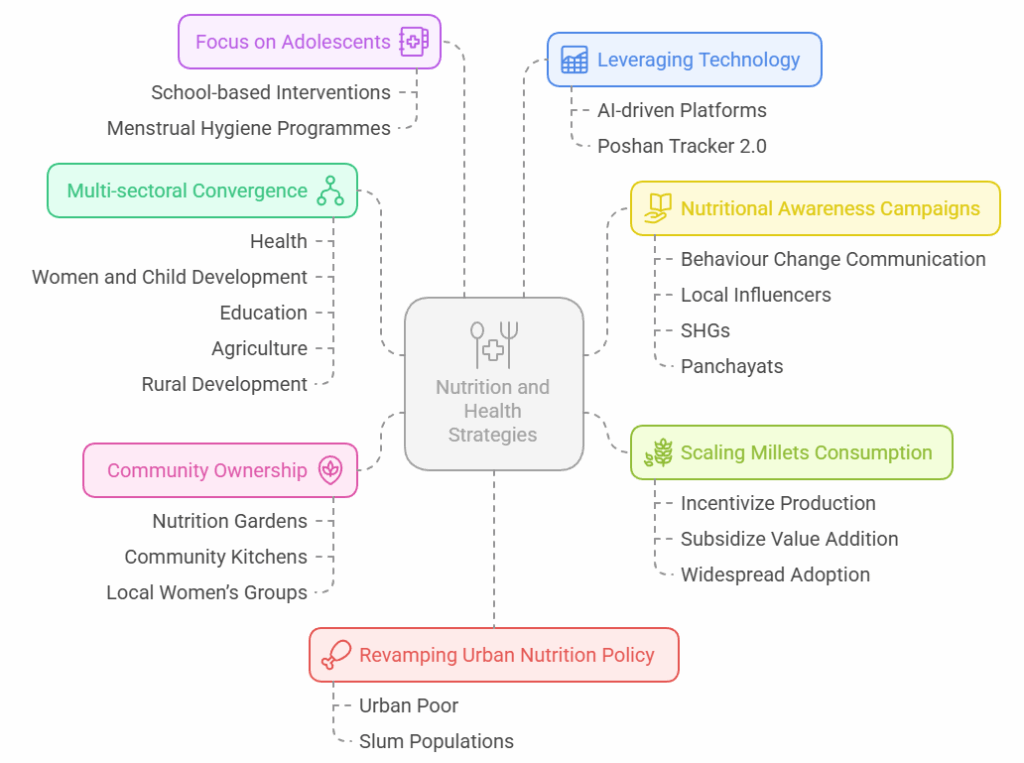
- Multi-sectoral Convergence: Strengthen coordination between Health, Women and Child Development, Education, Agriculture, and Rural Development departments.
- Focus on Adolescents: Address adolescent nutrition with school-based interventions and menstrual hygiene programmes.
- Nutritional Awareness Campaigns: Expand the reach of Behaviour Change Communication (BCC), involving local influencers, SHGs, and Panchayats.
- Leveraging Technology: Use AI-driven platforms and Poshan Tracker 2.0 for real-time data and predictive analytics.
- Revamping Urban Nutrition Policy: With growing urbanization, policies must target urban poor and slum populations.
- Scaling Millets Consumption: Incentivize millet production, subsidize value addition, and ensure widespread adoption in PDS and ICDS.
- Community Ownership: Promote nutrition gardens, community kitchens, and local women’s groups for sustainable nutrition.
Conclusion
India’s nutrition revolution is critical not just for human development but for achieving its broader Sustainable Development Goals (SDGs). With a sustained focus on child, maternal, and adolescent nutrition, leveraging technology, and strengthening grassroots delivery systems, India can turn the tide against malnutrition. A well-nourished India will translate into a healthier, more productive, and globally competitive nation in the coming decades.
|