
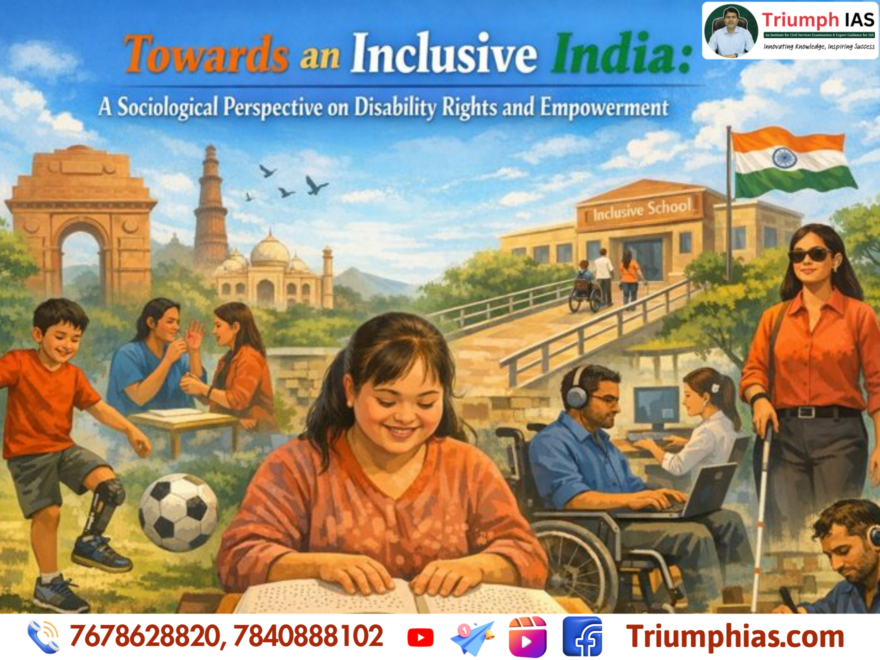
Towards an Inclusive India: A Sociological Perspective on Disability Rights and Empowerment
(Relevant for Sociology Paper 1: Stratification and Mobility and Sociology Paper 2: Population Dynamics)
Towards an Inclusive IndiaCreating an inclusive society is not merely aspirational—it is a moral, social, and developmental imperative. India has made significant strides toward this vision through landmark legislation, government schemes, and initiatives that highlight the contributions of persons with disabilities (PwDs). Yet, despite these efforts, PwDs continue to face structural barriers that limit their full integration into social, educational, and economic life. From a sociological perspective, disability is not just a medical or biological condition; it is deeply socially constructed. Social norms, institutional barriers, and structural inequalities often define the lived experiences of PwDs, shaping how society enables or disables them. According to Census 2011, India has 2.68 crore PwDs, accounting for 2.21% of the population. Ensuring their full participation is both a legal obligation and a societal responsibility. Disability Through a Sociological LensSociology provides powerful tools to understand the challenges faced by PwDs. The social model of disability, developed by thinkers like Michael Oliver, reframes disability not as an individual deficit but as a product of societal barriers. Physical inaccessibility, discriminatory practices, and attitudinal biases are what truly “disable” individuals. Erving Goffman’s theory of stigma also provides insight into how social perceptions affect identity. PwDs often experience stigma that marginalizes them, limiting their social roles and reinforcing exclusion. Goffman’s framework highlights the symbolic and relational dimensions of disability: society’s labels and stereotypes can become internalized, shaping self-perception and social participation. Pierre Bourdieu’s concepts of social and cultural capital further illuminate structural inequalities. Access to education, vocational training, and professional networks allows individuals to accumulate capital that facilitates upward mobility. PwDs often face systemic exclusion from these opportunities, reinforcing cycles of disadvantage. Policies aimed at education, skill development, and employment can be seen as interventions to enhance the social and cultural capital of PwDs. From a normative perspective, John Rawls’ theory of justice emphasizes the moral obligation to prioritize the least advantaged. Ensuring inclusion and equal opportunities for PwDs is not charity—it is an ethical imperative grounded in fairness and social justice. Amartya Sen’s Capability Approach adds another layer, arguing that justice is measured not by formal rights alone but by individuals’ actual freedom to achieve functionings they value. Without accessible infrastructure, education, and employment, PwDs are deprived of the substantive freedoms necessary for meaningful participation. Legal and Policy Framework in IndiaIndia has made significant legislative efforts to protect and empower PwDs:
These laws embody the principle of substantive equality, advocated by thinkers like Nancy Fraser, which emphasizes removing structural barriers and providing resources for genuine inclusion rather than merely granting formal rights. Government InitiativesIndia has operationalized its laws through several initiatives:
Structural and Social ChallengesDespite these efforts, PwDs continue to face significant social and structural barriers:
Through a sociological lens, Goffman’s stigma theory explains how societal labeling marginalizes PwDs. Meanwhile, Sen’s capability approach emphasizes that legal rights are insufficient without the practical freedom to participate fully in social, economic, and civic life. Advancing Inclusion: Sociological ImperativesTo create a genuinely inclusive society, India must focus on reforms that address both structural and attitudinal barriers:
Sociological Perspective: Inclusion is not charity. Rawlsian justice demands that opportunities be equitable, and Fraser’s social justice framework insists on structural reform to remove barriers. The integration of PwDs strengthens social cohesion, equity, and democratic legitimacy. Keywords and Sociological ConceptsSocio-Economic Development:
Morality ,Dignity and service:
Social Justice and Rights:
ConclusionIndia’s disability rights framework, anchored by the RPwD Act 2016, Accessible India Campaign, and allied initiatives, represents substantial progress. However, sociological insights show that legal mandates alone are insufficient. Structural barriers, social stigma, and economic exclusion persist, restricting the freedoms and capabilities of PwDs. For a truly inclusive and just society, India must combine enforcement of laws, economic empowerment, technological innovation, and attitudinal change. From a sociological perspective, inclusion is not charity—it is a cornerstone of social justice, equity, and human dignity, ensuring that all citizens can participate fully in the social, economic, and political life of the nation. |
To Read more topics, visit: www.triumphias.com/blogs
Read more Blogs:
The Right to Disconnect: A Sociological Lens on Work-Life Balance in India
One comment