
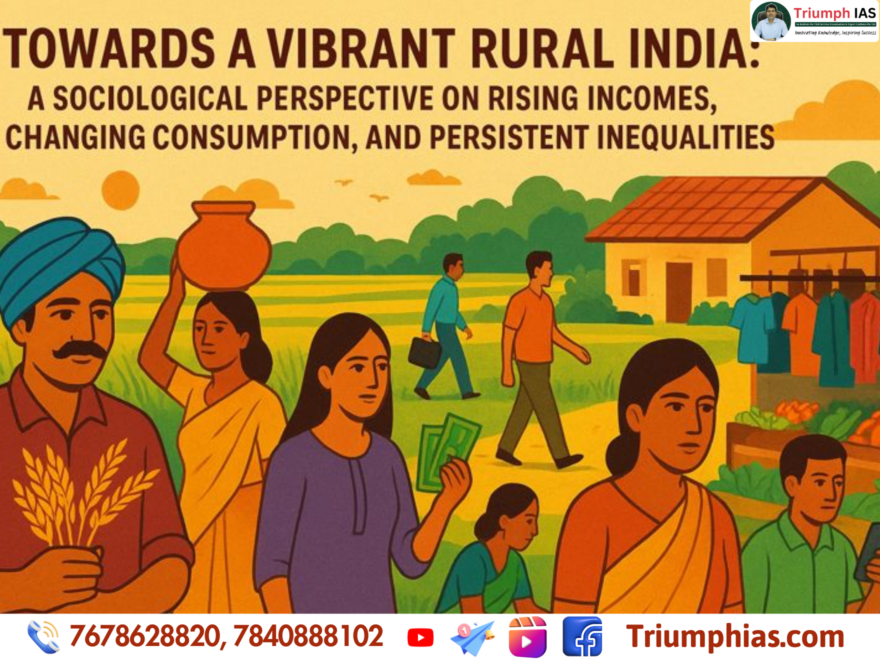
Towards a Vibrant Rural India: A Sociological Perspective on Rising Incomes, Changing Consumption, and Persistent Inequalities
(Relevant for Sociology Paper 1: Stratification and Mobility and Sociology Paper 2: Social Movements in Modern India)
|
Recent data from the Household Consumption Expenditure Survey (HCES 2022–23) suggests a quiet but significant transformation unfolding across rural India. For the first time, the share of food expenditure in rural households has fallen below 50%, indicating rising incomes and shifting consumption priorities. Spending is expanding in areas such as conveyance, medical services, and consumer goods—a sign that rural India is moving beyond subsistence. Yet, amid these promising indicators, the rural landscape continues to be marked by deep structural challenges—agrarian distress, weak infrastructure, healthcare inequities, and persistent gender-based disparities. Understanding this dual reality requires a sociological lens that captures both the economic and social dynamics shaping India’s villages. As Gandhiji famously said, “The soul of India lives in its villages.” The vibrancy of rural India is not merely an economic concern but a sociological and civilizational imperative. Rural Development in India: Constitutional and Institutional FoundationsThe Indian Constitution envisions empowered village communities.
In theory, this decentralization aligns with Alexis de Tocqueville’s ideas on local self-government as the foundation of democracy. However, in practice, Panchayati Raj Institutions often struggle due to lack of funds, functions, and functionaries. The Drivers of Rural India’s Recent Growth
The fall of food expenditure share to 46% indicates rising real income. Increasing spending on mobility (7.55%) suggests greater job opportunities, vehicle ownership, and social mobility. Sociological Perspective: Engel’s Law & Aspirational Mobility Engel’s Law states that as income rises, the proportion of income spent on food falls. This shift reflects aspirational mobility, a phenomenon rural sociologists describe as the transition from needs-based to lifestyle-based consumption.
Schemes such as the Soil Health Card, PM-KSY, and seed modernization have improved crop productivity. Modern irrigation, high-yield crops, and precision farming are transforming agriculture from a traditional livelihood to a technology-driven enterprise. Everett Rogers’ Diffusion of Innovations Rogers explains how new ideas and technologies spread unevenly across communities. Rural India’s adoption of advanced inputs shows increasing integration into global agricultural trends, though diffusion remains uneven across regions.
Projects like PMGSY (rural roads), DAY-NRLM, and digital connectivity initiatives have strengthened rural logistics, market access, and mobility. Durkheim’s Organic Solidarity Improved connectivity leads to interdependence between rural and urban areas, moving society from traditional, isolated solidarity to organic solidarity, where diverse communities rely on each other economically.
Programs like SVEP, Mudra loans, and livelihood missions have created a culture of entrepreneurship across villages. Schumpeter’s Theory of Innovation Entrepreneurs act as “change agents.” Rural entrepreneurship creates local employment, disrupts traditional caste-based occupations, and reduces migration pressures.
The Jan Dhan Yojana, Aadhaar-enabled systems, and digital payment infrastructure have transformed access to banking. Amartya Sen’s Capability Approach Financial inclusion expands people’s capabilities—enabling choice, security, and empowerment. Digital systems also reduce dependency on intermediaries.
With BharatNet, Common Service Centres, and app-based welfare delivery, rural India is entering the digital governance era. Anthony Giddens’ Structuration Theory Digital tools reshape both structure (governance systems) and agency (citizen empowerment), leading to a reconfiguration of rural-state relations.
Government schemes and GI tags help protect indigenous arts. Arun Appadurai’s “Cultural Economy” Rural artisanship shows how local traditions produce global value, preserving identity while fostering livelihood security. Persistent Challenges: The Unfinished Agenda of Rural DevelopmentDespite progress, structural issues remain deeply entrenched.
More than half of Indian farming households are indebted, with inadequate irrigation, price volatility, and climate vulnerability. Daniel Thorner’s Agrarian Structure Analysis India’s agrarian crisis stems from semi-feudal land relations, unequal bargaining power, and the limited reach of modernization.
The failure to devolve adequate funds and authority undermines local governance. Panchayats often become implementers, not decision-makers. Robert Chambers’ Development Bias Top-down governance leads to “urban bias,” sidelining rural priorities in planning.
Despite PMGSY, many roads are poor. Electricity and water supply remain unreliable in several districts.
Rural areas house 65% of the population but only ~30% of India’s hospitals. NFHS-5 shows low sanitation access and poor health indicators. Thomas McKeown’s Thesis Public health improves more through sanitation and primary care than hospitals—highlighting the need for preventive, community-based care.
ASER 2022 shows that only 38.5% of rural class V students can read at Grade II level. Pierre Bourdieu’s Cultural Reproduction Theory Schooling often reproduces inequalities unless pedagogy, teacher support, and local context are strengthened.
Women seldom own land despite performing the bulk of agricultural work. Feminization of Agriculture (Bina Agarwal) As men migrate, women shoulder farming responsibilities but without rights, recognition, or resources. A Way Forward: Strategies for Sustainable and Inclusive Rural Growth
Conclusion: The Sociology of Rural TransformationRural India today stands at a crossroads. Rising incomes, better connectivity, entrepreneurship, and digital inclusion are reshaping the countryside. Yet, structural inequalities—agrarian distress, gender gaps, educational deficits—continue to restrict the full realization of rural potential. From a sociological perspective, India’s villages are moving from traditional solidarity to modern interdependence, from subsistence to aspirations, and from isolation to digital integration. But the journey toward a truly vibrant rural India requires not only economic investment but also structural reforms, social empowerment, and inclusive governance. Only then can India fulfil the constitutional promise that strengthening Bharat is the foundation of strengthening India. |
To Read more topics, visit: www.triumphias.com/blogs
Read more Blogs:
The Right to Disconnect: A Sociological Lens on Work-Life Balance in India
One comment