Introduction
In the tech-saturated chaos of Bengaluru, a quiet movement is unfolding—people are opening up their homes not for profit, but for peace. A nap without noise. A jam session with strangers. A painting corner shared in silence. Across Bengaluru’s bustling neighbourhoods, some residents are transforming their homes into sanctuaries for others—offering rest, creativity, and connection, free from judgement or obligation.
Welcome to the rise of third spaces in India’s Silicon Valley—a grassroots answer to urban stress and social isolation.
What Are These “Third Spaces”?
Traditionally, “third spaces” refer to places that aren’t home (first space) or work (second space). Think libraries, parks, or cafés. But in today’s over-commercialised and overstimulated world, even cafés come with cover charges, loud music, and an invisible pressure to “perform social wellness.”
That’s why a few empathetic Bengaluru residents are taking it further—they’re inviting strangers into their homes as third spaces. These are places where no one expects you to order a drink, smile for selfies, or network. Instead, you can just exist.
Sociological analysis
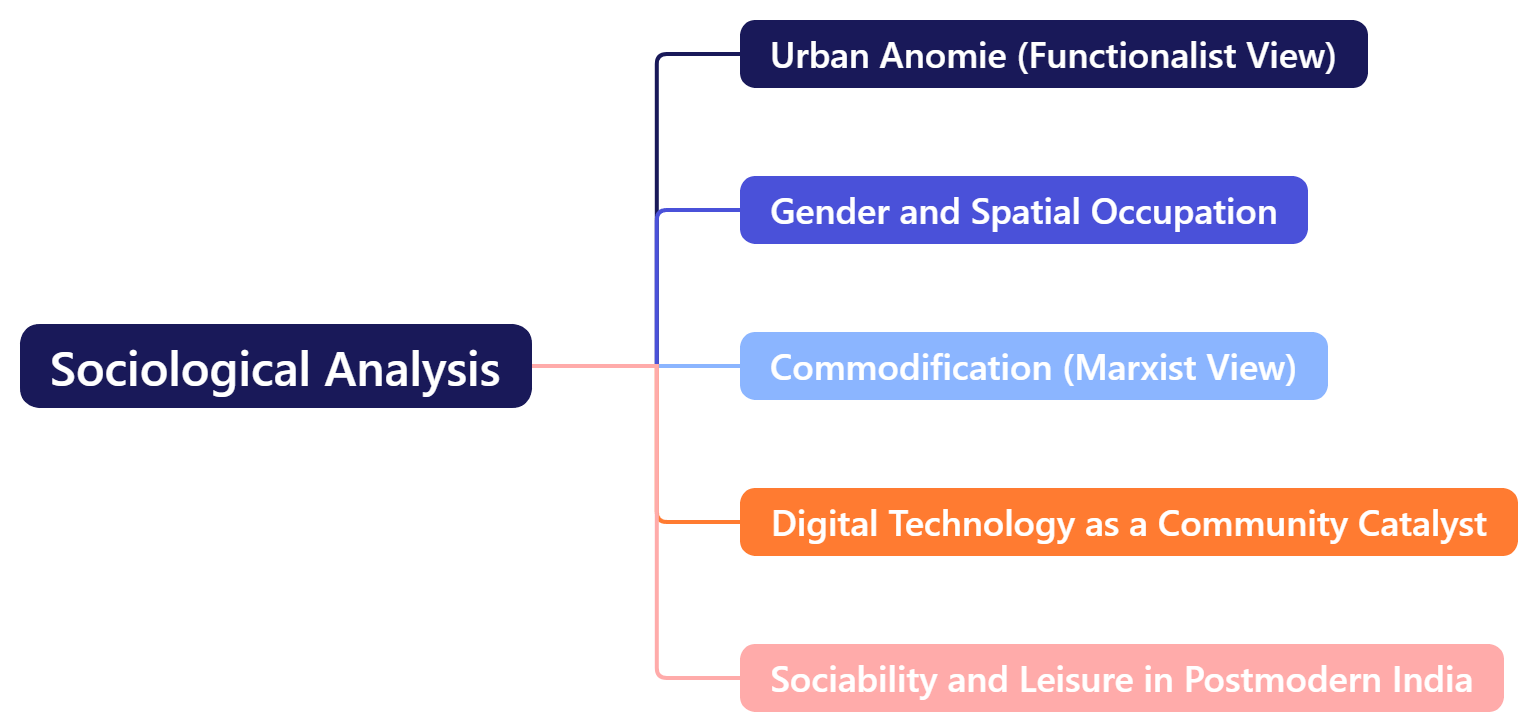
- Urban Anomie (Functionalist view): Urban living often leads to social isolation and disintegration of traditional bonds. In megacities like Bengaluru—marked by high migration, intense work culture, and cramped housing—people feel disconnected. These third spaces act as an antidote to urban anomie, fostering community and emotional wellbeing.
- Gender and Spatial Occupation: women and queer individuals are often restricted from freely occupying public spaces without judgment. These home-based third spaces provide a gender-sensitive environment, allowing marginalised identities to “just be” without performativity.
- Commodification (Marxist view): Cafés and bars demand constant consumption and performance, often becoming unaffordable and exclusive. These informal third spaces decommodify leisure and create alternative economies of care and connection.
- Digital Technology as a Community Catalyst: These third spaces leverage platforms like Instagram and Reddit to build micro-communities. It exemplifies “networked individualism”—where digital connections enable physical community-building, bypassing traditional institutions.
- Sociability and Leisure in Postmodern India: In a fluid, postmodern urban world, relationships are fleeting, identities are multiple, and people long for intimacy without pressure. These third spaces offer low-commitment sociability, reflecting new leisure trends in urban India.
Urban Loneliness Meets Human Hospitality
Meghna Chaudhary, a mental health professional-in-training who lives in Indiranagar. She opens her house for two visitors a day—between 12 to 4 PM—for nothing more than quiet comfort. There’s no fee, no schedule, no small talk unless you want to. Visitors can nap, write, paint, or simply sit in silence with Millie, her deaf rescue dog. Her Instagram bio says it all: “Come rest. This is a house where you don’t have to explain why you’re tired.” Apeksha, a 41-year-old mother, found her way here after a long workday and napped for two hours without interruption—a rare luxury in her busy domestic life. “I just needed a space where I didn’t have to be accountable,” she said.
From Comfort to Community
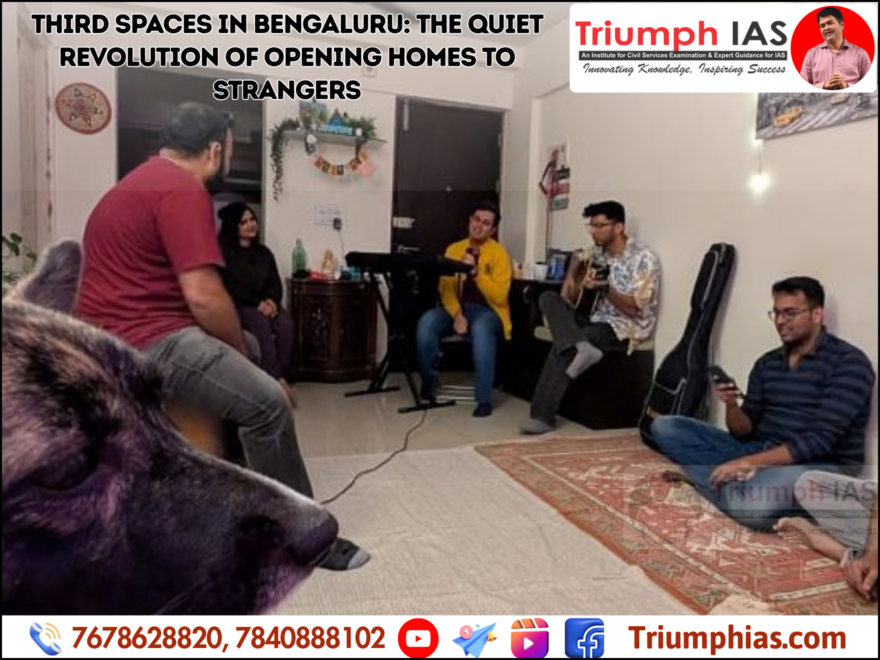
Not all third spaces are about solitude. Some, like Circles, started by 31-year-old Ammu, are rooted in community and creativity. What began as a tweet evolved into a 90-member collective where strangers meet in homes across the city to jam, sing, dance, and share stories. Their first jam night—hosted by Sneha, an entrepreneur—had strangers strumming Lucky Ali classics on a ukulele in her living room. “We don’t fit into the bar crowd,” Sneha explains. “We just want music and people without the pressure.”
Why This Movement Matters
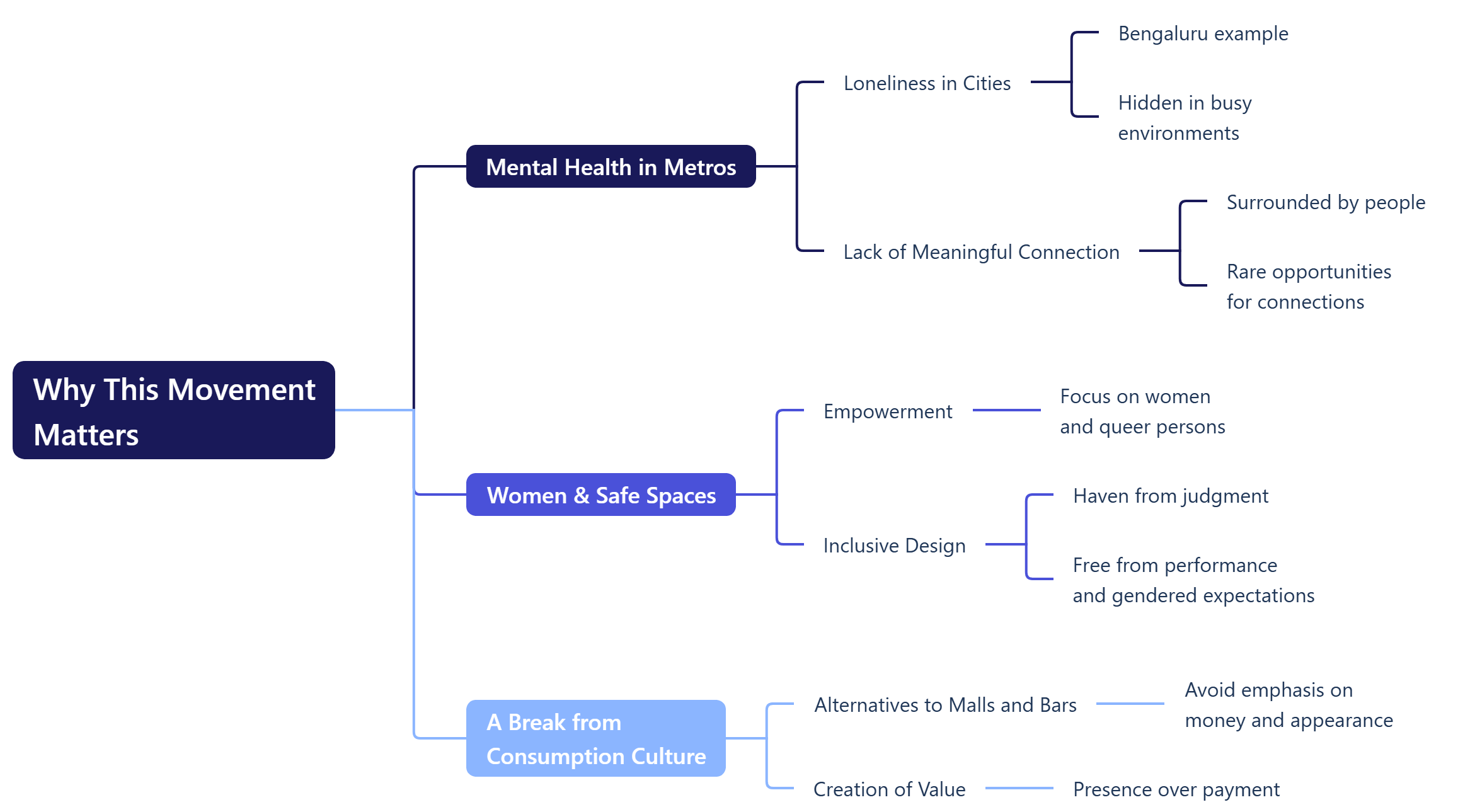
- Mental Health in Metros: In cities like Bengaluru, loneliness often hides behind buzzing co-working spaces and jam-packed commute hours. Despite being surrounded by people, meaningful connection is rare.
- Women & Safe Spaces: These third spaces especially empower women and queer persons. Meghna’s space, for instance, is consciously inclusive—designed to be a haven from judgment, performance, and gendered expectations.
- A Break from Consumption Culture: While malls and bars demand money and appearance, third spaces offer an alternative—a setting where value is created through presence, not payment.
Challenges and the Road Ahead
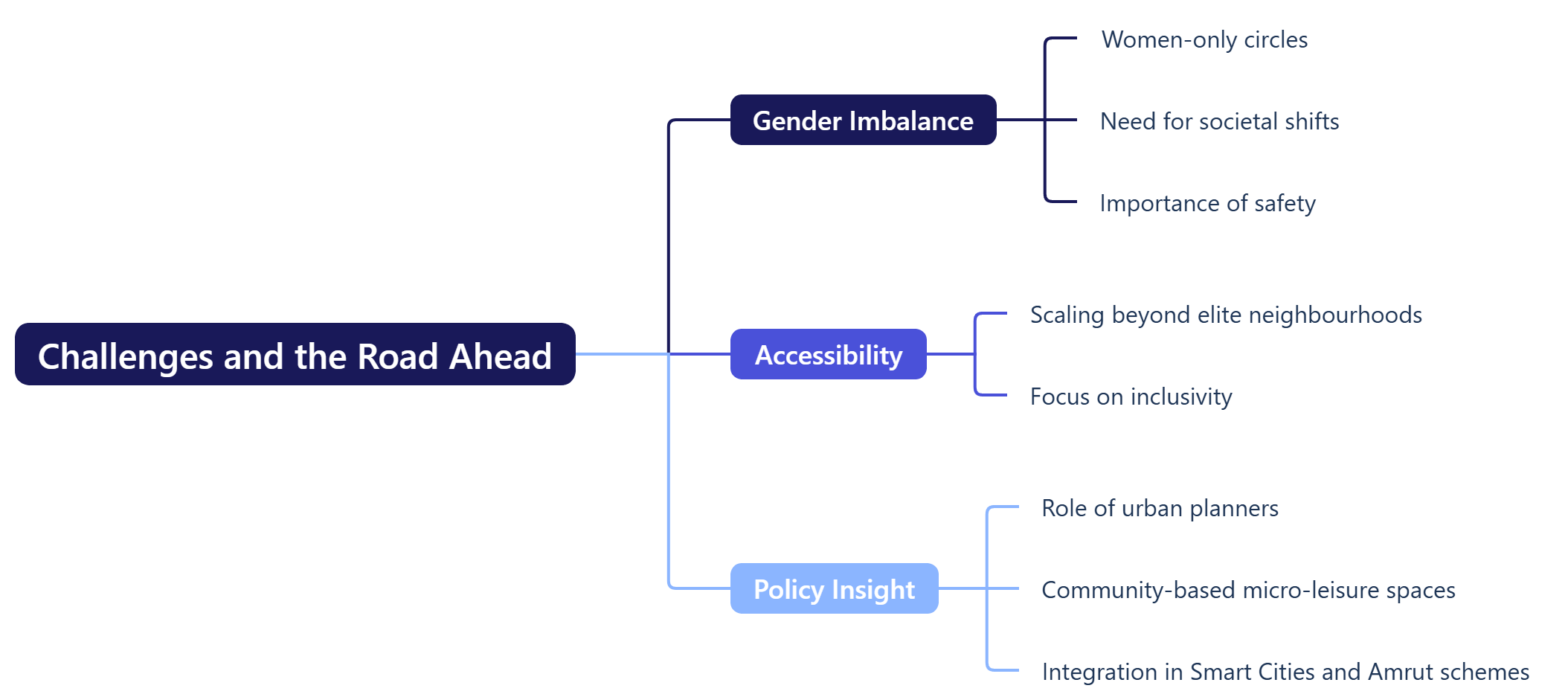
- Gender imbalance: Women-only circles are a positive step, but broader societal shifts in perception and safety are essential.
- Accessibility: Such models must be scaled beyond elite neighbourhoods like HSR or Indiranagar.
- Policy Insight: Urban planners could integrate the idea of community-based micro-leisure spaces in Smart Cities or Amrut schemes.
Conclusion
In a city known for tech parks, traffic, and a transient population, it’s easy to feel lost. But these third spaces are a gentle reminder: sometimes, healing doesn’t need a therapist’s couch or a café corner. Just a quiet room, a warm hug from a stranger, or a jam session in someone’s living room can bring us back to ourselves. Perhaps the most radical thing in an always-online world is simply opening your door and saying, “Come in. You don’t have to be anyone here.”
PYQs
Paper 1 –
- How is the increasing use of cyberspace redefining social relationships in modern society? (2023)
- What is the significance of ‘third place’ in understanding modern urban social life? (2022)
- Discuss the nature of social control in urban societies. How do informal means of control operate in such settings? (2021)
- Examine the impact of globalization on identity formation among urban youth. (2020)
- How does the growth of urban centres influence the patterns of social interaction and social mobility? (2019)
- How does urbanization lead to social disorganization? Illustrate with sociological perspectives. (2017)
- Examine the sociological dimensions of loneliness and alienation in modern society. (2016)
- Discuss the concept of Gemeinschaft and Gesellschaft. How is it relevant in today’s urban-rural transition? (2015)
- Analyze the relationship between space, social groups, and community in urban sociology. (2014)
Paper 2 –
- How has urbanization affected traditional social institutions and values in Indian society? (2023)
- Examine the rise of individualism and its implications for community living in Indian cities. (2021)
- Discuss the challenges of creating inclusive urban spaces in Indian cities, especially for marginalized groups. (2019)
- Explain the role of voluntary associations and civil society in strengthening social cohesion in urban India. (2018)
- How does the growth of urban enclaves (gated communities, clubs, safe spaces) reflect new patterns of social exclusion and inclusion? (2016)
- What are the implications of urban anonymity and privatization of public spaces for community development in India? (2015)
- Discuss the sociological relevance of new spaces of interaction like art collectives, cafes, and online platforms in urban India. (2014)
|


One comment