
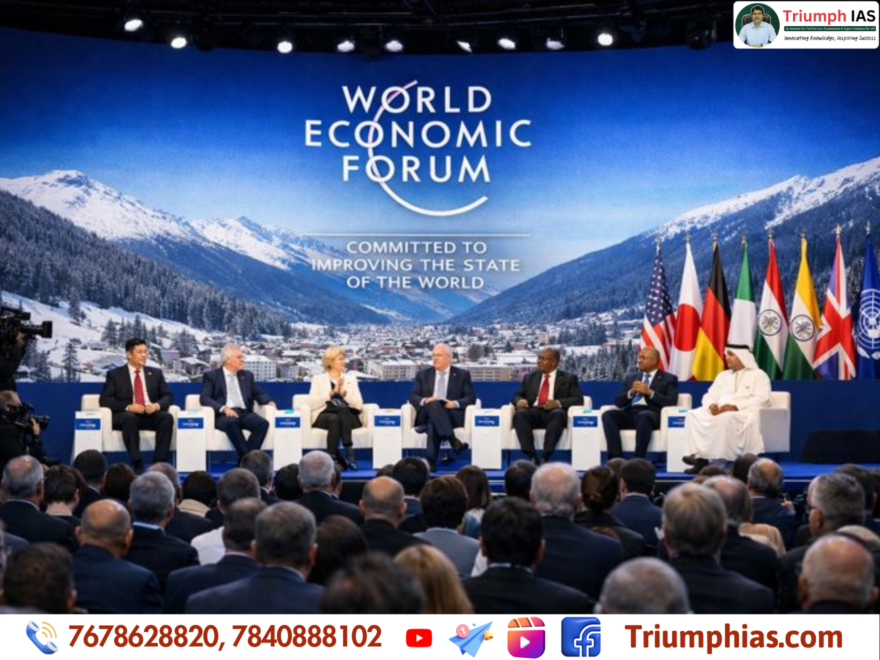
Global Diplomacy Takes Center Stage: The World Economic Forum at Davos
(Relevant for Sociology Paper 2)
|
The annual meeting of the World Economic Forum (WEF) at Davos has long served as a barometer of global political and economic priorities. In 2026, however, the forum assumed an even greater significance. Amid continuing wars, fractured multilateral institutions, economic uncertainty, and deep geopolitical polarization, Davos emerged not merely as a space for economic dialogue but as a stage where new ideas of global governance and peacebuilding were openly debated. The 56th World Economic Forum, held from 19 to 23 January 2026 in Davos, Switzerland, brought together heads of state, senior policymakers, corporate leaders, diplomats, and civil society representatives. While discussions covered climate finance, artificial intelligence, global growth, and supply chain resilience, global attention gravitated towards one controversial diplomatic proposal — former U.S. President Donald Trump’s launch of a “Board of Peace”, and the subsequent pledge of support by Russian President Vladimir Putin. Together, these developments highlighted the changing nature of global diplomacy, where traditional institutions face growing challenges and alternative platforms seek to redefine conflict resolution and international cooperation. Davos and the Changing Nature of Global DiplomacyThe World Economic Forum was originally conceived as a platform for dialogue between business and government. Over time, it evolved into a broader arena where global political narratives are shaped. Davos does not produce treaties or binding resolutions, yet its significance lies in agenda-setting and informal diplomacy. In recent years, Davos has increasingly reflected a world marked by:
The 2026 meeting reflected these realities. Leaders repeatedly emphasized the need for dialogue, yet beneath this rhetoric lay deep disagreements over how peace should be achieved, who should lead global governance, and which institutions remain relevant. It was in this context that Trump’s announcement of the Board of Peace gained global attention. The “Board of Peace”: Concept and VisionThe Board of Peace, unveiled by Donald Trump at Davos, was presented as a new international mechanism designed to resolve conflicts, enforce ceasefires, and oversee post-conflict reconstruction. Trump framed the initiative as a response to what he described as the “inefficiency and politicization” of existing international bodies. According to its stated vision, the Board of Peace aims to:
The initial focus of the board was projected to be on conflict-affected regions, particularly the ongoing humanitarian crisis in Gaza. Trump argued that long-standing institutions had failed to deliver lasting peace and that a new structure, led by decisive leadership and backed by significant funding, was necessary. This proposal immediately triggered debate over whether the Board of Peace represents innovation in diplomacy or a challenge to established international norms. Challenging the United Nations and Multilateral NormsOne of the most contentious aspects of the Board of Peace is its implicit positioning as an alternative to the United Nations. Although Trump insisted that the board would complement existing institutions, many diplomats and analysts perceived it as a rival structure. The United Nations is founded on principles of:
In contrast, the Board of Peace appears to rely on:
This raises fundamental questions:
Critics argue that this model risks privatizing peace, turning conflict resolution into an elite-driven process rather than a collective global responsibility. Non-Traditional Diplomacy and Personalized PowerDespite criticism, the Board of Peace reflects a broader trend in contemporary global diplomacy: the rise of non-traditional and personality-driven diplomatic initiatives. In recent decades, global politics has seen:
Trump’s initiative fits this pattern. His diplomatic style emphasizes direct negotiation, transactional agreements, and strong personal leadership. The Board of Peace, in many ways, institutionalizes this approach. Supporters argue that such methods can break diplomatic deadlocks, especially when traditional processes are stalled by vetoes and bureaucratic delays. Critics counter that this undermines transparency, accountability, and international law. Russia’s Pledge: Strategic Support with Global ImplicationsThe announcement that Russia may contribute $1 billion to the Board of Peace added a new layer of geopolitical complexity. The funds were reportedly linked to previously frozen assets and were intended to support humanitarian and reconstruction efforts, particularly in Gaza. Russia’s interest in the Board of Peace can be understood through several strategic lenses. Reasserting Global RelevanceRussia has faced diplomatic isolation following its conflict with Ukraine. Supporting a high-profile peace initiative allows Moscow to project itself as a constructive global actor, countering narratives of isolation. Middle East InfluenceRussia has long sought influence in the Middle East. Participation in peacebuilding efforts related to Gaza enables Moscow to strengthen ties with regional actors and position itself as a stakeholder in future regional settlements. Challenging Western DominanceBy backing a non-UN peace mechanism, Russia implicitly challenges Western-led multilateral institutions. This aligns with its broader objective of promoting a multipolar world order. Financial and Legal SignificanceThe potential use of frozen assets raises important questions about sanctions, international finance, and sovereignty. If such funds are redirected through new mechanisms, it could set precedents affecting global sanctions regimes. Global Reactions: Division and DebateInternational responses to the Board of Peace were mixed and often polarized. Western AlliesMany Western countries expressed skepticism. Concerns were raised about:
Several governments refrained from committing to the initiative, signaling caution rather than outright rejection. Non-Western and Global South StatesSome countries from Asia, Africa, and the Middle East expressed interest in the board’s approach, particularly its emphasis on reconstruction financing and rapid intervention. For states frustrated with slow international responses, the promise of decisive action was appealing. The United NationsUN officials responded cautiously, reiterating that any peace initiative must align with international law and existing resolutions. While not dismissing engagement outright, the UN emphasized its central role in global peace and security. Implications for Global GovernanceThe Board of Peace debate highlights deeper transformations underway in international relations. Crisis of MultilateralismMultilateral institutions face criticism for inefficiency, politicization, and deadlock. Alternative frameworks emerge partly as a response to this dissatisfaction. Fragmented Global OrderRather than a single global system, the world increasingly operates through overlapping institutions, coalitions, and informal groupings. Power and ResourcesFinancial capacity is becoming a key determinant of influence in global governance, raising concerns about equity and representation. Peace as a Development IssueBy linking peacebuilding with reconstruction funding, the Board of Peace reflects a growing recognition that security and development are inseparable. Long-Term Risks and OpportunitiesWhile the Board of Peace could potentially mobilize resources and attention for neglected crises, it also carries risks:
At the same time, its emergence forces global institutions to reflect on their own limitations and adapt to new realities. Conclusion: A Symbol of a Changing World OrderThe events at the World Economic Forum 2026 underscored a fundamental truth: global diplomacy is in transition. Trump’s Board of Peace and Russia’s pledge of support are not merely isolated announcements; they are symptoms of a broader shift towards:
Whether the Board of Peace becomes a lasting institution or fades as a symbolic gesture remains uncertain. However, its emergence at Davos has already reshaped debates on peace, power, and global governance. For students of international relations, sociology, and political science, Davos 2026 will be remembered as a moment when the future of diplomacy itself was openly contested. |
To Read more topics, visit: www.triumphias.com/blogs
Read more Blogs:
Economy and Inflation: Navigating Uncertainty in a Changing Global Order
5 comments