

The Waqf Amendment Act 2025: A Sociological Exploration of Religion, Law, and State Power in India
(Relevant for Sociology Paper 2: Politics and Society)
Introduction: The Waqf Amendment Act 2025The recent Supreme Court stay on key provisions of the Waqf (Amendment) Act, 2025 has reignited debates around the intersection of religion, law, state power, and community autonomy in India. Waqf properties — endowments made for religious or charitable Muslim purposes — represent not just assets but the living history and socio-religious identity of a community. The government’s reform attempt, while aimed at transparency and efficiency, has sparked concerns about excessive administrative interference, minority rights, and religious freedom under the Constitution. Overview of the Waqf Act and AmendmentsThe Waqf Act, 1995 governs the administration and protection of Waqf properties, setting up State and Central Waqf Boards to oversee these endowments. The 2025 Amendment — dubbed UMEED (Unified Waqf Management, Empowerment, Efficiency, and Development) Act — introduces reforms like mandatory audits, lowering financial contributions, and curbing misuse. However, some provisions — such as granting District Collectors power to declare waqf properties government-owned during inquiries, requiring five years of practicing Islam to create a waqf, and increasing non-Muslim representation on Waqf Boards — have been stayed by the Supreme Court for violating constitutional rights and community autonomy. Sociological Dimensions of the Waqf Amendment Debate
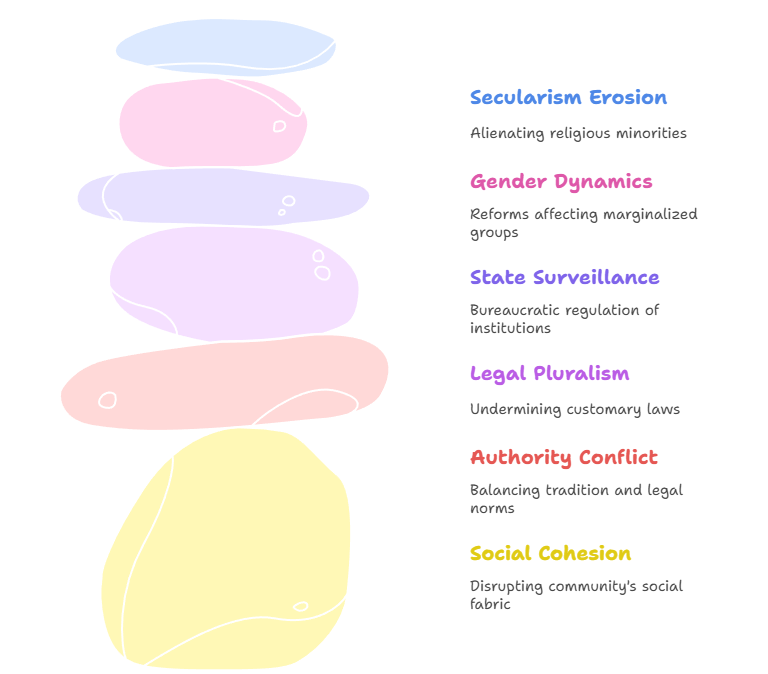
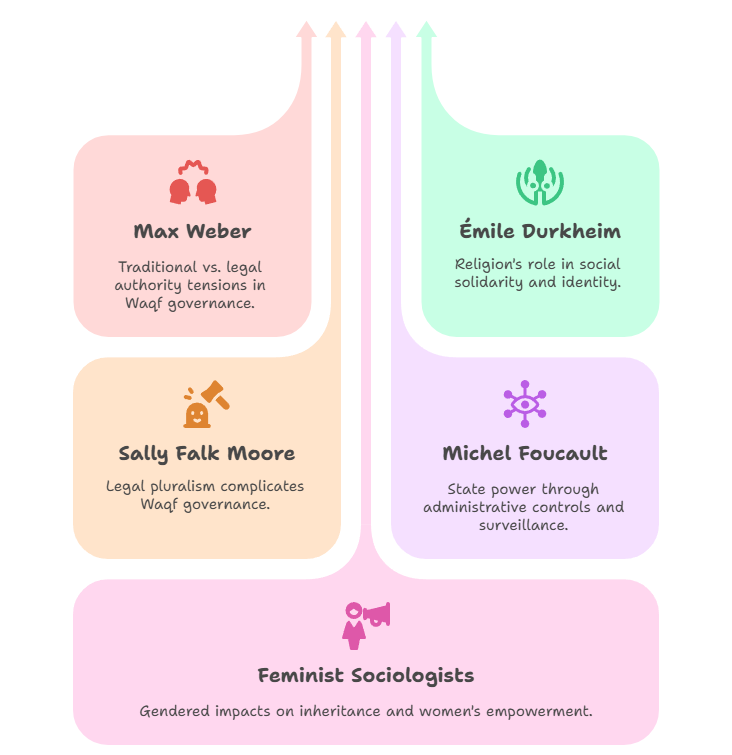
Émile Durkheim emphasized religion’s role in creating social cohesion and collective consciousness. For Indian Muslims, Waqf properties symbolize more than material wealth — they represent sacred trust and community solidarity. Governmental interference is perceived as a threat to religious autonomy, potentially disrupting the social fabric that binds the community. Religious endowments function as sites where collective identity is reaffirmed, and changes here resonate far beyond the economic.
Max Weber’s typology of authority offers insight into the conflict between inherited religious governance (traditional authority) and the modern state’s bureaucratic control (legal-rational authority). Waqf Boards, historically community-led, face increasing administrative oversight by state actors. The challenge lies in balancing respect for religious traditions while ensuring legal transparency and preventing corruption — a classic Weberian tension.
Sally Falk Moore’s theory of legal pluralism explains how multiple legal orders coexist in society, often overlapping or clashing. India’s plural legal system allows religious communities to govern personal laws, property, and institutions like Waqfs alongside secular state law. The Waqf Amendment highlights these tensions: state laws aiming to regulate religious endowments can inadvertently undermine customary laws, leading to conflicts over sovereignty and legitimacy.
Michel Foucault’s concept of governmentality helps us understand how states exercise power through subtle controls embedded in administrative reforms. The Amendment’s provisions for audits, district-level inquiries, and board composition reflect a shift from direct confrontation to bureaucratic regulation — a form of ‘soft power’ to discipline minority institutions under the guise of reform and accountability.
Feminist sociologists encourage analysis of how reforms affect marginalized groups within minority communities. The Amendment’s explicit protection of women’s inheritance rights in waqf properties challenges patriarchal norms within some religious interpretations, signaling progressive shifts. Yet, debates persist about how reforms may either empower or inadvertently marginalize women, depending on implementation and community acceptance.
India’s secular democracy is marked by the coexistence of multiple religious communities with varying degrees of autonomy. The question of how far the state should intervene in religious institutions is contentious. Critics argue that excessive interference may erode secularism by alienating minorities, while proponents claim reforms are necessary to protect public interest and prevent misuse of charitable assets. Linking to Broader Indian and Global ContextsIndia is not alone in navigating tensions between state power and religious community autonomy. Globally, minority religious endowments and charities often face scrutiny to prevent misuse or terrorism financing, as seen with Islamic waqfs in countries like Egypt and Malaysia. However, heavy-handed regulation risks alienating communities and undermining trust in the state. In India, the colonial legacy continues to shape governance of religious institutions, with the state often acting as a paternalistic overseer. The Waqf Act itself derives from colonial-era interventions, reflecting ongoing struggles over sovereignty and rights. Post-independence, India’s commitment to multiculturalism and religious freedom requires constant negotiation between uniform legal frameworks and respect for diversity. Sociological Thinkers on Religion, Law, and State Power
Several thinkers provide key lenses to unpack this issue:
Conclusion: Balancing Reform and Religious Autonomy in a Plural SocietyThe Waqf (Amendment) Act, 2025 exemplifies the complex interplay between modern state governance, religious community autonomy, and constitutional rights in India. Sociological analysis reveals that reforms are not just legal matters but deeply intertwined with social identity, authority, and power relations. For India to uphold its constitutional promise of secularism and religious freedom while promoting transparency, it must carefully navigate these tensions. This requires meaningful dialogue with communities, respect for plural legal traditions, and awareness of the sociocultural significance of institutions like waqfs. The Supreme Court’s measured intervention reflects this delicate balance, underscoring the need for reforms that empower without alienating, modernize without erasing tradition, and regulate without suppressing diversity. |
To Read more topics, visit: www.triumphias.com/blogs
Read more Blogs:
Between Custom and Codification: The Politics of Tribal Governance