

The Startup Mandala: A Sociological Decoding of India’s New Caste System
(Relevant for Sociology Paper 2: Visions of Social change in India)
The Startup MandalaIndia’s startup ecosystem is often portrayed as a pure meritocracy—a fluid, dynamic space where brilliant ideas triumph. However, a deeper sociological analysis reveals a different truth: it is a powerful new social field, in the Bourdieusian sense, that is actively producing and legitimizing new forms of social stratification, mirroring ancient inequalities in a digital avatar. The issues of funding, talent, and geography are not mere operational challenges; they are the symptoms of a deeper social structure under construction. The Alchemy of Capital: Converting Privilege into “Innovation”
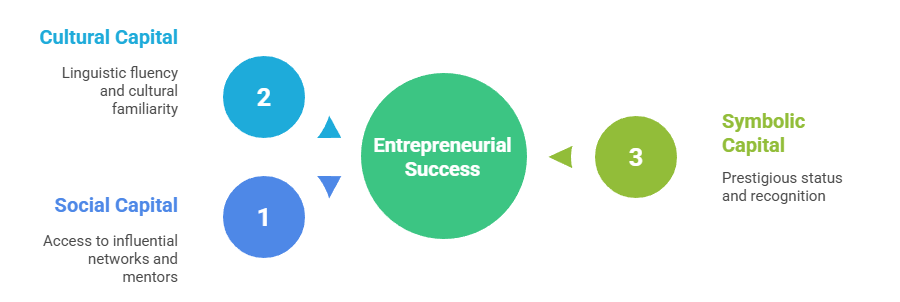
The extreme geographic concentration of funding and unicorns in Bengaluru, Delhi-NCR, and Mumbai is not an economic accident. It is the physical manifestation of the unequal distribution of capital, as theorized by Pierre Bourdieu.
This concentration leads to a “brain drain” from smaller cities, not just of people, but of the very social and cultural capital needed to foster regional entrepreneurship, thereby deepening the core-periphery divide in India’s development. The Deep-Tech Divide: Education as a System of Social ClosureThe critical talent shortage in deep-tech is a classic sociological problem of the mismatch between education and the economy. But it’s more than that; it’s a mechanism of social closure, a concept used by Max Weber to describe how groups monopolize opportunities. The traditional education system, with its focus on rote learning, acts as a gatekeeper. It produces a large mass of general graduates but fails to create the specialized, critical thinkers needed for deep-tech. This creates a new, sharp social hierarchy:
This is not a simple skills gap; it is a structurally engineered scarcity. By restricting the supply of truly high-quality, innovative talent, the system ensures that those who possess it can leverage it for immense economic and social reward, effectively closing the door to others. The Gendered Pitch: Patriarchy in the Venture Capital Ritual
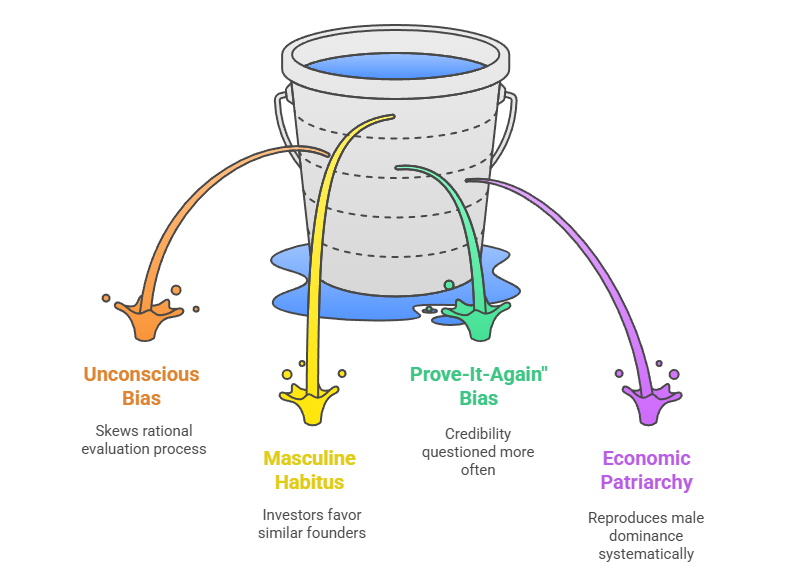
The persistent gender gap in funding—where women-led startups receive a paltry 9.3% of VC money—cannot be explained by a lack of capability. It must be analyzed as a ritual of social reproduction. The VC pitch is not a neutral, rational evaluation. It is a social interaction laden with unconscious bias. Drawing from the work of sociologists like Catherine Turco, the venture capital world operates with a deeply embedded masculine habitus. Investors, predominantly male, often exhibit homophily—a tendency to connect with and trust founders who are like them. A woman founder’s pitch is often subjected to a “prove-it-again” bias, where her credibility is questioned more than her male counterparts. This is a direct transposition of patriarchal norms from the wider society into the supposedly “modern” startup sphere. The funding gap is thus a form of economic patriarchy, where capital flows in a way that systematically reproduces male dominance in the new economy. Anomie and the Funding Winter: The Collapse of a Moral OrderThe “funding winter” can be powerfully understood through Émile Durkheim’s concept of Anomie. The previous era of “growth-at-all-costs” was governed by a clear, if frenzied, moral order: blitzscale, acquire users, and dominate markets. Profitability was secondary. This norm provided a clear goal for entrepreneurs and investors alike. Its sudden collapse has created a state of normlessness or anomie. The old rules are gone, but a new, stable set of norms around sustainable profitability has not yet crystallized. This anomie produces profound strain, confusion, and a surge in deviance (in this case, startup failures and distress sales). Entrepreneurs who internalized the old rules now find their aspirations out of sync with the new economic reality, leading to a crisis of both strategy and identity. The ecosystem is in a transitional, anomic state, searching for a new collective conscience to guide it. The Digital Panopticon: Regulation and the Disciplined EntrepreneurThe complex regulatory landscape, including new laws like the DPDP Act, can be analyzed through Michel Foucault’s theory of power and the panopticon. For a small startup, these regulations function as a form of constant, disciplinary surveillance. The state (and its compliance requirements) is the unseen guard in the tower, compelling the entrepreneur to internalize this gaze and self-discipline their operations. The entrepreneur must now constantly ask: “Is this data practice compliant?” “Are we meeting all reporting requirements?” This “governmentality” shapes the very subjectivity of the entrepreneur, transforming them from a wild, disruptive innovator into a self-policing, compliant subject. The demand for a single-window clearance is, sociologically, a rebellion against this diffuse, burdensome disciplinary mechanism—a plea for a more legible and less intrusive form of governance. Conclusion: The Startup as a Social MirrorThe Indian startup ecosystem, therefore, is far more than an economic project. It is a vibrant, contested social space where new hierarchies are being built, old inequalities are being replicated in code, and the very definition of a “successful” Indian is being rewritten. To understand it, we must look beyond the jargon of valuations and burn rates and see it for what it is: a powerful mandala reflecting the enduring structures of caste, class, and gender, even as it promises a future of radical change. The challenge is not just to build successful companies, but to consciously design a social structure that is more equitable than the one it seeks to disrupt. |
To Read more topics, visit: www.triumphias.com/blogs
Read more Blogs:
Ladakh Turmoil: A Sociological Lens on Statehood, Identity, and Power
Beti Bachao Beti Padhao: A Sociological Decode of India’s Gender Transformation