Introduction
The 21st-century Indian urban household is undergoing a quiet revolution. Enter the DINK couples—Double Income, No Kids—a lifestyle choice gaining popularity among young, urban, and upwardly mobile Indians. Far from just being a Western concept, DINK households represent an evolving sociology of the Indian family, shaped by aspirations, career ambitions, and lifestyle transformations. Understanding this trend offers deep insights into how macro social structures interact with individual choices, transforming traditional institutions like marriage, kinship, and family.
What’s Fueling the DINK Phenomenon in India?
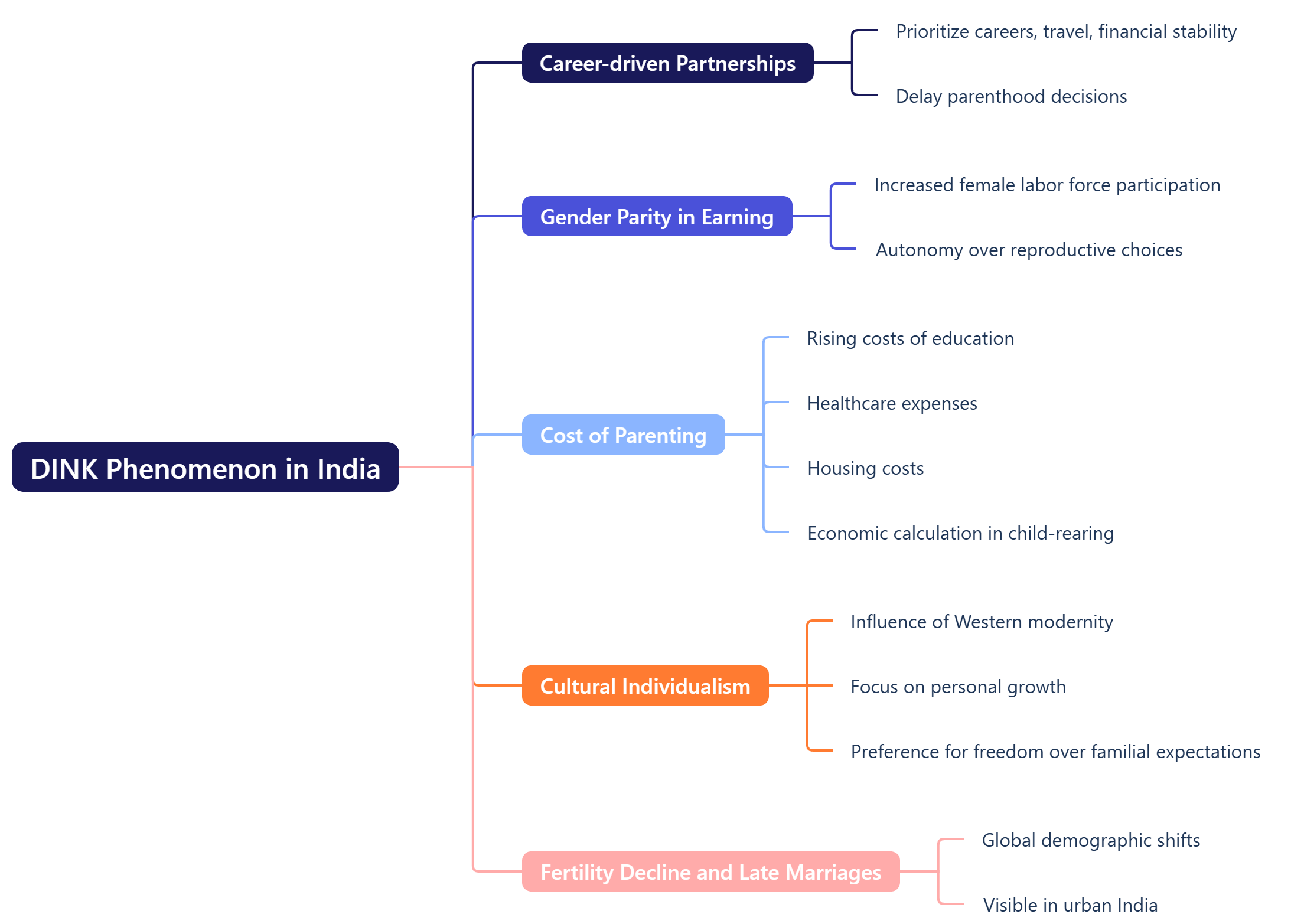
- Career-driven partnerships: Many urban couples prioritize careers, travel, and financial stability over parenthood.
- Gender parity in earning: With increased female labour force participation, women are asserting autonomy over reproductive choices.
- Cost of parenting: Rising costs of education, healthcare, and housing make child-rearing a calculated economic decision.
- Cultural individualism: Influenced by Western modernity, couples now place personal growth and freedom over familial expectations.
- Fertility decline and late marriages: These global demographic shifts are visible in India too—particularly in urban zones.
Sociological Analysis
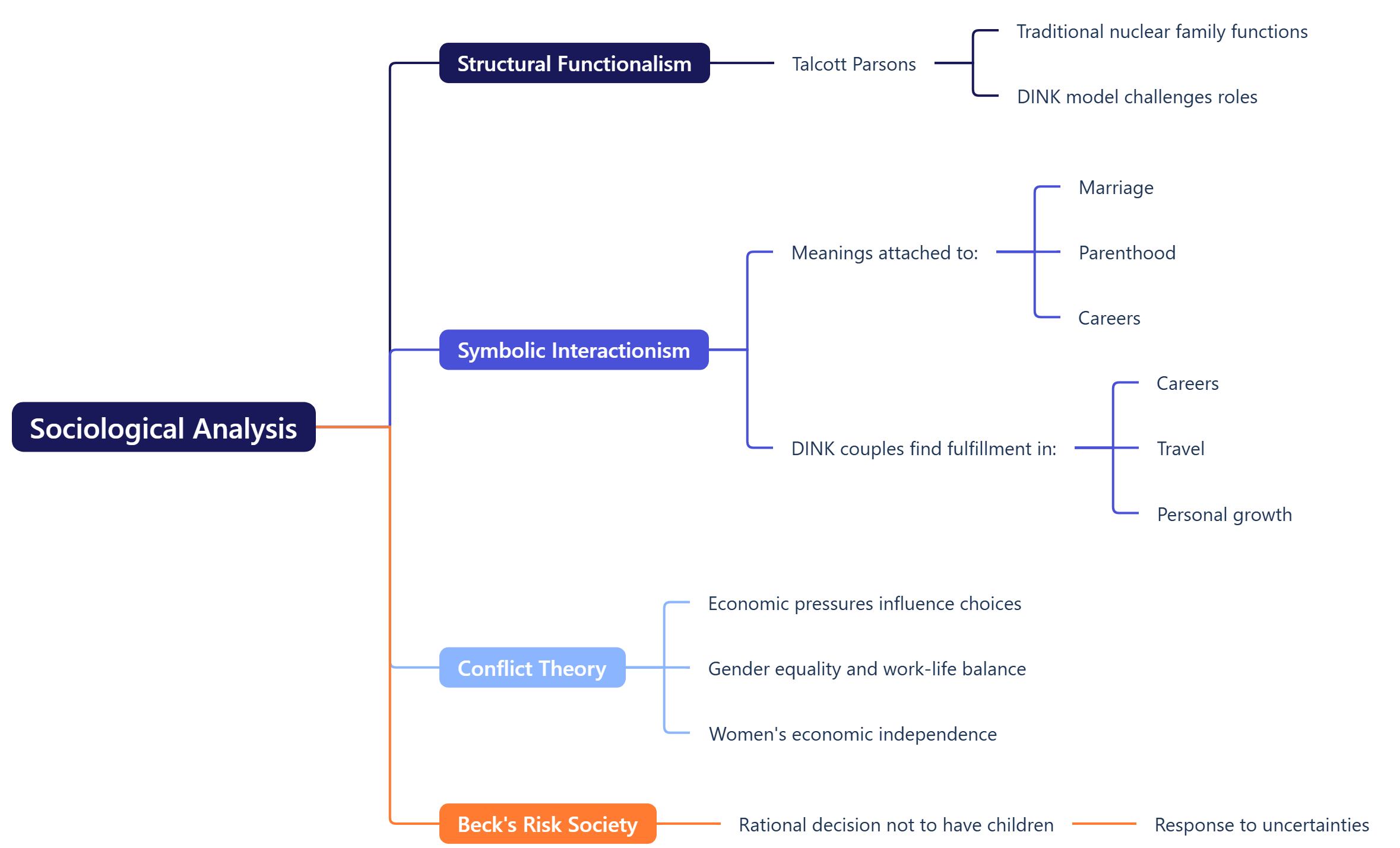
- Structural Functionalism (Talcott Parsons): Argues that the traditional nuclear family served vital functions like reproduction and socialization. The DINK model challenges these roles, indicating a shift in the manifest and latent functions of the family.
- Symbolic Interactionism: Emphasizes the meanings attached to marriage, parenthood, and careers. For DINK couples, fulfillment may come from careers, travel, or personal growth rather than child-rearing.
- Conflict Theory: Highlights how economic pressures, gender equality, and work-life balance fuel the rise of such choices. Women’s economic independence has altered power dynamics in marriage, allowing couples to negotiate non-traditional life choices.
- Beck’s Risk Society: Choosing not to have children can be seen as a rational decision in a world filled with uncertainties—economic, environmental, and personal.
Indian Context
- The rise of DINK households highlights the urban, educated, professional class, especially in IT, corporate, and academic sectors.
- Reflects the rise of individualism, delayed marriage, voluntary childlessness, and nuclear families in urban India.
- Challenges traditional patriarchal expectations around motherhood and family obligations, often facing social stigma, particularly for women.
- Indicates a shift towards materialism and consumerism, where lifestyle choices and aspirational class behavior replace traditional familial roles.
Implications of the DINK Trend

- Demographic impact: Lower fertility rates may help stabilize population growth but also lead to an aging population.
- Cultural anxiety: Traditional family structures are increasingly questioned.
- Economic effects: More disposable income leads to increased consumption, investment in travel, real estate, and luxury services.
- Social Policy Concerns: Government schemes aimed at promoting fertility (like maternity leave, childcare support) may need re-evaluation.
Challenges:
- Weakens traditional kinship systems and care structures for the elderly.
- Reinforces consumerism, potentially deepening social inequality.
- May lead to emotional or social isolation in later life without children as support.
Conclusion
The DINK lifestyle may seem like a personal or economic decision—but it reflects deep sociological shifts in Indian society. As urban India evolves, sociology offers the tools to decode how values, gender norms, economic structures, and identity are reshaping family life.
Previous Year Questions
Paper I:
- “Changes in family structure influence socialization patterns.” Discuss with examples. (2017)
- Examine how feminist theories explain the evolving role of women in family. (2020)
- How does urbanization impact the traditional functions of marriage and family? (2022)
Paper II:
- Describe the role of emerging middle class in transforming values of marriage and family in India. (2020)
- Discuss the socio-economic reasons behind delayed marriages and fertility decline in urban India. (2021)
- Examine the influence of working women on the decision to have children in contemporary Indian families. (2023)
|



One comment