Introduction
Child labour in India continues to be a deeply entrenched social issue despite constitutional guarantees and policy interventions. With over 10.1 million child workers (Census 2011) in the age group of 5–14 years, India still battles structural poverty, educational exclusion, and socio-cultural acceptance of child labour. In 2025, rising urban informal work and rural distress post-COVID have further worsened this crisis.
Key Statistics
- NSSO (Periodic Labour Force Survey 2023–24) reveals that over 3% of children in rural India are engaged in economic activities.
- ILO estimates (2023) suggest India is among the top ten countries with the largest number of child labourers.
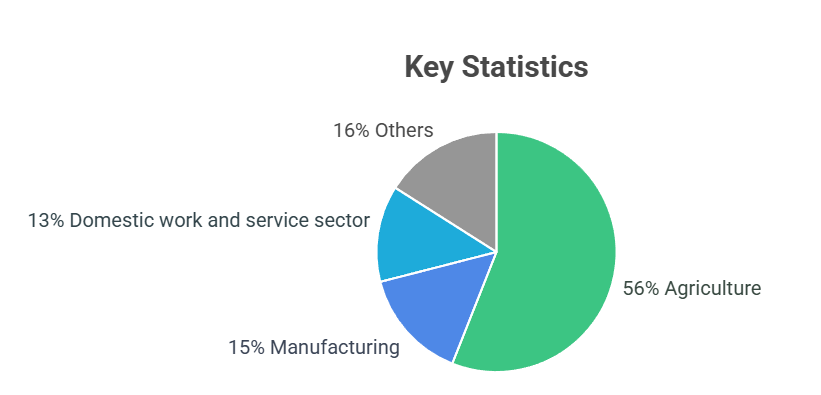
- Sectors: Agriculture (56%), Manufacturing (15%), Domestic work and service sector (13%).
Major Causes of Child Labour in India
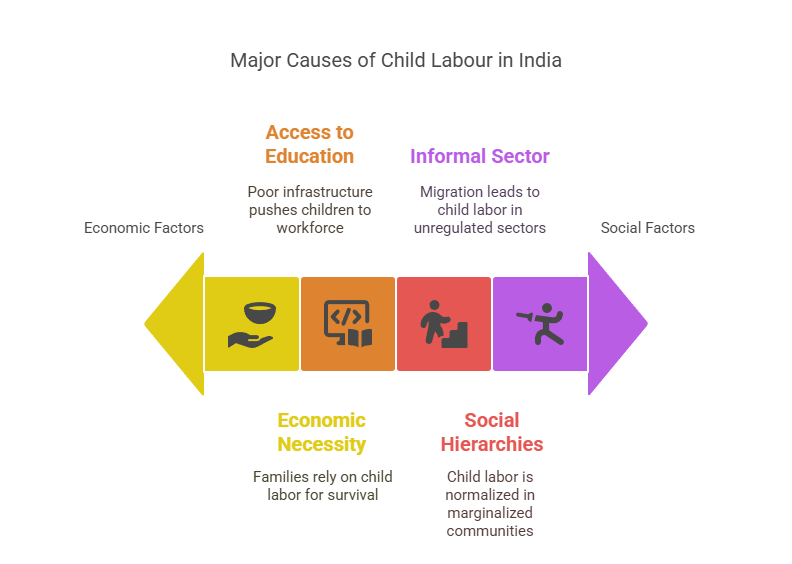
- Poverty and Economic Necessity: Poverty remains the most compelling driver of child labour in India. Families struggling to meet basic needs often rely on their children’s income for survival. This leads to children working in brick kilns, beedi-making units, roadside dhabas, or farms—sacrificing their right to education and childhood in the process.
- Lack of Access to Quality Education: Despite the Right to Education Act, millions of children are out of school due to poor infrastructure, understaffed schools, and long travel distances. Additionally, lack of inclusive and engaging learning environments often leads to high dropout rates, pushing children into the workforce instead of classrooms.
- Cultural Normalization and Social Hierarchies: In many communities, especially among marginalized caste groups, child labour is culturally normalized. Children are expected to follow in their family’s occupational footsteps—be it manual scavenging, artisanal work, or domestic labour—thus perpetuating cycles of inequality and social stagnation.
- Urban Informal Sector and Migration: Rural distress and lack of employment push families to migrate to urban areas, where children often end up working in the unregulated informal sector. They take up roles as ragpickers, hawkers, cleaners, or helpers in restaurants and households, facing exploitation, abuse, and lack of legal protection.
Legal Framework and Government Schemes
- Article 24: Prohibits employment of children below 14 in hazardous jobs.
- Child Labour (Prohibition and Regulation) Amendment Act, 2016: Prohibits work in all occupations for children under 14.
- PENCIL Portal and National Child Labour Project (NCLP) aim to rehabilitate children and link them to schools.
Sociological Analysis
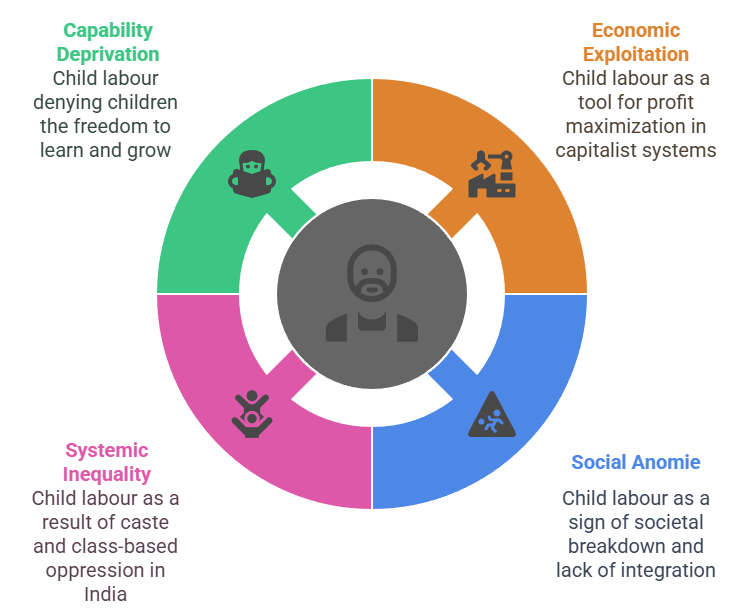
- Exploitation of Labour: Karl Marx viewed child labour as a byproduct of capitalist systems that thrive on the exploitation of the working class. Children are used as cheap, docile labour to maximize profits, especially in informal sectors, where their rights are unprotected. This economic exploitation dehumanizes them and sustains class inequality.
- Lack of Social Integration: Émile Durkheim would interpret child labour as a sign of anomie—where traditional institutions like family and school fail to integrate individuals into the moral fabric of society. When children are excluded from education and meaningful social roles, they become vulnerable to deviant paths like exploitative labour.
- Marxist Indian Perspective: A.R. Desai argued that India’s semi-feudal and capitalist economy perpetuates systemic exploitation, where landlessness and caste oppression push lower-caste children into labour. For Desai, child labour is not an individual choice but a structural outcome of class and caste-based inequalities in rural India.
- Capability Deprivation: Amartya Sen emphasized that child labour represents a denial of basic capabilities—like the freedom to learn, grow, and aspire. When children are forced into labour, they lose the opportunity to develop their full potential, thus compromising their long-term well-being and freedom to lead a dignified life.
Real-Life Example: M.V. Foundation’s Model
Founded by Shanta Sinha, the MV Foundation adopted a non-negotiable principle: No child should work, and every child must be in school. It has mainstreamed over 1.5 million children into formal education and stopped over 20,000 child marriages.
Way Forward
- Strengthen School Infrastructure: RTE must be fully implemented, especially in tribal and backward regions.
- Social Awareness Campaigns: Shift public mindset that sees child labour as “helping the family.”
- Strict Enforcement: Labour inspectors need more powers and accountability mechanisms.
- Link Welfare Schemes: MNREGA and PDS must support families to avoid pushing children into work.
Conclusion
Child labour in India is not merely an economic issue; it reflects deeper structural injustices embedded in poverty, social hierarchy, and policy failures. A sociological lens offers insights into the systemic oppression and cultural conditioning that normalize child labour. Only a holistic approach—rooted in education, empowerment, and enforcement—can ensure every child’s right to a childhood.
PYQs
Paper I –
- How does the process of socialization in a family influence occupational roles in society? (2022)
- Discuss the relationship between education and social mobility. How does lack of education contribute to perpetuation of inequality? (2021)
- How is social exclusion linked with economic deprivation? Illustrate with suitable examples. (2020)
- Discuss the role of informal sector in shaping labour relations in developing countries. (2019)
- How does Karl Marx explain the relationship between class and exploitation in capitalist societies? Discuss with reference to labour practices. (2018)
Paper II –
- Explain the impact of rural-to-urban migration on child labour practices in Indian cities. (2022)
- Critically examine the functioning of labour laws in protecting vulnerable sections of Indian society. (2020)
- Discuss the sociological reasons behind high dropout rates among children in rural and tribal areas in India. (2018)
- Child labour is still a major problem in India despite constitutional and legal provisions. Discuss the causes and measures taken to tackle it. (2017)
- How does poverty contribute to the violation of child rights in India? Suggest policy measures. (2016)
- What role do NGOs play in combating child labour and promoting education? Give examples. (2015)
|



One comment