
𝐑𝐞𝐥𝐞𝐯𝐚𝐧𝐭 𝐟𝐨𝐫: Essay for IAS
INTRODUCTIONHuman beings live in the present, aspire toward the future, yet think, feel, and act through the prism of the past. Memories, traditions, historical experiences, and inherited values continuously shape individual consciousness and collective life. In this sense, the past is not a closed chapter but a living presence. The assertion that “the past is a permanent dimension of human consciousness and values” highlights a profound truth: time does not erase experience; rather, experience accumulates and becomes embedded in moral frameworks, cultural identities, and social institutions. While societies often claim to break away from tradition in the name of progress, the past persists—sometimes as guidance, sometimes as burden, and often as both. Therefore, understanding the role of the past is essential to grasp how human consciousness is formed and how values are sustained, transformed, or contested across generations. MAIN BODY:To begin with, the past must be understood not merely as a sequence of events that have already occurred, but as a repository of meanings. Chronological time may move forward, but psychological and cultural time often loops back. Memories are recalled, traditions are reenacted, and historical narratives are reinterpreted. Philosopher Henri Bergson distinguished between mechanical time and lived time, arguing that human consciousness experiences the past as duration, not as something that has vanished. At the level of the individual, the past plays a decisive role in shaping identity. Childhood experiences, education, family background, and personal memories influence perception, emotion, and decision-making. Psychological theories emphasize that personality development is cumulative, with earlier experiences conditioning later responses. Moving from the individual to the collective, the past assumes an even more visible role. Societies construct shared memories through history, myths, monuments, and commemorations. These collective memories provide a sense of continuity and belonging. Sociologist Maurice Halbwachs argued that memory is socially framed; communities decide what to remember and how to remember it. Tradition represents one of the most enduring ways in which the past inhabits the present. Cultural practices, religious beliefs, social norms, and ethical codes are transmitted across generations, often without explicit instruction. These traditions embody accumulated wisdom but also inherited prejudices. The past often functions as a moral guide. Historical examples of courage, sacrifice, and leadership inspire ethical conduct. Conversely, past failures and atrocities serve as warnings. The popular adage that those who forget history are condemned to repeat it reflects this moral dimension. However, the permanence of the past is not always benign. The past can also constrain and divide. Historical grievances, unresolved injustices, and rigid traditions may fuel conflict and resentment. Collective memories can be selectively constructed to legitimize exclusion or dominance. Modernity often presents itself as a break from the past. Scientific progress, technological innovation, and social reform create the impression of radical novelty. Yet, even the most transformative changes are rooted in historical context. Ideas of modern democracy emerged from earlier philosophical traditions. Scientific inquiry evolved from centuries of observation and debate. Cultural identity is inseparable from historical memory. Language, art, literature, and customs carry the imprint of past experiences. Cultural narratives help communities locate themselves in time and space. They provide continuity amidst change. Philosophically, the permanence of the past raises questions about time itself. Augustine famously reflected that the past exists in memory, the present in attention, and the future in expectation. From this perspective, all three dimensions coexist within consciousness. Contemporary ethical and political debates frequently invoke the past. Questions of historical accountability, reparations, and identity politics revolve around interpretations of history. While some argue for “moving on,” others insist that unresolved past injustices demand recognition. Given its permanence, the challenge is not to escape the past but to engage with it reflectively. Critical historiography, education, and dialogue enable societies to distinguish between values worth preserving and practices that require transformation. Memory must be accompanied by interpretation. CONCLUSION:In conclusion, the past is indeed a permanent dimension of human consciousness and values. It survives in memory, tradition, identity, and moral frameworks, shaping how individuals and societies understand themselves and the world. While the present is the arena of action and the future the horizon of aspiration, the past provides depth, meaning, and orientation. However, the permanence of the past is neither entirely liberating nor wholly constraining. It can inspire wisdom and justice, or perpetuate prejudice and conflict. The true task of human consciousness lies in engaging with the past critically—honouring its lessons, questioning its assumptions, and transforming its legacy. Only through such reflective engagement can the past enrich human values and contribute constructively to a more humane and ethical future. |
Read more blog:
Customary morality cannot be a guide to modern life – Triumph IAS & Vikash Ranjan Sir
Best Essay Writing Course for UPSC CSE
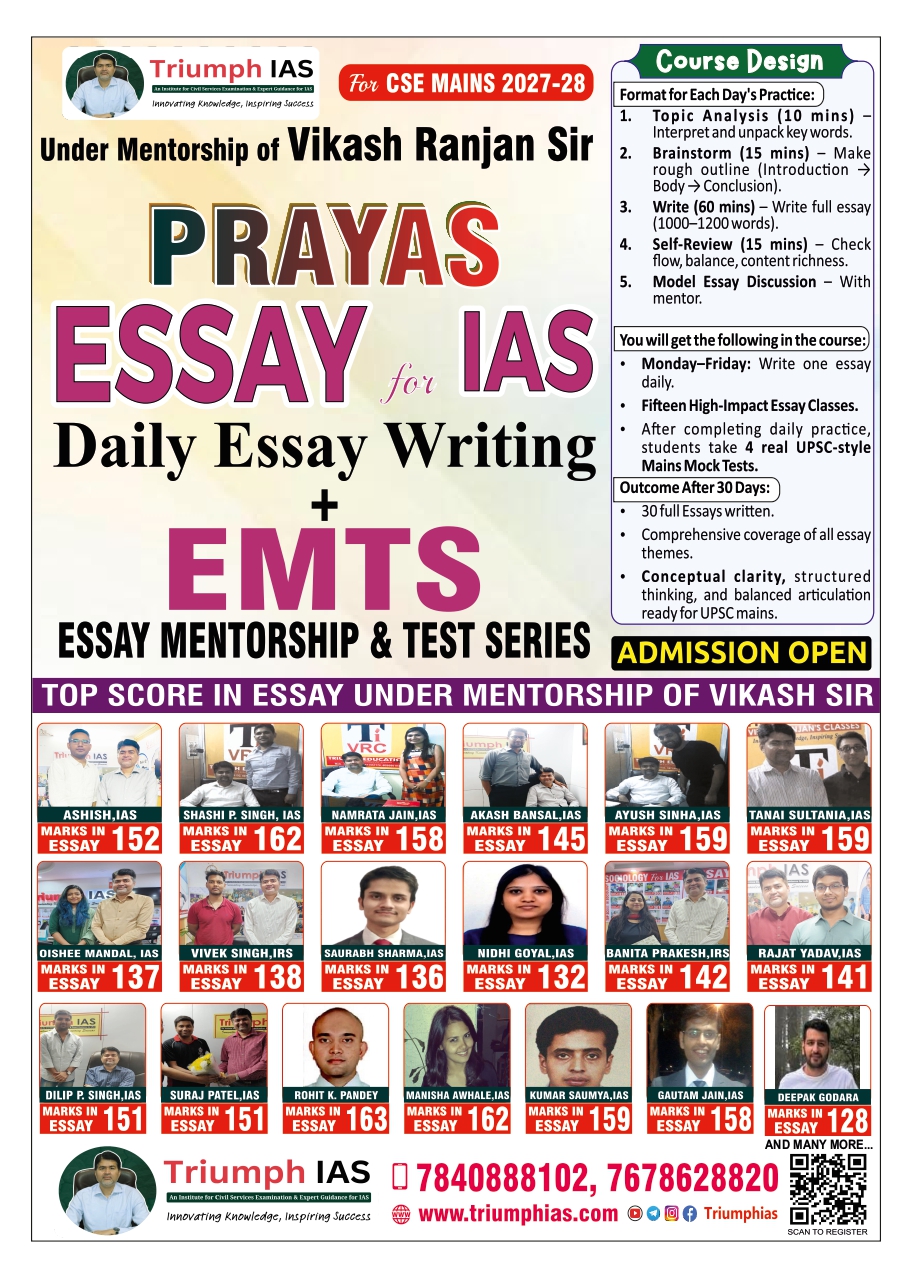
If you’re preparing for the UPSC Civil Services Examination (CSE), one paper that can unlock exceptional scores and a top rank is the Essay Paper. While General Studies and Optional Subjects are structured and syllabus-driven, the Essay writing segment is where individuality, critical thinking, and articulation truly shine.
Among various Essay programs available across India, Triumph IAS, under the expert mentorship of Vikash Ranjan Sir, offers the Best Essay writing Course for UPSC CSE. This comprehensive guide explores what makes this program unparalleled and why it should be part of every serious aspirant’s preparation strategy.

One comment