Introduction
In today’s rapidly globalizing and tech-driven world, the crisis of morality is no longer just a philosophical debate—it’s a sociological reality that defines the decay of values in modern society. We live in an age where convenience trumps conscience, and ethical degradation is normalized in everyday life. This erosion of moral values has deep-rooted implications for social structure, institutional trust, and the very functioning of democracy.
The Symptoms: From Dream11 to White-Collar Scams
From gambling apps like Dream11 and RummyCircle to massive white-collar scams like the PNB Fraud (Nirav Modi-Mehul Choksi) and the 2G Spectrum scam, one can observe how means have become irrelevant, and only the ends—money and power—are worshipped.
What’s worse is the normalization of unethical success. Scamsters were once celebrated as “business icons.” Even public service is not untouched, as seen in the Pooja Khedkar case, where meritocracy was undermined through falsified claims.
Sociological Analysis: What Explains This Moral Crisis?

- Anomie in Modern Society: Durkheim argued that rapid social change weakens norms, creating a state of anomie, or normlessness. In today’s fast-changing digital economy, traditional moral frameworks are eroding, leaving individuals morally adrift.
- Strain Theory: Merton’s theory explains deviance as a result of discrepancy between societal goals (like wealth) and the approved means to achieve them. When legitimate paths are blocked, individuals resort to shortcuts—fraud, cheating, scams.
- Rationalization and Bureaucracy: Weber warned that excessive rationalization dehumanizes institutions. Bureaucrats and leaders begin to follow rules mechanically, ignoring ethics. This explains moral numbness in administrative scandals.
- Capitalist Exploitation: Marx saw capitalism as inherently alienating and exploitative. The drive for profit becomes paramount, pushing aside human values and collective welfare, leading to systemic moral decay.
The Indian Context: Why Morality is in Freefall
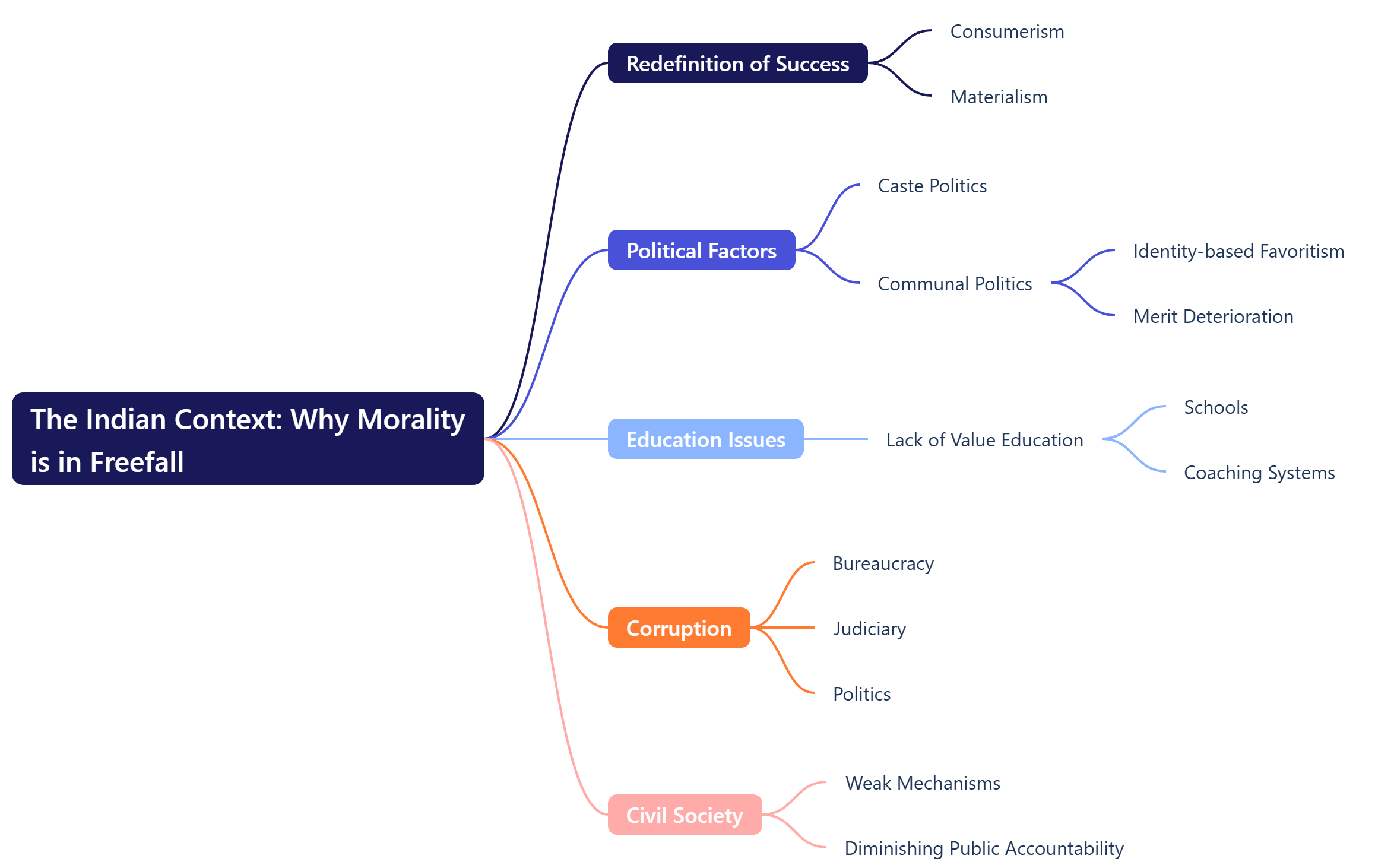
India’s sociological landscape reveals several contributing factors:
- Consumerism and materialism have redefined success.
- Caste and communal politics continue to fuel identity-based favoritism over merit.
- Lack of value education in schools and coaching systems.
- Institutional corruption in bureaucracy, judiciary, and politics.
- Weak civil society mechanisms and diminishing public accountability.
Implications for Indian Society
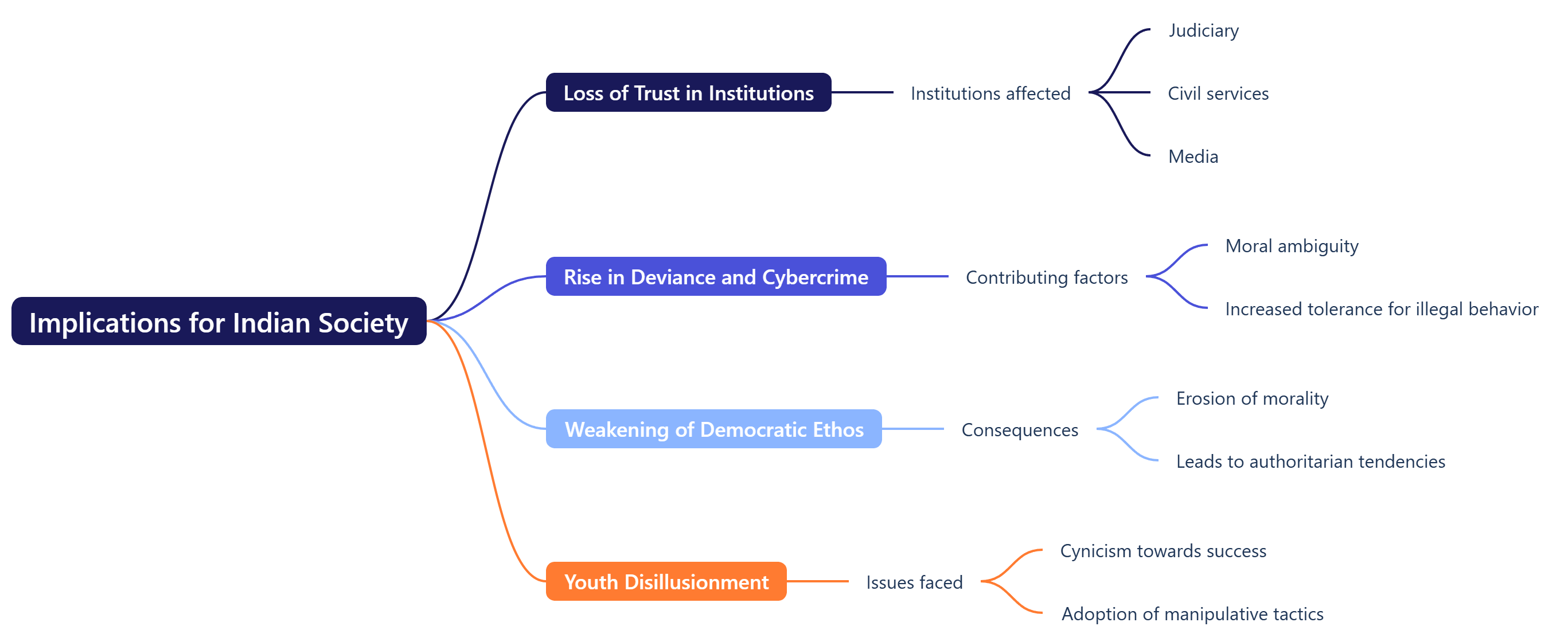
- Loss of trust in institutions: Judiciary, civil services, and even media are viewed with suspicion.
- Rise in deviance and cybercrime: Moral ambiguity increases tolerance for illegal or unethical behavior.
- Weakening of democratic ethos: Morality is the backbone of accountability in a democracy; its erosion leads to authoritarian tendencies.
- Youth disillusionment: When success seems tied to manipulation and deceit, young minds may become cynical or adopt similar tactics.
Sociological Reflection: Are We Rewarding the Wrong Behaviour?
“People do what their society rewards them for doing.”
Today, wealth and fame are celebrated regardless of their origins. Social media glorifies influencers and fraudsters alike, creating a distorted moral compass. Even among bureaucrats and civil servants — those who should uphold public ethics — fraud and deceit are rising.
If society stops rewarding honesty and starts romanticizing shortcuts, the entire value system collapses, leaving behind a hollow, dysfunctional structure.
Way Forward: Reclaiming Moral Ground
- Value-based education from the school level must be institutionalized.
- Strengthening institutions like Lokpal, CVC, and judiciary to uphold ethical standards.
- Public accountability and citizen participation through platforms like RTI and social audits.
- Promoting positive role models in governance, sports, media, and civil services.
- Drawing from Indian ethical traditions like Gandhian morality, Ambedkar’s vision of justice, and the Bhakti movement call for compassion.
Conclusion: Choose What Is Right, Not What Is Easy
As Mahatma Phule, Babasaheb Ambedkar, and Subhash Chandra Bose proved — it is possible to build a just society by walking the difficult path of righteousness. We too must confront this modern-day test: choose easy money or choose a life of integrity.
The collapse of morality is not just an ethical concern, but a sociological one — deeply tied to India’s social fabric. The revival of values is the only vaccine against societal collapse.
PYQs
Paper 1:
- Discuss how role conflict leads to moral crisis in professional life. (2017)
- Examine the contribution of Durkheim to the study of social order and moral regulation. (2018)
- How does value system influence social institutions? Discuss with examples. (2020)
- Examine how conflict theory explains deviant and criminal behavior in society. (2020)
- What is meant by ‘cultural lag’? Explain how it can lead to moral dilemmas in contemporary society. (2021)
- Critically analyze Weber’s concept of rationalization in the context of moral neutrality in bureaucratic institutions. (2021)
- Explain the concept of ‘relative deprivation’ and discuss how it leads to deviant behavior. (2022)
- What is social disorganization? How is it relevant in the context of rising urban crimes and moral decline? (2023)
Paper 2:
- Critically analyze the causes and consequences of growing intolerance and erosion of civil values in India. (2016)
- Corruption is deeply embedded in the structure of Indian society. Discuss sociologically. (2017)
- Discuss the role of education in promoting ethical values and reducing corruption in Indian society. (2019)
- Discuss the impact of globalisation on ethical and moral values in Indian society. (2020)
- Analyze the role of caste and politics in perpetuating inequality and moral decline in public life. (2021)
- Explain the rise of deviant behavior and cyber crimes in urban India with sociological examples. (2022)
- Discuss the relevance of Gandhian ethics and morality in contemporary Indian society. (2022)
- Examine the sociological factors responsible for the decline of moral values among youth in India. (2023)
- “Institutional decay leads to moral erosion.” Comment in the Indian context. (2023)
|



One comment