Introduction:
Teenage pregnancy remains a significant public health and sociological issue in India. According to the National Family Health Survey-5 (NFHS-5), nearly 7.9% of girls aged 15-19 were already mothers or pregnant at the time of the survey. Though there has been some decline over the years, the issue persists—especially in rural and marginalized communities. The phenomenon of teenage pregnancy cannot be understood in isolation; it is embedded in broader social structures like patriarchy, poverty, education, and gender-based violence.
Teenage Pregnancy in India
Teenage pregnancy, defined as pregnancy occurring in young women aged 13–19, is a pressing concern in many developing nations, including India. The issue not only poses health risks to adolescent girls but also reflects deep-rooted socio-cultural and economic challenges. Teenage pregnancy is a crucial topic intersecting with issues of gender, patriarchy, sexuality, education, health, family structure, and state policy.
Causes of Teenage Pregnancies in India
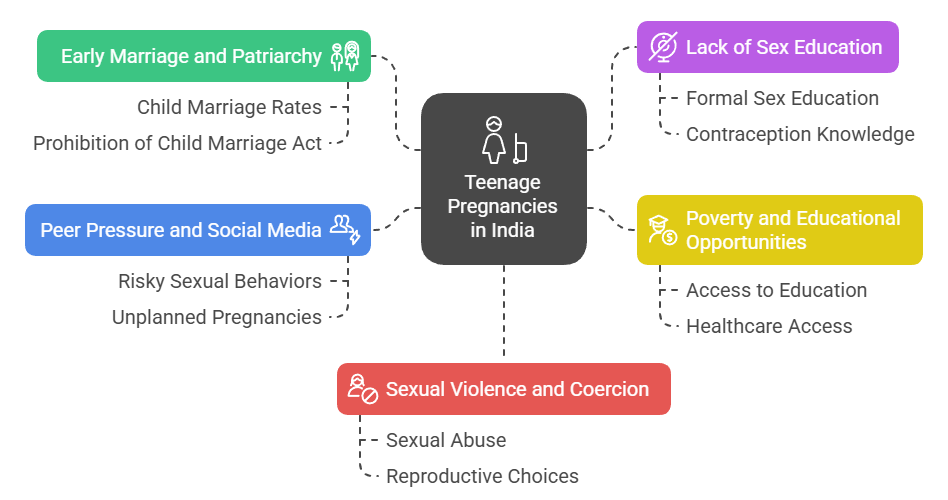
- Early Marriage and Patriarchy: India has one of the highest rates of child marriage globally. Despite laws like the Prohibition of Child Marriage Act, 2006, over 23% of Indian girls are married before the age of 18 (NFHS-5). Marriage becomes a socially sanctioned context for adolescent motherhood. Patriarchy often dictates that a girl’s worth is linked to reproduction and family honor.
- Lack of Comprehensive Sex Education: Sexuality is a taboo subject in most Indian households. There is little to no formal sex education in schools, leading to ignorance about contraception, consent, and reproductive health. Misinformation and myths about sexual intercourse prevail.
- Poverty and Lack of Educational Opportunities: Poverty restricts access to education, healthcare, and employment. Poor families may see marriage and motherhood as the only viable life path for their daughters. Many girls drop out of school before reaching secondary education, increasing their vulnerability to early pregnancy.
- Peer Pressure and Social Media: With increased exposure to social media and digital content, adolescents are exploring their identities. However, without adequate guidance, they may engage in risky sexual behaviors, leading to unplanned pregnancies.
- Sexual Violence and Coercion: A significant number of teenage pregnancies occur as a result of sexual abuse, incest, or coercion. Adolescent girls often lack the autonomy to make reproductive choices and may face threats or violence if they resist.
Sociological Analysis
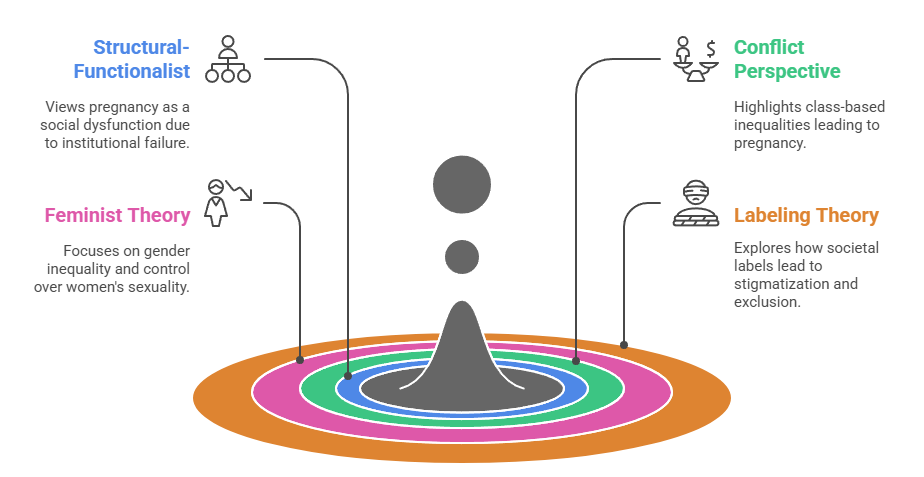
- Structural-Functionalist Perspective: This perspective views teenage pregnancy as a dysfunction in the social system. When institutions like family, education, and religion fail to regulate adolescent behavior, social problems like early pregnancies emerge. Emile Durkheim’s notion of anomie—a breakdown of social norms—can be applied to understand changing adolescent behavior.
- Conflict Perspective (Marxist View): Teenage pregnancies are symptomatic of class-based inequalities. Poor access to education and healthcare for lower-class families creates a cycle of disadvantage, keeping them in poverty. A.R. Desai’s Marxist analysis of Indian society highlights how capitalist structures reproduce social inequality.
- Feminist Theory: Feminist scholars argue that teenage pregnancy is rooted in gender inequality. Patriarchy controls women’s sexuality and girls are often denied bodily autonomy. Simone de Beauvoir’s notion that “one is not born, but becomes a woman” captures how society shapes girls into submissive roles that normalize early motherhood.
- Labeling Theory: This theory suggests that once a teenager is labeled as a “bad girl” or “immoral” due to pregnancy, it leads to stigmatization and social exclusion. This can perpetuate a cycle of disadvantage, making reintegration into school or society difficult.
Impact of Teenage Pregnancies
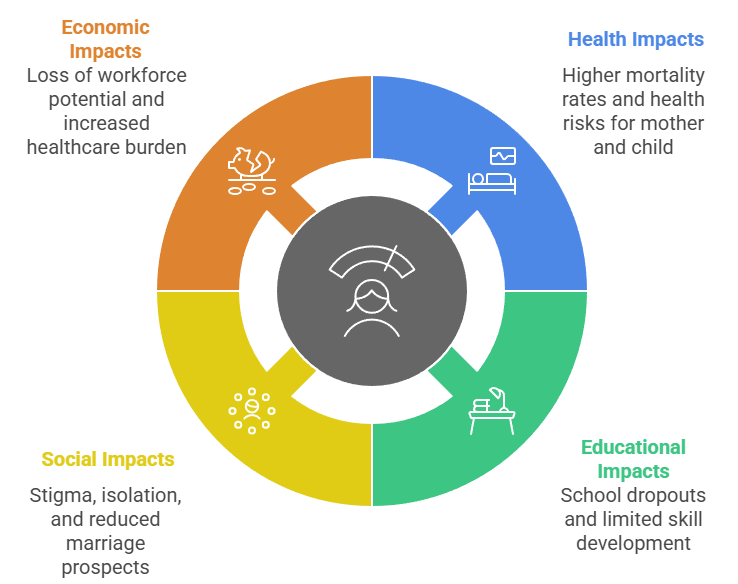
Health Impacts
- Higher maternal and infant mortality rates
- Increased risk of anemia, preeclampsia, and obstructed labor
- Psychological stress and postpartum depression
Educational Impacts
- School dropouts among adolescent mothers
- Lack of skill development and reduced economic opportunities
Social Impacts
- Stigma, isolation, and reduced marriage prospects
- Intergenerational cycle of poverty and early pregnancies
Economic Impacts
- Loss of workforce potential
- Increased burden on public healthcare systems
Government Schemes and Legal Framework
- Rashtriya Kishor Swasthya Karyakram (RKSK): Focuses on adolescent health, including sexual and reproductive health, nutrition, and mental well-being.
- Prohibition of Child Marriage Act, 2006: Legally sets the marriage age at 18 for girls. However, enforcement remains weak, especially in rural areas.
- National Adolescent Health Programme (NAHP): Promotes access to information and services related to menstrual hygiene, contraception, and safe abortion.
- Beti Bachao Beti Padhao: Encourages the education and empowerment of girl children, which has indirect implications for reducing early pregnancies.
Teenage Pregnancy and Sociological Concerns in India
Teenage pregnancies reflect not just a health problem but a societal failure. It signals:
- Failure of education systems to impart life skills
- Failure of family and community structures to protect and empower girls
- Failure of state and policy enforcement mechanisms
They indicate the urgent need to move beyond token policies to transformational interventions rooted in gender justice, youth empowerment, and grassroots participation.
Sociological Solutions and Recommendations
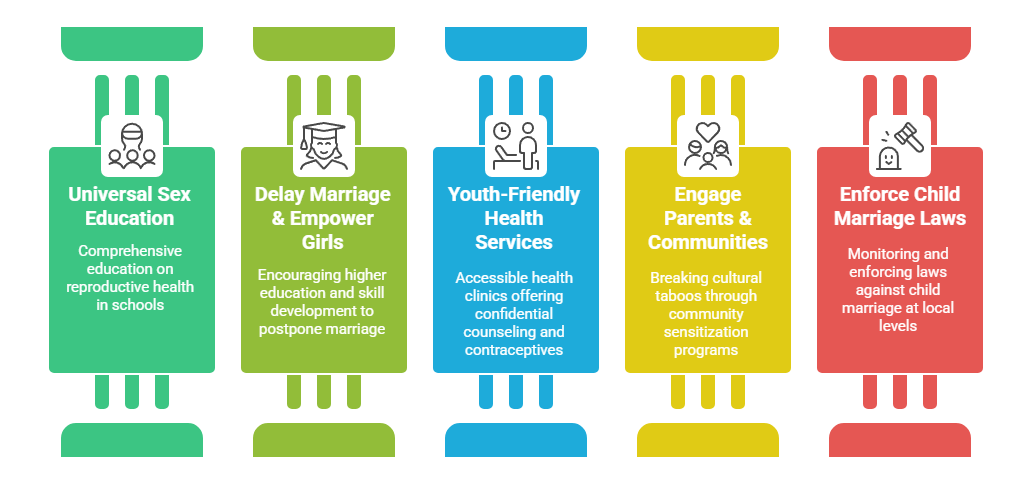
- Universal Sex Education: Make reproductive and sexual health education a compulsory part of school curricula.
- Delay Marriage and Empower Girls: Promote higher education and skill development to delay marriage.
- Access to Youth-Friendly Health Services: Establish adolescent-friendly health clinics with confidential counseling and contraceptives.
- Engage Parents and Communities: Break cultural taboos around menstruation, sexuality, and gender roles through community sensitization.
- Strict Enforcement of Child Marriage Laws: Monitor implementation at local levels, especially in high-risk districts.
Case Studies
- Bihar and Jharkhand have the highest rates of teenage pregnancies due to poor education, poverty, and high child marriage rates.
- Kerala and Tamil Nadu show better indicators due to high female literacy and better health infrastructure.
- The urban-rural divide is stark: rural areas account for over 70% of teenage pregnancies.
Global Comparison
Compared to sub-Saharan Africa and Latin America, India’s teenage pregnancy rate is lower but still high given its population. Nations with comprehensive sexuality education and access to youth reproductive health services—like the Netherlands and Sweden—report the lowest teenage pregnancy rates globally.
Conclusion
Teenage pregnancies are not just a matter of individual behavior but a sociological crisis emerging from systemic failures in education, health, and gender justice. They represent a challenge and an opportunity—an opportunity to reimagine youth-centric policies, empowers girls, and creates a just society where adolescents are informed, confident, and supported.
Previous Year Questions
Paper 1:
- Discuss the role of socialization in shaping gender roles among children and its implications for gender inequality in India. (2016)
- Examine the role of the family in the reproduction of gender inequalities. (2018)
- How do social institutions perpetuate gender-based violence and discrimination? (2021)
- Evaluate the impact of cultural lag in understanding changing sexual behavior among adolescents in Indian society. (2022)
- Discuss the impact of media and technology on adolescent behavior and its sociological consequences. (2022)
- Discuss how patriarchy and caste intersect to influence the reproductive rights of women in India. (2023)
Paper 2:
- How do population policies and programs in India address the issue of adolescent reproductive health? (2014)
- Explain how early marriage and motherhood among girls in rural India impact the demographic and social structure. (2015)
- Analyze the role of patriarchy in controlling women’s sexuality and reproductive choices in India. (2016)
- Examine the causes and consequences of high dropout rates among adolescent girls in rural India. (2017)
- Discuss how education and awareness can help reduce maternal mortality and adolescent pregnancy in India. (2018)
- Discuss the impact of poverty and illiteracy on reproductive health among teenage girls in marginalized communities. (2019)
- Evaluate the role of NGOs and self-help groups in addressing issues related to teenage mothers. (2020)
- What are the sociological implications of increasing teenage pregnancies in India? (2021)
- Critically examine the effectiveness of government schemes for the welfare of adolescent girls in India. (2022)
- Discuss the interrelationship between gender-based violence and early pregnancies in India. (2023)
|


One comment