

Technocracy in Contemporary Society
(Relevant for Sociology Paper I: Politics and Society; Social Change in Modern Society and Sociology Paper II: Politics and Society; Visions of Social Change in India)
Introduction
In the 21st century, where technology penetrates nearly every facet of life, governance systems are increasingly shaped by technical expertise rather than political ideology. This shift has given rise to the concept of technocracy—a form of governance where technocrats (scientists, engineers, economists, and administrators) hold decision-making power. Understanding technocracy offers insights into the changing nature of power, authority, governance, and social control.
What is Technocracy?
Technocracy refers to a system of governance or influence where technical experts—rather than elected representatives—play a dominant role in policymaking. A technocracy is a system of governance in which decision-makers are selected based on their expertise in a given area, particularly scientific or technical knowledge. The term emerged during the early 20th century, particularly after the Great Depression in the United States, when engineers and planners advocated for scientific and rational methods in economic and political affairs.
Features of Technocracy
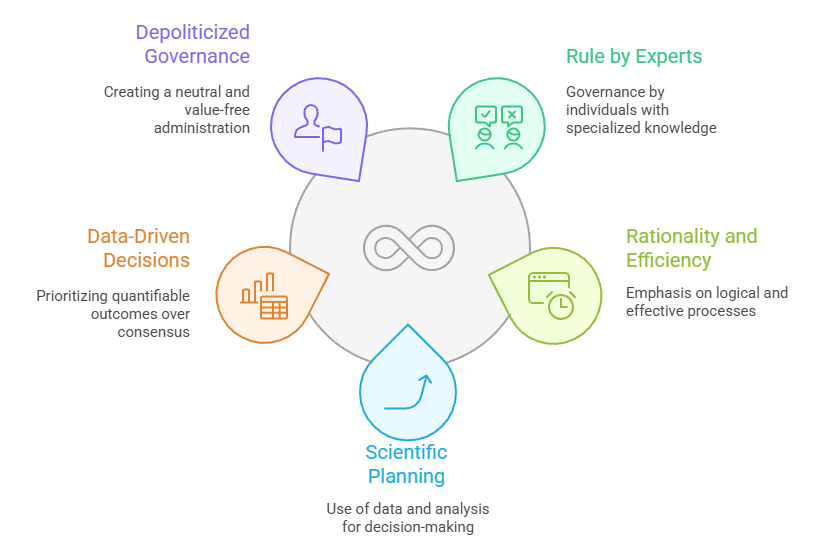
- Rule by experts rather than generalist politicians.
- Emphasis on rationality, efficiency, and scientific planning.
- Often overlaps with bureaucratic structures, but technocrats may not be traditional civil servants.
- Decision-making is data-driven, often prioritizing quantifiable outcomes over democratic consensus.
- Tends to depoliticize governance, creating a neutral or value-free image of administration.
Technocracy vs Democracy:
| Criteria | Technocracy | Democracy |
|---|---|---|
| Basis of Authority | Technical expertise | Popular mandate |
| Decision-making | Scientific, rational, top-down | Political, negotiated, bottom-up |
| Accountability | Limited, internal | Public, electoral |
| Participation | Limited to experts | Open to all citizens |
| Legitimacy | Knowledge and efficiency | Representation and public consent |
Technocracy in India:
- NITI Aayog: Seen as a technocratic replacement of the Planning Commission, promoting evidence-based policy with professionals from outside bureaucracy.
- COVID-19 Response: India’s pandemic management was driven largely by expert bodies like ICMR and AIIMS, with limited political debate—highlighting technocratic decision-making.
- Digital India and AI-driven governance: Use of data analytics, Aadhaar-based delivery, and automation reflect the rise of algorithmic governance.
These examples illustrate a shift toward managerial rationality and away from political deliberation in many spheres of Indian governance.
Sociological Analysis
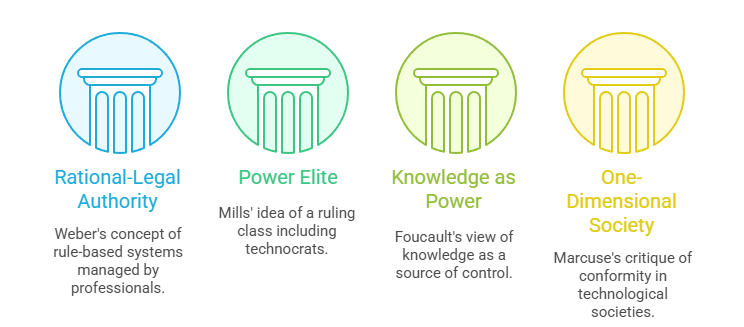
- Rational-Legal Authority
Weber’s concept of rational-legal authority forms the foundation for understanding technocracy. In his analysis of bureaucracy, Weber noted the rise of a rule-based, impersonal system managed by trained professionals. Technocracy extends this by emphasizing technical and scientific knowledge as the core of authority. It reflects the rationalization of modern society.
- The Power Elite
Mills argued that modern societies are dominated by a power elite consisting of political, military, and corporate leaders. In technocracies, this elite also includes technocrats, who are unelected but powerful due to their control over specialized knowledge and systems.
- Knowledge as Power
Foucault’s notion that knowledge produces power applies directly to technocracy. Technocrats derive power not through coercion or charisma but through their control over scientific discourse, data, and expertise. This creates new forms of social control, often invisible and embedded in algorithms, policies, and systems.
- One-Dimensional Society
Herbert Marcuse criticized technological societies for promoting conformity and depoliticization. Technocracy often narrows the range of public debate, promoting efficiency over ethics or dissent—a danger in any democratic setup.
Advantages of Technocracy
- Evidence-based policymaking leads to better outcomes in complex areas like health, environment, and infrastructure.
- Minimizes populism and policy myopia by focusing on long-term rational solutions.
- Enables efficient crisis management, as seen during natural disasters or pandemics.
- Ensures standardization and accountability, especially in sectors requiring high specialization.
Criticisms of Technocracy
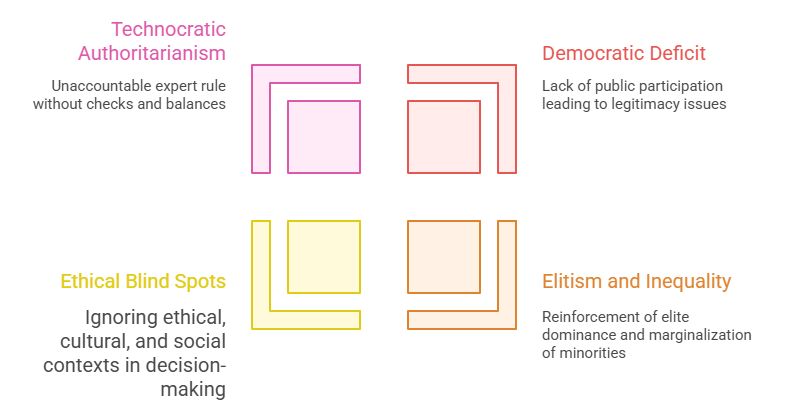
- Democratic Deficit: Technocratic governance sidelines public participation, creating a legitimacy crisis. Policies may be efficient but lack consensus or fail to represent marginalized voices.
- Elitism and Inequality: Technocracy can reinforce elite dominance, especially when access to education and expertise is stratified. In India, upper-caste urban elites disproportionately occupy technocratic spaces, marginalizing Dalits, Adivasis, and rural populations.
- Ethical Blind Spots: Decisions based solely on data may ignore ethical, cultural, and social contexts. For instance, AI-driven policing or welfare delivery can deepen exclusion if not socially audited.
- Technocratic Authoritarianism: Without checks and balances, technocracy can become technocratic authoritarianism, where experts become unaccountable rulers insulated from criticism.
Technocracy and Social Stratification
Technocracy contributes to a new form of stratification based on:
- Educational qualifications
- Digital literacy
- Access to elite institutions
This mirrors the concept of cultural capital by Pierre Bourdieu, where certain social groups dominate due to their embedded advantages in acquiring specialized knowledge.
Technocracy and the Indian Bureaucracy
While Indian bureaucracy has traditionally been based on generalist IAS officers, recent decades have seen an infusion of:
- Lateral entries from the private sector
- Appointments of domain experts in ministries (e.g., Nandan Nilekani for Aadhaar)
- Use of data consultants and think tanks in public policy
This signals a hybrid model—a fusion of democratic bureaucracy and technocratic expertise.
Real-Life Examples in India
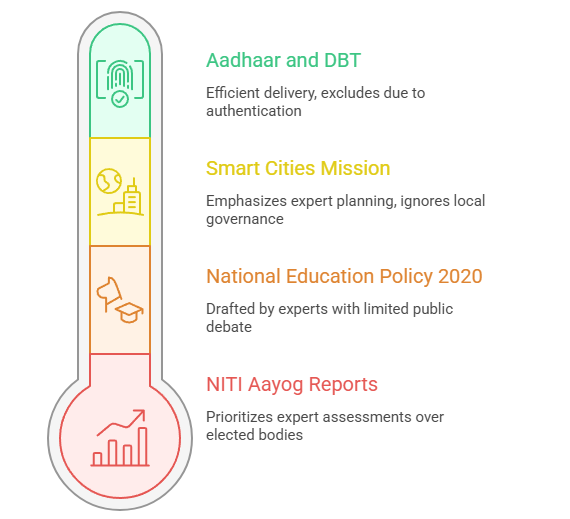
- Aadhaar and Direct Benefit Transfer (DBT): Efficient delivery of welfare, but led to exclusion of millions due to authentication failures.
- National Education Policy 2020: Drafted by experts, criticized for limited public debate.
- Smart Cities Mission: Emphasizes planning by urban experts, but often ignores local participatory governance.
- NITI Aayog Reports: Technocratic assessments often drive policy framing, leaving elected bodies sidelined.
Conclusion
Technocracy represents both promise and peril. While expert-driven governance can enhance efficiency and innovation, it must not come at the cost of democratic accountability and social justice. For a diverse society like India, technocratic solutions must be tempered with participatory governance, equity, and ethical reflection.
Previous Year Questions
Paper I:
- Discuss Max Weber’s concept of rational-legal authority and its relevance in modern bureaucratic states. (2017)
- How has science and technology influenced social change in modern society? (2020)
Paper II:
- Critically examine the role of bureaucrats and technocrats in Indian policy-making. (2022)
- What are the implications of digital governance on the rural poor in India? (2021)
To Read more topics, visit: www.triumphias.com/blogs
Read more Blogs:
Harmonising Development and Conservation in Andaman and Nicobar
2 comments