

Taboo
(Relevant for Sociology Paper I: Religion and Society and Sociology Paper II: Tribal Communities in India; Social Change)
What is Taboo?
A taboo is a strong social or cultural prohibition against certain actions, objects, people, or talk, often enforced by moral or religious authority. Not simply a preference, taboos are viewed as violations of sanctity or purity, often carrying supernatural or legal consequences.
Etymology: Derived from the Polynesian word “tapu”, meaning “forbidden, holy, sacred”.
Sociological Analysis
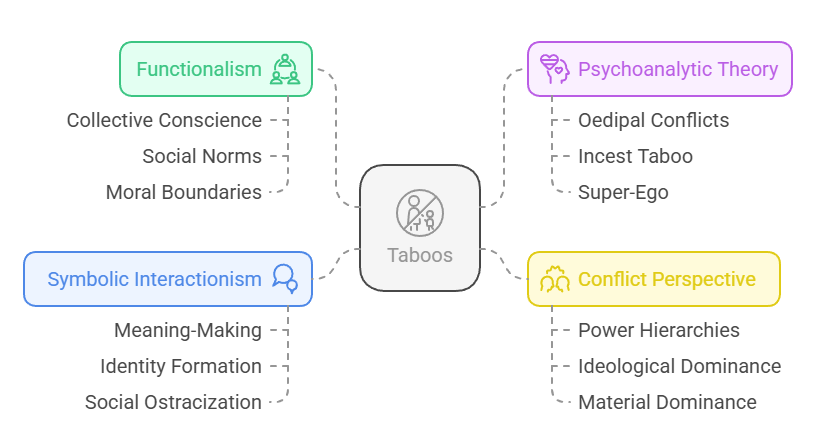
Functionalism
- Emile Durkheim (1858–1917): Argued that taboos enforce collective conscience, reinforcing social norms and moral boundaries. They demarcate sacred vs. profane, generating social cohesion through shared prohibitions.
- In structural-functionalism, taboos operate as social control mechanisms: by declaring certain actions off-limits, societies maintain stability and order, reducing deviance.
Psychoanalytic Theory
- Sigmund Freud (1856–1939), in Totem and Taboo, linked taboos to Oedipal conflicts, describing them as societal responses to repressed desires. The incest taboo, he argued, is universal due to its role in limiting primal urges and forming the super-ego.
- Thus, taboos have both social and psychological origins, pitting individual impulses against communal norms.
Conflict Perspective
- From a Marxist or conflict viewpoint, taboos reflect power hierarchies. Dominant groups control taboos to maintain ideological and material dominance.
- Example: caste-based taboos in India restrict inter-caste interactions to uphold social stratification and privilege.
Symbolic Interactionism
- Focuses on meaning-making: taboos exist because through interaction we collectively decide these acts are taboo. They shape identity and group membership.
- Stigma theory (Goffman) overlaps: breach of taboo leads to social ostracization, labeling individuals as deviant.
Types of Taboo
| Types of Taboo | Definition | Indian Example |
|---|---|---|
| Sexual Taboos | Prohibitions on sexual acts and relations | Incest taboo, caste endogamy, strict norms around premarital and extramarital sex |
| Food Taboos | Bans on consuming certain foods | Cow beef taboo among Hindus; pork prohibition in Islam; vegetarianism in Jainism |
| Ritual Taboos | Prohibitions on ritual acts or roles | Menstruation taboos (ban from temples, kitchens); Ardha Nari taboo |
| Caste/Death Taboos | Bans related to contact with certain castes or the deceased | Untouchability, rituals forbidden for Dalits, widow ostracism |
| Occupational Taboos | Restrictions on engaging in certain types of work | Manual scavenging by Dalits; upper-caste aversion to menial or “polluting” jobs |
Current Affairs Relevance
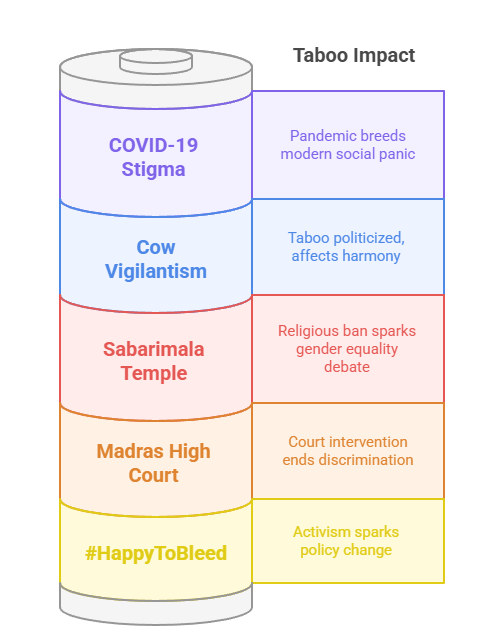
Menstrual Taboos & #HappyToBleed
- In 2015, activist Lavanya—shamed in Pune for carrying sanitary napkins—triggered #HappyToBleed, spotlighting menstrual taboos and patriarchal values. Influenced political discourse and public policy on menstrual hygiene.
- In 2018, Madras High Court held that meninas cannot be denied spaces due to menstruation—significant legal intervention in menstrual taboo.
Sabarimala Temple Verdict (2018–2023)
- Women of menstruating age banned at Sabarimala temple led to massive protests.
- SC overturned the ban in 2018, reinstated in 2020 (2023 SC review).
- Reflects the tug-of-war between religious taboo and gender equality.
Cow Vigilantism & Beef Bans
- Religious taboo concerning beef consumption politicised in several states, affecting dietary freedom and communal harmony.
- Taboo shapes agrarian, cultural, and political narratives.
COVID-19 Stigma
- Pandemic bred taboos around survivors, health workers, and certain states/hotels. Reflects modern social panic expressed through taboo.
Why Taboos Persist & Evolve
- Taboos maintain social order and prevent disruptive behaviour.
- Clear-cut taboos (g., incest) universal across cultures—essential for family and kinship structure.
- Taboos are socially constructed symbols.
- Violation leads to negative labeling, so individuals conform to avoid stigma.
- Taboos benefit dominant groups, reinforcing hierarchy (e.g., caste, gender).
- They function as ideological tools, legitimizing discrimination (g., untouchability, menstrual exclusion).
- Taboo-labeling of menstruation is seen as gender-based oppression.
- Feminists advocate de-tabooing bodily functions, promoting dignity: menstrual cup use, period positivity campaigns.
- Urbanisation and literacy dilute many traditional taboos.
- Yet, new taboos appear (g., around digital privacy, body image).
Case Studies & Illustrations
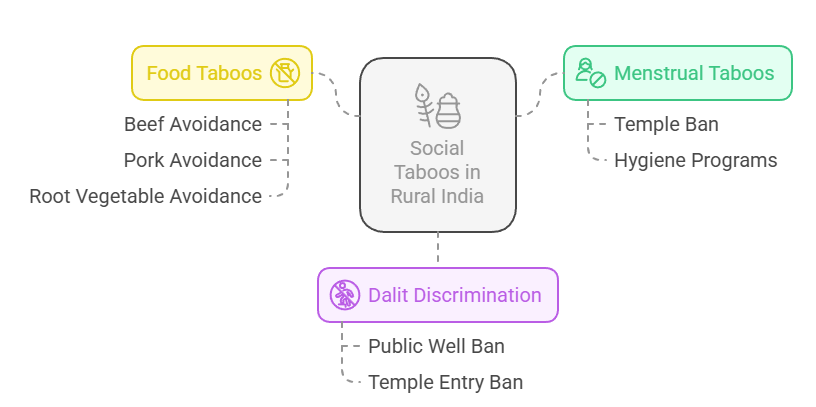
Menstrual Taboos in Rural India
- Many areas ban girls from temples for 2–3 days a month.
- NGOs & government-run Menstrual Hygiene Management programs aim to break taboos, promote hygiene and dignity.
Dalits & Untouchability
- In rural regions, Dalits still banned from using public wells, entering temples, or sharing meals.
- Legal protections exist (SC/ST Atrocities Act), but social enforcement remains strong.
Food Taboos across Religions
- Caste Hindus avoid beef; Muslims avoid pork; Jains avoid root vegetables.
- These taboos serve as identity markers but also barriers to social integration and nutrition.
Taboo and Social Change
Legal Interventions
- SC rulings (e.g., Sabarimala, menstrual exclusion) have challenged taboos.
- Legislation like Protection of Women from Domestic Violence Act indirectly addresses bodily taboos (g., shame and divorce).
Media & Technology
- Social media (Twitter/Instagram) amplifies anti-taboo campaigns (#MenstruationMatters).
- Telegram/Zoom platforms facilitate feminist discussions, de-stigmatizing taboo topics.
Education & Youth
- Universities conduct sensitization workshops on gender taboos, mental health.
- Student protests and NSS/Rushikesh initiatives seek taboo-reform.
Conclusion
Taboos continue to shape Indian society—from religious practices and caste norms to gender relations and public policy. Understanding them through classical & contemporary sociological lenses helps aspirants critically analyse social processes, policy impacts, and cultural dynamics.
To Read more topics, visit: www.triumphias.com/blogs
Read more Blogs:
Social Consequences of Artificial Intelligence on Employment and Creativity
One comment