Introduction
The term “surveillance society” describes a social order in which the monitoring, collection, and analysis of personal data have become a central mechanism of governance, control, and commerce. In the 21st century, surveillance extends beyond traditional law enforcement into everyday life — from CCTV cameras and biometric systems to social media tracking, AI-driven facial recognition, and digital footprints.
In the Indian context, current debates on Aadhaar, Pegasus spyware, CCTNS (Crime and Criminal Tracking Network & Systems), and data protection laws highlight the urgency of discussing surveillance.
Defining Surveillance Society
A surveillance society is one where technological systems routinely collect, store, and process personal information to influence, regulate, or predict people’s behaviour. Sociologists point out that this kind of monitoring:
- Extends into both public and private spheres.
- Is justified in the name of security, efficiency, and service delivery.
- Often leads to power imbalances between the watchers (state, corporations) and the watched (citizens, consumers).
Sociological Analysis
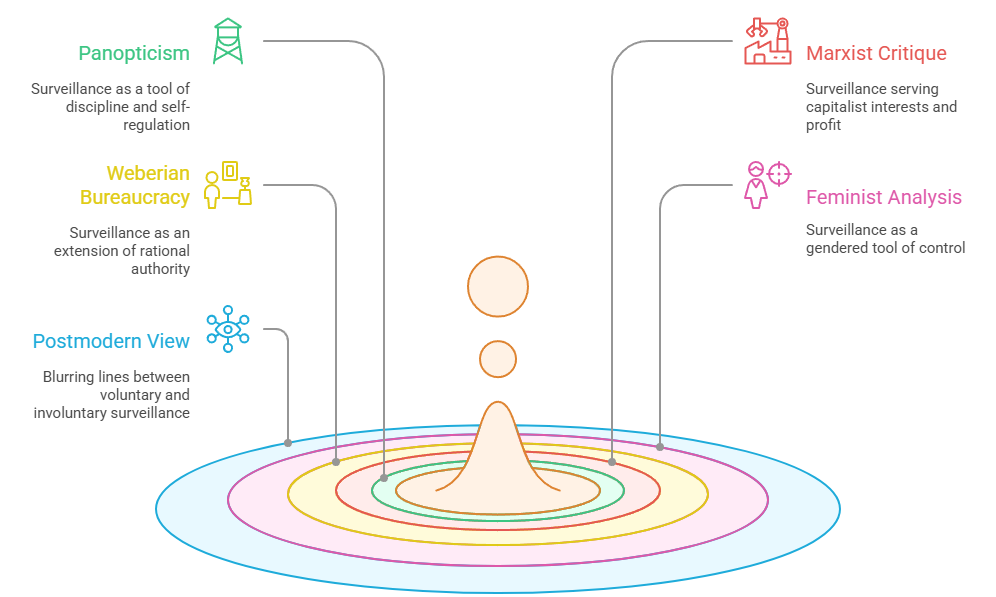
- Michel Foucault – Panopticism
Foucault’s concept of the Panopticon illustrates how surveillance becomes a tool of discipline. In a modern context, citizens may modify their behaviour simply because they know they might be watched — whether by CCTV, employer monitoring software, or social media visibility.
- Marxist Perspective
From a Marxist lens, surveillance serves the interests of the ruling class and capitalist enterprises. Data collection fuels targeted advertising, consumer manipulation, and labour discipline, enabling profit maximization at the expense of individual autonomy.
- Weberian Perspective
Max Weber’s theory of bureaucracy applies to surveillance as an extension of rational-legal authority. While surveillance promises efficiency and order, it can also lead to the “iron cage” of excessive control and loss of personal freedom.
- Feminist Perspective
Feminists argue that surveillance is gendered. Women face not only state and corporate surveillance but also patriarchal monitoring by families and communities — from restricting mobility to monitoring online activity — under the guise of “protection”.
- Postmodern Perspective
Postmodernists highlight the blurring lines between voluntary and involuntary surveillance. Social media users willingly share personal data for connectivity, unaware of how algorithms commodify their identity.
Types of Surveillance in the Contemporary World
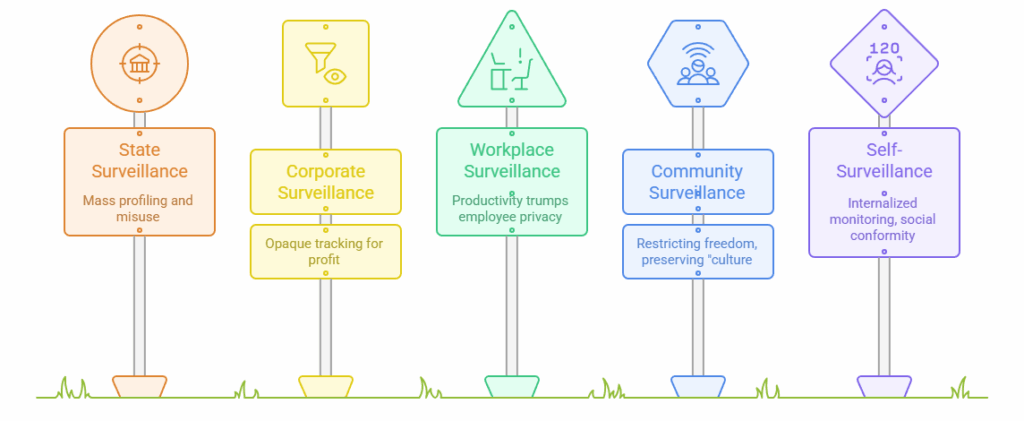
- State Surveillance
Includes law enforcement monitoring, intelligence gathering, and national ID systems like Aadhaar. While these can enhance security and service delivery, they raise concerns about mass profiling and potential misuse.
- Corporate Surveillance
Big Tech companies track user data for targeted advertising, content recommendation, and behavioural prediction, often without transparent consent.
- Workplace Surveillance
Employee productivity tools, keylogging software, and remote monitoring systems have increased, especially in post-pandemic work-from-home setups.
- Community and Social Surveillance
Neighbourhood vigilance, moral policing, and community-based monitoring restrict individual freedoms in the name of preserving “culture” or “safety”.
- Self-Surveillance
Individuals internalize monitoring norms — editing behaviour and appearance for online platforms — reinforcing social conformity.
Surveillance in the Indian Context
India is rapidly becoming a digitally monitored society:
- Aadhaar and Biometric Tracking: The world’s largest biometric database, linking welfare services to identity verification.
- Pegasus Spyware Controversy: Allegations of government agencies using spyware to monitor journalists, activists, and politicians.
- CCTNS and Facial Recognition: Used in policing and crowd monitoring.
- Social Media Regulation: IT Rules, 2021, increase government oversight on digital content.
- Smart Cities Mission: Integration of surveillance technologies into urban governance.
Arguments in Favour of Surveillance
- National Security: Helps prevent terrorism, cybercrime, and organized crime.
- Public Safety: Deters street crime and aids in criminal investigations.
- Efficiency in Service Delivery: Streamlines welfare schemes by reducing leakages.
- Workplace Productivity: Helps monitor employee output and compliance.
Criticisms and Concerns
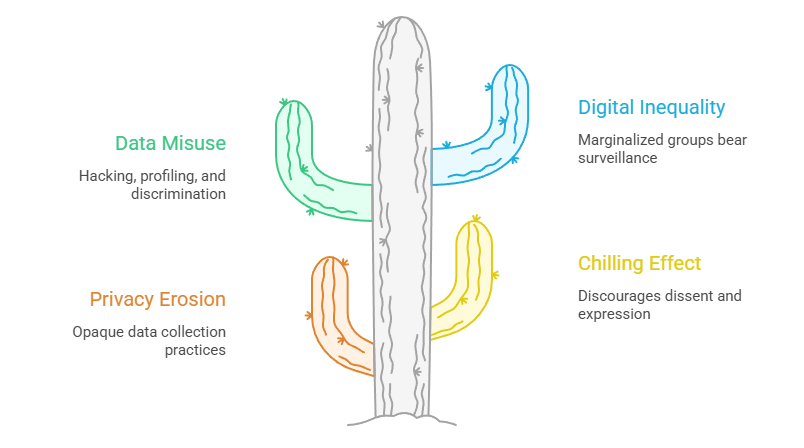
- Privacy Erosion: Lack of consent and opaque data collection practices.
- Chilling Effect: Discourages dissent and free expression.
- Data Misuse: Risk of hacking, profiling, and targeted discrimination.
- Digital Inequality: Marginalized groups often bear disproportionate surveillance.
Recent Examples
- Supreme Court Judgment on Right to Privacy (2017) – Declared privacy as a fundamental right under Article 21.
- Aadhaar and Welfare Schemes Debate – Balancing efficiency with privacy risks.
- Facial Recognition in Delhi Police Operations (2023) – Criticism over accuracy and bias.
- Draft Digital Personal Data Protection Act, 2023 – Attempt to regulate how data is collected and stored.
Policy Recommendations
- Strong Data Protection Laws: Enforce accountability for state and corporate actors.
- Public Awareness Campaigns: Educate citizens on digital rights and privacy.
- Independent Oversight Bodies: Prevent abuse of surveillance powers.
- Transparency Mechanisms: Ensure individuals know when and why they are being monitored.
- Technology Audits: Evaluate accuracy, bias, and ethical implications of surveillance tools.
Conclusion
The surveillance society is not an abstract future — it is our present reality. While surveillance can enhance security, governance, and efficiency, it also risks creating a society of constant monitoring, where freedom is subtly eroded. The sociological challenge lies in balancing the benefits of technology with the protection of individual rights.
This topic demonstrates the interplay between technology, social control, power structures, and individual agency, making it an essential area of study in the era of digital governance.
PYQs
Paper 1
- Analyse the role of surveillance in shaping deviance and conformity in society. (2015)
- Examine the role of information and communication technology in social control. (2016)
- Evaluate the concept of disciplinary society in the context of the digital age. (2017)
- Explain how globalization has transformed the mechanisms of surveillance and governance. (2018)
- Discuss Michel Foucault’s concept of Panopticism and its relevance in contemporary society. (2020)
- Discuss the sociological implications of self-surveillance in the age of social media. (2021)
- Evaluate the impact of digitalization on power relations in society. (2022)
- Critically analyse the relationship between technology and social stratification in the era of big data. (2023)
Paper 2
- Critically examine the challenges to right to privacy in the context of state and corporate data collection. (2017)
- Discuss the sociological implications of linking welfare schemes to biometric databases in India. (2018)
- Examine the role of Aadhaar in reshaping the relationship between state and citizen. (2018)
- Analyse the role of surveillance in Smart Cities Mission in India. (2019)
- Discuss the tension between security and liberty in the context of increasing surveillance in India. (2019)
- Analyse the role of surveillance in national security and its impact on civil rights. (2020)
- Examine how surveillance practices exacerbate digital inequality in India. (2021)
- How has social media surveillance influenced political mobilization in India? (2022)
- Evaluate the use of facial recognition technology by Indian law enforcement agencies. (2023)
|

One comment