Introduction
India’s education system, often hailed for producing some of the brightest minds globally, is also under intense scrutiny for an alarming rise in student suicides. Competitive exams like NEET, JEE, and UPSC demand relentless preparation, often pushing students to their physical and emotional limits. The problem is particularly acute in coaching hubs like Kota, Jaipur, Sikar, Hyderabad, Chennai, Delhi, and Mumbai, where stories of young lives cut short due to academic stress have become distressingly common.
In a landmark move, the Supreme Court of India has issued 15 nationwide guidelines aimed at curbing student suicides and strengthening mental health support systems in educational institutions. These guidelines draw from the UMMEED Draft Guidelines, MANODARPAN initiative, and the National Suicide Prevention Strategy. Until comprehensive legislation is enacted, these directives will serve as a binding protective framework.
Key Highlights of the Supreme Court Guidelines

The court’s directives cover multiple aspects of student welfare, mental health management, and institutional accountability. The main provisions include:
- Uniform Mental Health Policy: All institutions must adopt a mental health policy based on UMMEED, MANODARPAN, and the National Suicide Prevention Strategy. The policy should be reviewed annually and made publicly available.
- Qualified Counsellors in Institutions: Institutions with over 100 students must employ trained counsellors, psychologists, or social workers. Smaller institutions must create referral linkages with mental health professionals.
- Optimal Student-to-Counsellor Ratio: Mentors should be assigned to small student batches, particularly during exams and academic transitions.
- Ban on Batch Segregation and Public Shaming: No student should be segregated or humiliated based on academic performance.
- Immediate Referral Protocols: Institutions must have written procedures for referring students to mental health services and suicide prevention helplines such as Tele-MANAS.
- Suicide-Prevention Safety Measures: Residential institutions must install tamper-proof ceiling fans and restrict access to rooftops and other high-risk areas.
- Special Focus on Coaching Hubs: Cities with high concentrations of competitive exam aspirants must implement stronger mental health protections.
- Mandatory Training for Staff: Teaching and non-teaching staff must undergo biannual training to identify warning signs and provide psychological first aid.
- Confidential Grievance Redressal Systems: Institutions must maintain robust systems to address harassment, ragging, and sexual assault complaints without fear of retaliation.
- Annual Mental Health Reports: Institutions must maintain anonymised records of interventions and submit annual reports to regulatory bodies like UGC, AICTE, or CBSE.
- Career Counselling for Students and Parents: Regular sessions should reduce unrealistic academic pressure and broaden understanding of diverse career paths.
Sociological Analysis

- Structural Functionalism Perspective
Émile Durkheim’s theory of suicide (1897) categorises suicides into types such as egoistic, anomic, and fatalistic.
- Anomic Suicide: Seen when societal norms break down, leaving students without clear guidance. Academic pressure without adequate mental health support can cause this.
- Fatalistic Suicide: Results from excessive regulation, where students feel trapped in rigid, high-pressure environments like coaching institutes.
By introducing flexible learning, counselling, and grievance mechanisms, the guidelines attempt to restore balance between regulation and individual freedom.
- Conflict Theory Perspective
Karl Marx’s conflict theory would argue that educational stress and student suicides are symptoms of systemic inequality.
- Elite urban schools often have better support systems, while rural and marginalised communities lack mental health infrastructure.
- Coaching industry commercialisation widens the gap, turning education into a competitive, profit-driven race.
The Supreme Court guidelines, particularly those mandating counsellors in all institutions, aim to reduce this inequality by standardising mental health support.
- Symbolic Interactionism Perspective
This micro-sociological view focuses on daily interactions and their impact on mental health.
- Public shaming and batch segregation send damaging symbolic messages about self-worth.
- Teacher-student interactions can either build resilience or reinforce feelings of inadequacy.
The ban on public shaming directly addresses harmful symbolic messages in educational settings.
- Social Institutions and Role Strain
Education, as a social institution, is supposed to foster growth, but in competitive contexts, it creates role strain for students trying to meet conflicting expectations from parents, peers, and teachers. Career counselling provisions in the guidelines address this role strain by aligning academic pathways with students’ interests.
- Mental Health as a Social Problem
From a sociological standpoint, mental health issues are not just individual pathologies but consequences of social structures and pressures. The guidelines acknowledge this by integrating preventive systems into the educational structure itself.
Linking Guidelines to Ground Reality
The need for such measures becomes evident when examining recent data:
- NCRB’s 2022 report showed 13,000+ student suicides in India, with exam-related stress being a major factor.
- In Kota alone, 27 student suicides were reported in 2023, the highest ever.
By institutionalising mental health policies, the SC is attempting to create preventive and supportive ecosystems rather than responding reactively to tragedies.
Challenges in Implementation
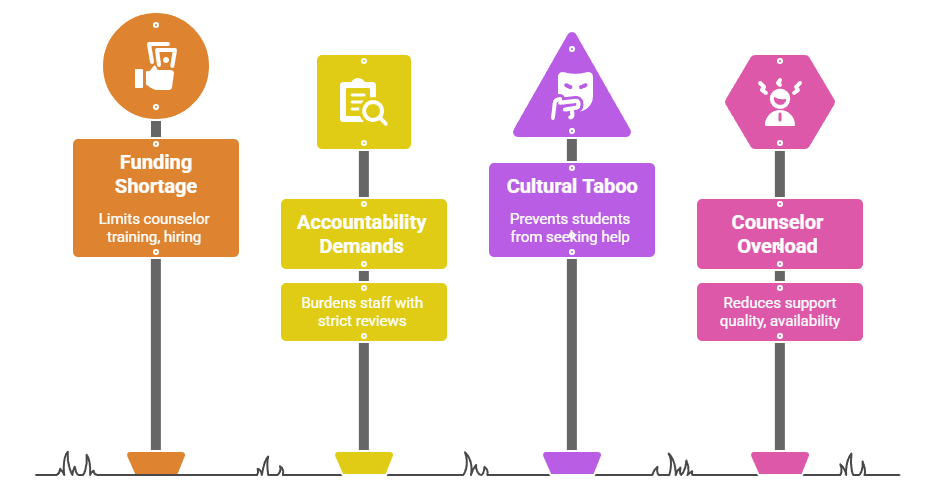
While the guidelines are comprehensive, their real-world success will depend on:
- Funding and Resource Allocation – Hiring trained counsellors and conducting biannual staff training requires significant investment.
- Monitoring and Accountability – Annual reports must be strictly reviewed by regulatory bodies.
- Cultural Stigma – In many parts of India, mental health is still taboo, preventing students from seeking help.
- Overburdened Counsellors – If the student-to-counsellor ratio is too high, support quality will decline.
Way Forward
- Legislative Backing: Parliament must enact a Mental Health in Education Act for long-term sustainability.
- Integration into Curriculum: Life skills, resilience training, and emotional intelligence should be part of school syllabi.
- Community Involvement: Parents and local communities must be engaged in mental health awareness programs.
- Digital Solutions: Online counselling and AI-based early warning systems can help identify at-risk students.
Conclusion
The Supreme Court’s 15 guidelines are a historic step towards making mental health a central pillar of India’s education system. By blending structural reforms, preventive measures, and emotional support systems, these guidelines aim to break the cycle of academic stress, isolation, and despair. This judgment is not just current affairs—it is a case study in law as an agent of social change, the interplay of education and mental health, and the sociological understanding of suicide as a social problem. If implemented with sincerity, these measures could transform Indian educational spaces into places that nurture holistic growth rather than crush young potential under the weight of unrealistic expectations.
PYQs
Paper 1 –
- Examine the impact of urban environments on individual mental health with reference to high-density competitive spaces like coaching hubs. (2014)
- Explain the concept of labelling theory. How does it apply to academic performance-based segregation of students? (2015)
- Discuss the concept of role conflict and role strain with reference to the lives of students in competitive academic environments. (2016)
- How do educational institutions act as agents of socialisation and social control? Illustrate with examples from contemporary India. (2017)
- Discuss Émile Durkheim’s theory of suicide. How is it relevant in understanding rising student suicides in India? (2018)
- Examine the role of social institutions in the reproduction of inequality. How can education be both a cause of and a remedy for inequality? (2019)
- Examine the functionalist perspective on the role of education in society. How does the high-pressure education system affect social equilibrium? (2020)
- Discuss the significance of symbolic interactionism in understanding peer relationships and self-esteem among students. (2021)
- Analyse the relationship between mental health and social structure with suitable examples. (2022)
- Critically examine the relationship between social policy and social change in India, with examples from the education sector. (2023)
Paper 2 –
- Analyse the interplay between family expectations, education, and mental health in contemporary Indian society. (2014)
- Examine the role of education in the social mobility of disadvantaged groups in India. (2015)
- Discuss the issues and challenges of the Indian education system in the context of globalisation and commercialisation of education. (2016)
- Discuss the relevance of grievance redressal mechanisms in educational institutions in ensuring gender equality in India. (2017)
- Explain how the Indian judiciary has acted as a catalyst for social change with reference to educational reforms. (2018)
- Examine the role of career counselling in reducing academic stress and unrealistic expectations in Indian families. (2019)
- Discuss the causes and consequences of student suicides in India. Suggest sociological measures for prevention. (2020)
- How does the Indian state address social problems such as youth suicide through policy interventions? Give examples. (2021)
- Evaluate the effectiveness of government initiatives like MANODARPAN in addressing mental health concerns among students. (2021)
- Critically analyse the impact of coaching culture in urban India on students’ mental health and social relationships. (2022)
|