India Disaster Preparedness
India is one of the most disaster-prone countries in the world, with more than 85% of its area vulnerable to multiple hazards, including floods, cyclones, droughts, earthquakes, and landslides. The increasing frequency and intensity of natural and anthropogenic disasters, worsened by climate change and urbanisation, underline the critical need for robust disaster preparedness. Over the years, India has made notable strides in transforming its approach from reactive response to proactive preparedness and resilience-building.
Disaster Risk Profile of India
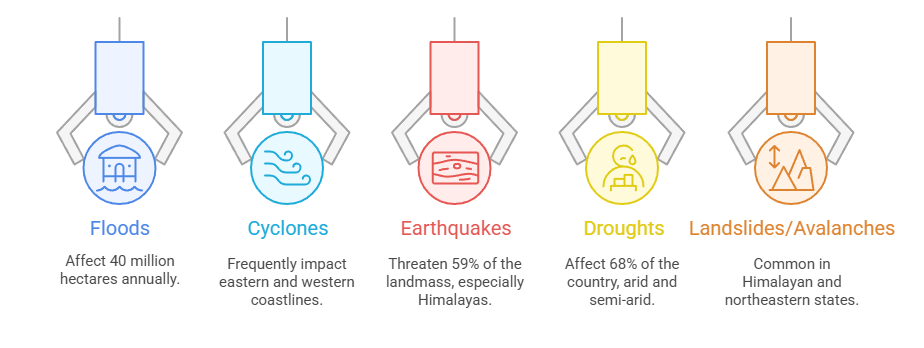
India’s vast and diverse geography makes it highly susceptible to a variety of natural disasters:
-
- Floods affect over 40 million hectares annually.
- Cyclones frequently impact eastern and western coastlines.
- Earthquakes threaten nearly 59% of the landmass, especially in the Himalayan belt.
- Droughts affect over 68% of the country, particularly in arid and semi-arid regions.
- Landslides and avalanches are common in the Himalayan and northeastern states.
According to the Global Climate Risk Index 2021, India ranked among the top 10 most climate-affected countries in 2019, underscoring the urgency of effective disaster preparedness.
Evolution of Disaster Management in India
India’s disaster management has evolved significantly over the past few decades:
- The Bhuj earthquake (2001) and Tsunami (2004) acted as turning points, leading to a paradigm shift from relief-centric to prevention and preparedness approaches.
- The Disaster Management Act, 2005 institutionalised disaster risk reduction (DRR) by establishing the National Disaster Management Authority (NDMA) and mandating disaster management plans at all levels.
- The Sendai Framework for Disaster Risk Reduction (2015–2030) has further guided India’s policies towards building resilience.
Institutional Framework
National Level
- NDMA: Headed by the Prime Minister, it formulates policies, approves national disaster plans, and coordinates disaster response.
- National Institute of Disaster Management (NIDM): Conducts training, capacity building, and research in disaster management.
- National Disaster Response Force (NDRF): A specialised force equipped to handle all types of disasters; currently has 16 battalions.
State and District Levels
- State Disaster Management Authorities (SDMAs) and District Disaster Management Authorities (DDMAs) are responsible for preparing and implementing disaster management plans at respective levels.
Key Preparedness Measures
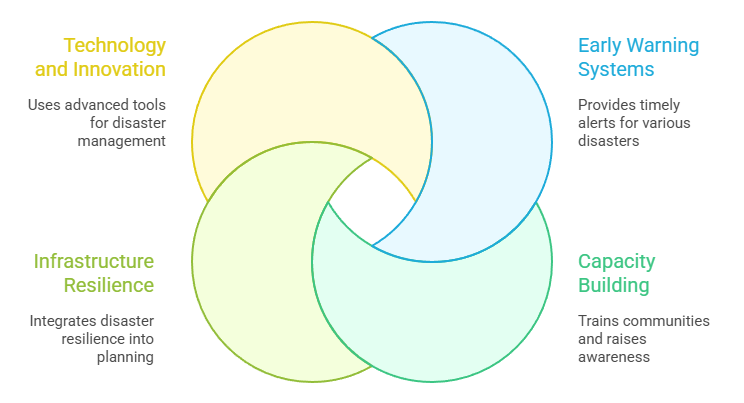
- Early Warning Systems
India has significantly improved its early warning capabilities:
- Indian Meteorological Department (IMD) and Indian National Centre for Ocean Information Services (INCOIS) provide timely cyclone, tsunami, and weather alerts.
- The Common Alert Protocol (CAP) enables unified alert dissemination via SMS, radio, TV, and mobile apps.
- Technologies like Doppler radars, GIS, and satellite-based monitoring enhance forecasting precision.
- Capacity Building and Community Participation
- Programs like Aapda Mitra train community volunteers to act as first responders.
- School and college safety programs raise awareness and readiness among students.
- Regular mock drills, public education campaigns, and skill development workshops are conducted across the country.
- Infrastructure Resilience
- Amrit Sarovar, Smart Cities Mission, and PM Gati Shakti integrate disaster resilience into infrastructure planning.
- Construction guidelines by the Bureau of Indian Standards (BIS) promote earthquake, cyclone, and flood-resilient structures.
- The Climate Resilient Cities initiative works to mainstream DRR in urban planning.
- Technology and Innovation
- Mobile applications like ‘SACHET’, ‘DISHA’, and ‘Meghdoot’ facilitate citizen-level alerts and preparedness.
- Use of AI, drones, and Big Data for damage assessment, search and rescue operations, and predictive analytics is expanding.
Recent Initiatives and Developments
- National Disaster Management Plan (2020): Updated in line with the Sendai Framework and SDGs to address biological, chemical, and radiological hazards.
- Coalition for Disaster Resilient Infrastructure (CDRI): A global initiative led by India to promote resilient infrastructure development.
- Heat Action Plans (HAPs): Implemented in states like Gujarat and Maharashtra to address rising incidences of heatwaves.
- Urban Flood Management Guidelines (2023): Issued by NDMA to help cities manage and mitigate flood risks.
Challenges in Disaster Preparedness
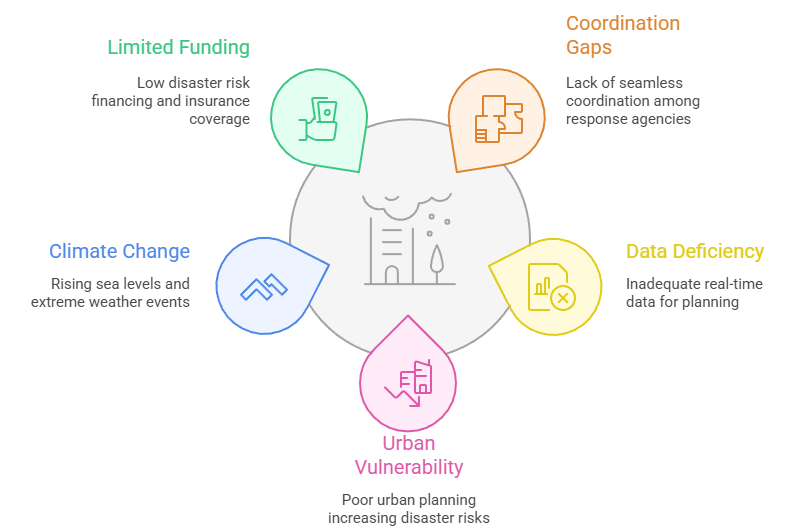
Despite progress, India faces several challenges:
- Coordination Gaps: Lack of seamless coordination among different disaster response agencies during emergencies.
- Data Deficiency: Inadequate real-time data and historical disaster records for effective planning.
- Urban Vulnerability: Poor urban planning, encroachment, and unregulated construction increase disaster risks.
- Climate Change: Rising sea levels, extreme weather events, and glacial melt are introducing newer risks and uncertainties.
- Limited Funding and Insurance Penetration: Disaster risk financing mechanisms and insurance coverage remain low, especially for rural populations.
Way Forward
- Mainstreaming DRR in Development
DRR must be integrated into all sectors—housing, transport, health, and education. Urban local bodies and panchayats need to be empowered with resources and knowledge.
- Decentralised and Community-Centric Preparedness
Engaging local communities, SHGs, and NGOs in planning and capacity-building can enhance grassroots resilience.
- Investing in Risk Assessment and Forecasting
Advanced tools like hydro-meteorological modelling, glacial lake monitoring, and multi-hazard vulnerability mapping need to be expanded.
- Promoting Insurance and Risk Financing
Scaling up disaster insurance for farmers, SMEs, and infrastructure projects can improve financial recovery post-disasters.
- International Cooperation
India should continue its leadership in global DRR platforms and knowledge exchange through SAARC, UNDRR, and CDRI.
Conclusion
India’s evolving disaster preparedness strategy is rooted in prevention, resilience, and inclusive growth. By leveraging technology, empowering communities, and integrating risk reduction into policy and planning, India can effectively minimise disaster impacts and build a safer future. The road ahead lies in sustainable development backed by proactive disaster risk governance, making resilience a shared national responsibility. |


One comment