Introduction:
Street crime refers to criminal offenses that occur in public spaces such as roads, parks, markets, and neighbourhoods. These include crimes like robbery, theft, assault, vandalism, and drug-related offenses. Street crime has become a growing concern in urban India due to rapid urbanization, socio-economic inequalities, and poor policing mechanisms. As India continues its transformation into a largely urban society, the visibility and frequency of street crime have gained prominence both in media narratives and public policy debates. From a sociological perspective, street crime is not merely an issue of law and order but reflects deeper structural and cultural issues such as unemployment, alienation, social inequality, and moral breakdown. It offers a fertile ground for UPSC aspirants to understand the intersection between society and deviance.
Types of Street Crimes in India
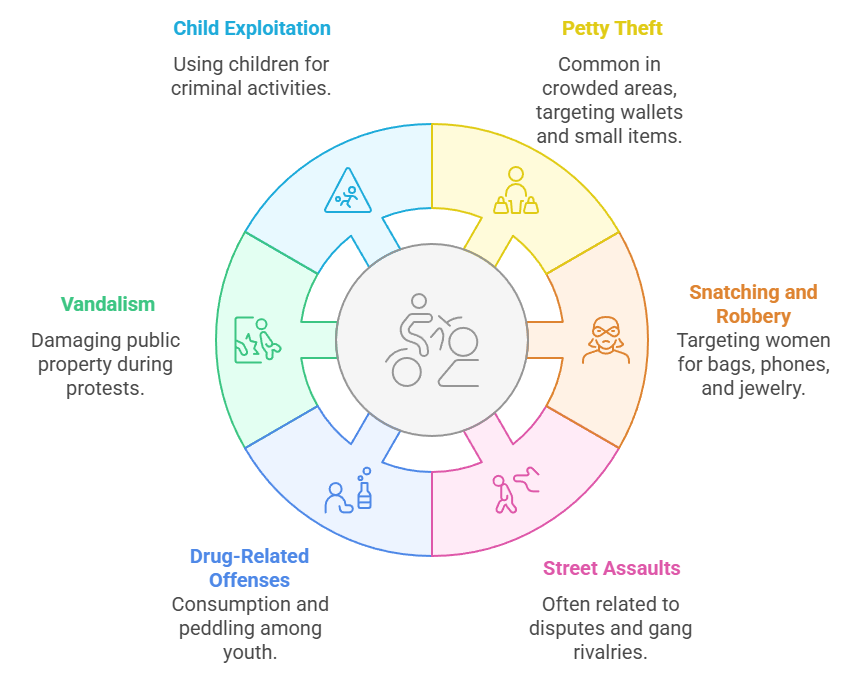
- Petty Theft and Pickpocketing: Common in crowded areas like buses, metro stations, and markets.
- Snatching and Robbery: Particularly targeting women with bags, phones, and jewelry.
- Street Assaults and Fights: Often related to local disputes, gang rivalries, or road rage.
- Drug-Related Offenses: Consumption and petty peddling among youth in slums and urban peripheries.
- Vandalism: Damaging public property, especially during protests or gang activities.
- Begging Mafias and Child Gangs: Exploitation of children for criminal activities.
Sociological Analysis
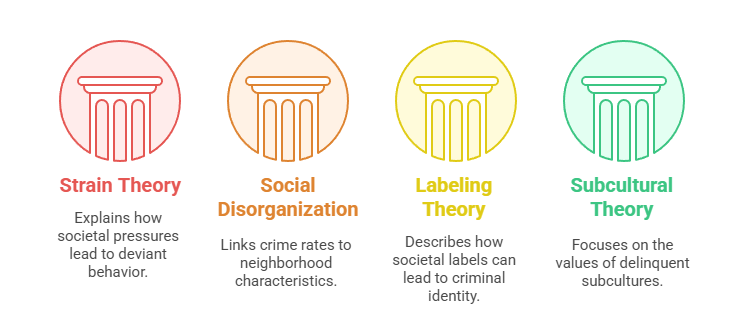
- Robert Merton’s Strain Theory
Merton argues that societal pressure to achieve culturally approved goals (like wealth and success) without equal means leads individuals to innovate, often through deviant behavior. For instance, an unemployed youth who sees material success in social media may resort to mugging or chain snatching to fulfill those aspirations.
- Social Disorganization Theory (Shaw and McKay)
This theory links crime rates to neighborhood ecological characteristics. Areas with poverty, broken families, migration, and lack of community control often witness more street crime. Slums and unauthorized colonies in Indian cities become hotspots under this framework.
- Labeling Theory (Howard Becker)
This theory explains how people become criminals when labeled as such by society. A minor street offense like shoplifting can stigmatize a youth, pushing them into a permanent criminal identity due to societal rejection.
- Subcultural Theory (Albert Cohen)
Street crime often stems from the values of delinquent subcultures which emphasize toughness, street smarts, and anti-authority behavior. In urban ghettos, such norms dominate youth culture, especially when legitimate avenues of success are closed.
Street Crime in Indian Context
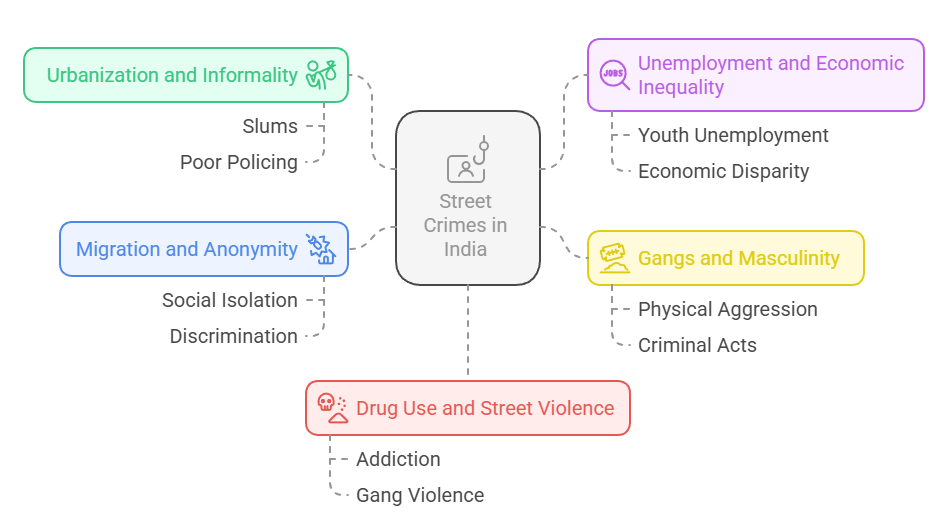
- Urbanization and Informality: India’s rapid urbanization has led to mushrooming of slums and informal settlements with poor policing and social infrastructure. This has created fertile ground for petty crimes.
- Unemployment and Economic Inequality: Youth unemployment and the widening gap between the rich and poor foster frustration and resentment. Street crime becomes both a means of survival and expression of rebellion.
- Gangs and Masculinity: Urban street gangs often promote a toxic masculinity culture. Boys are socialized to assert dominance through physical aggression, weapons, and criminal acts.
- Migration and Anonymity: Large cities provide anonymity. Migrants, with no social support networks, either fall prey to or are drawn into street crimes, especially when discriminated against in jobs or housing.
- Drug Use and Street Violence: Drugs and alcohol play a major role in street crimes. Addicted individuals resort to theft or robbery, and drug turf wars lead to gang violence.
Street Crime and Vulnerable Groups
- Women: Are often victims of purse snatching, harassment, or molestation in public places.
- Children: Used by criminal networks for pickpocketing, begging, or drug distribution.
- Elderly: Targets for chain-snatching and con schemes.
- Migrant Workers: Both victims and perpetrators due to lack of economic alternatives.
Government Initiatives and Crime Control
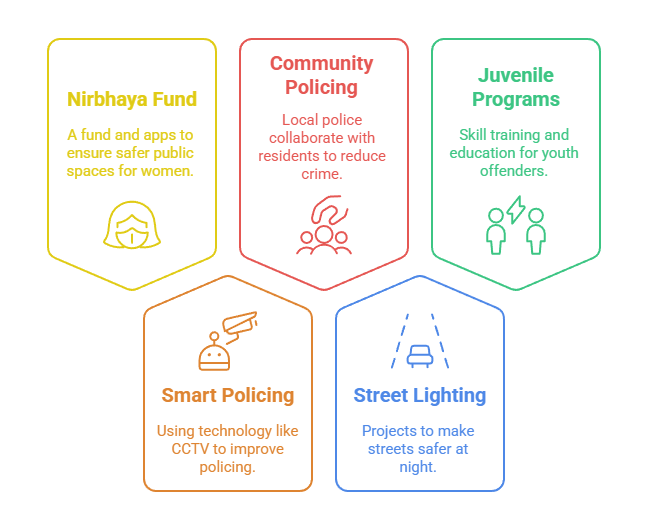
- Nirbhaya Fund and Women’s Safety Apps: To ensure safer public spaces for women.
- Smart Policing Initiatives: Use of CCTV, facial recognition, and predictive policing.
- Community Policing: Collaboration between local police and RWAs to curb neighborhood crime.
- Street Lighting Projects: Safer streets at night reduce chances of mugging and assault.
- Juvenile Reformation Programs: Focus on skill training and education for youth in conflict with law.
Examples
- Delhi Snatching Crisis (2022–2024): NCR region saw a spike in street crimes with daily chain snatching and mobile thefts. Media dubbed it “Snatchers’ Paradise”.
- Mumbai Underworld History: In the 1980s–90s, street crime was a stepping stone into organized crime syndicates like the D-Company.
- Hyderabad SHE Teams: A successful model of patrolling teams ensuring safety of women in public spaces, reducing harassment on the streets.
Conclusion: Toward Safer Streets
Street crime is a multidimensional issue that reflects broader societal challenges like inequality, unemployment, poor urban planning, and institutional failure. A purely punitive approach fails to address its root causes. Hence, sociological understanding is essential to formulate inclusive and humane policies. Creating safe and inclusive urban environments, youth engagement through education and employment, and strengthening community-police partnerships are crucial to combatting street crime in India.
PYQs
Paper 1
- Evaluate Durkheim’s concept of anomie and its relevance in contemporary society. (2022)
- What are the limitations of functionalist perspectives in studying crime and deviance? (2021)
- Explain Robert K. Merton’s typology of deviant forms of adaptation. Illustrate with suitable examples. (2020)
- How do strain theories explain deviance in society? (2019)
- Critically examine the labeling theory of deviance. (2017)
- Discuss the sociological significance of subcultures in understanding youth crime. (2016)
- Examine the contribution of ecological theories in understanding urban crime. (2015)
- How does cultural transmission theory explain the spread of deviant behavior? (2018)
- Discuss the feminist critique of traditional theories of crime and deviance. (2014)
- Explain the role of social disorganization in the genesis of crime. (2013)
Paper 2
- Critically analyze the role of community policing in controlling street crime in Indian cities. (2023)
- Discuss the effectiveness of technological solutions such as CCTV and predictive policing in reducing street crimes. (2023)
- Analyze how gender influences patterns of victimization in street crimes in Indian cities. (2022)
- What is the role of youth unemployment in the rise of street crimes? Discuss with Indian examples. (2021)
- Describe the challenges faced by law enforcement agencies in tackling street crime in metropolitan areas. (2020)
- Explain how marginalized communities become both victims and perpetrators of urban crime. (2019)
- Discuss how economic inequality contributes to the growth of crime in urban India. (2018)
- Examine the relationship between rapid urbanization and increase in crime rates in Indian cities. (2017)
- Explain the sociological factors behind the rise of drug-related offenses among urban youth in India. (2016)
- Examine the impact of migration and anonymity on crime patterns in urban India. (2015)
|



One comment