Introduction
Love has always been more than just a personal affair. In every society, it is deeply shaped by culture, religion, and law, and in modern states, it is regulated through a complex interplay between personal freedom and state authority. In India, this relationship between State, love, and the law is especially intricate due to its plural legal system, cultural diversity, and socio-political debates. From inter-caste marriages under the Hindu Marriage Act to interfaith unions regulated by the Special Marriage Act, the state has played a defining role in deciding who can marry, how they can marry, and under what conditions their love is legally recognised.
This topic has gained renewed attention due to recent debates on the Uniform Civil Code (UCC), rising cases under “love jihad” laws, and the Supreme Court’s interpretation of the right to choose one’s partner as a fundamental right.
State Regulation of Love:
- In pre-modern societies, marriage and love were governed primarily by customary laws dictated by religion, caste, and kinship systems. The colonial state in India began codifying personal laws for Hindus, Muslims, Christians, and Parsis, giving them legal recognition. This created a plural legal system where the law of marriage depended on one’s religion.
- Post-independence, the Indian state retained this system but also introduced secular legal provisions such as the Special Marriage Act (1954) to allow interfaith and inter-caste marriages without religious conversion. This was in line with R. Ambedkar’s vision of reforming marriage laws to break caste barriers.
Love in the Shadow of the Law

- Inter-caste Marriages: Inter-caste marriages are legally recognised under the Hindu Marriage Act and the Special Marriage Act. N. Srinivas’s concept of “Sanskritisation” explains how some marriage choices are influenced by upward caste mobility. Despite legal protection, NCRB data shows that such unions still face hostility, including honour killings. To promote acceptance, schemes like the Dr. Ambedkar Scheme for Social Integration through Inter-Caste Marriages provide incentives to couples.
- Interfaith Marriages: Interfaith marriages are usually governed by the Special Marriage Act, which requires a 30-day public notice—a provision criticised for exposing couples to harassment. Additionally, “love jihad” laws in states like Uttar Pradesh and Madhya Pradesh restrict religious conversion for marriage, sparking debates about state overreach into personal choice.
- Same-Sex Relationships and Marriage Equality: The Supreme Court’s Navtej Singh Johar v. Union of India (2018) judgment decriminalised homosexuality, affirming the right to love freely. However, in 2023, the Court declined to recognise same-sex marriages, deferring the matter to Parliament, leaving marriage equality unresolved in India.
The State’s Role:
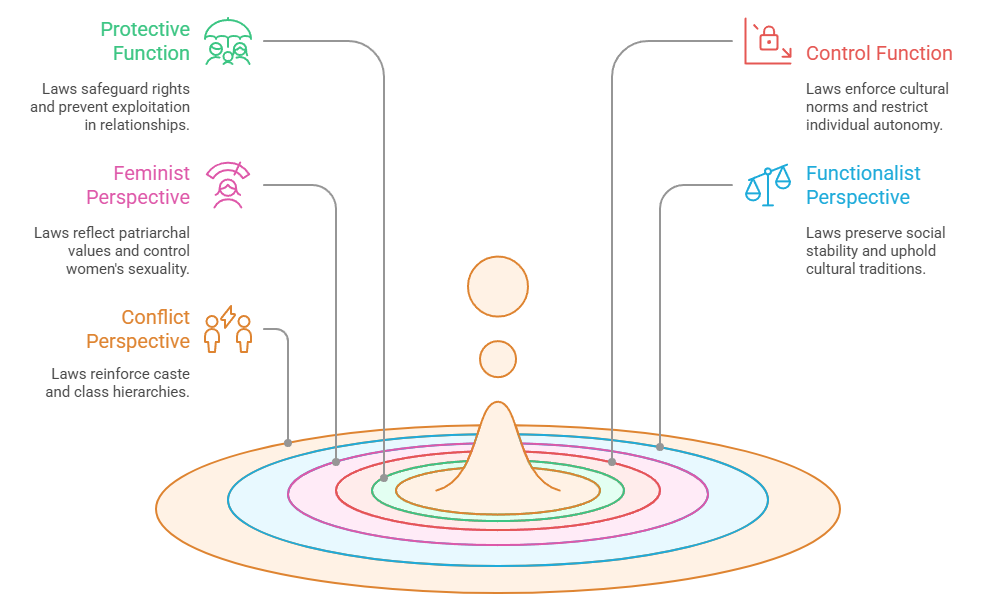
- Protective Function: The state enforces laws to safeguard rights, prevent exploitation, and promote equality in relationships. Examples include the Prohibition of Child Marriage Act, which sets a minimum marriage age to protect young individuals from forced unions.
- Control Function: Alongside protection, the state enforces cultural norms and maintains social order, which can restrict individual autonomy. Anti-conversion laws linked to marriage and procedural hurdles in interfaith unions often serve as tools of control rather than liberation.
- Feminist Legal Theory Perspective: Catharine MacKinnon and Flavia Agnes argue that laws often reflect patriarchal values, controlling women’s sexuality under the pretext of protection. In India, this is evident in how state interventions in interfaith marriages tend to disproportionately police women’s decisions.
- Functionalist Perspective: Talcott Parsons would view state regulation of marriage as a way to preserve social stability, uphold cultural traditions, and ensure the smooth functioning of family as a key social institution.
- Conflict Perspective: From Marxist and Ambedkarite perspectives, marriage laws can reinforce caste and class hierarchies. Instead of dismantling inequality, legal frameworks may sometimes legitimise social stratification under the guise of order and tradition.
Constitutional Dimensions of Love and Marriage
Article 21 of the Indian Constitution guarantees the right to life and personal liberty, which the Supreme Court has interpreted to include the right to marry a person of one’s choice (Shafin Jahan v. Asokan K.M., 2018).
However, personal laws often conflict with constitutional principles:
- Hindu Marriage Act permits certain religiously sanctioned practices,
- Muslim Personal Law recognises polygamy,
- These raise debates on the Uniform Civil Code and whether personal liberty can be harmonised with community traditions.
Recent Controversies
- Uniform Civil Code in Uttarakhand (2024) – Seen as a step towards secular uniformity but criticised for potentially ignoring minority customs.
- Love Jihad Laws – Challenged in High Courts for violating Articles 14, 19, and 21.
- Same-Sex Marriage Debate – Reflects global trends towards marriage equality and the Indian judiciary’s cautious approach.
- Khap Panchayat Interference – Despite Supreme Court orders, local bodies continue to enforce caste-endogamous norms.
Sociological Analysis

- Role of Law in Social Change: M.N. Srinivas observes that while law can shape social norms—such as by legalising inter-caste or interfaith marriages—its real impact depends on whether communities accept and internalise these changes. André Béteille adds that without parallel social reform, legal changes remain symbolic, as seen in the persistent caste-based resistance to intermarriage despite decades of legal sanction.
- State, Love, and Identity: In India, marriage is more than a personal decision—it reflects one’s religious, caste, and gender identity. Anthony Giddens notes that in modern societies, love is becoming individualised, driven by personal choice and emotional fulfilment. However, in India, collective identity and social approval continue to dominate marital decisions, often overriding individual autonomy.
- Global Comparison: Countries like France operate under a fully secular marriage framework where religion plays no role in the legal process. In contrast, India maintains a pluralistic legal system, where personal laws vary by religion. This coexistence of secular and religious legal frameworks makes India a distinctive case for studying the sociology of law, highlighting the challenges of balancing individual rights with community traditions.
Policy Recommendations
- Reform Special Marriage Act – Remove the 30-day notice requirement to protect couples from harassment.
- Strengthen Legal Protections – Implement fast-track courts for cases involving violence against interfaith or inter-caste couples.
- Public Awareness Campaigns – Promote constitutional values of equality and choice.
- Gender-Sensitive Laws – Address patriarchal biases in personal laws, especially regarding women’s rights in marriage and divorce.
Conclusion
The relationship between the state, love, and the law in India reflects the country’s ongoing struggle between individual freedom and collective identity. While the Constitution envisions a society where love transcends caste, religion, and gender, societal resistance and legal complexities continue to limit personal choice. This theme is important because it connects law, social institutions, and cultural norms—showing how legal frameworks both challenge and reinforce social hierarchies. The debates over the Uniform Civil Code, love jihad laws, and same-sex marriage are not just legal matters—they are also deeply sociological questions about the kind of society India wants to be.
Previous Year Questions
Paper 1 –
- Discuss the changing nature of marriage and family in modern society. (2014)
- Examine the impact of law and social policy on the institution of marriage. (2015)
- Evaluate the role of law in bringing about social change in India. (2016)
- How does patriarchy manifest itself in interpersonal relations within the family? (2016)
- Discuss the relationship between religion and social change in the context of marriage laws in India. (2017)
- Explain Anthony Giddens’ concept of “pure relationship” and its relevance to contemporary marriages. (2018)
- Discuss the role of feminist theories in understanding the regulation of sexuality through law. (2019)
- Analyse the conflict perspective on family as an institution. (2020)
- Examine how law can act both as an instrument of social change and social control. (2021)
- Discuss the relevance of Emile Durkheim’s theory of regulation to the modern institution of marriage. (2022)
Paper 2 –
- Explain the role of law in reforming marriage and family systems in India with reference to the Hindu Marriage Act and the Special Marriage Act. (2014)
- Discuss the persistence of caste in regulating marriage in India despite legal interventions. (2015)
- Critically examine the Special Marriage Act in the context of interfaith marriages in India. (2016)
- Analyse the causes and consequences of honour killings in India. (2017)
- Examine the sociological significance of Dr. Ambedkar’s advocacy for inter-caste marriages. (2018)
- Discuss the impact of personal laws on gender justice in India. (2019)
- Critically analyse the debate around Uniform Civil Code in India. (2020)
- Evaluate the implications of “love jihad” laws on women’s autonomy and interfaith marriages. (2021)
- Examine the challenges faced by same-sex couples in India in the context of marriage rights. (2022)
- Discuss the role of judiciary in safeguarding individual choice in marriage in India with suitable case studies. (2023)
|


One comment