
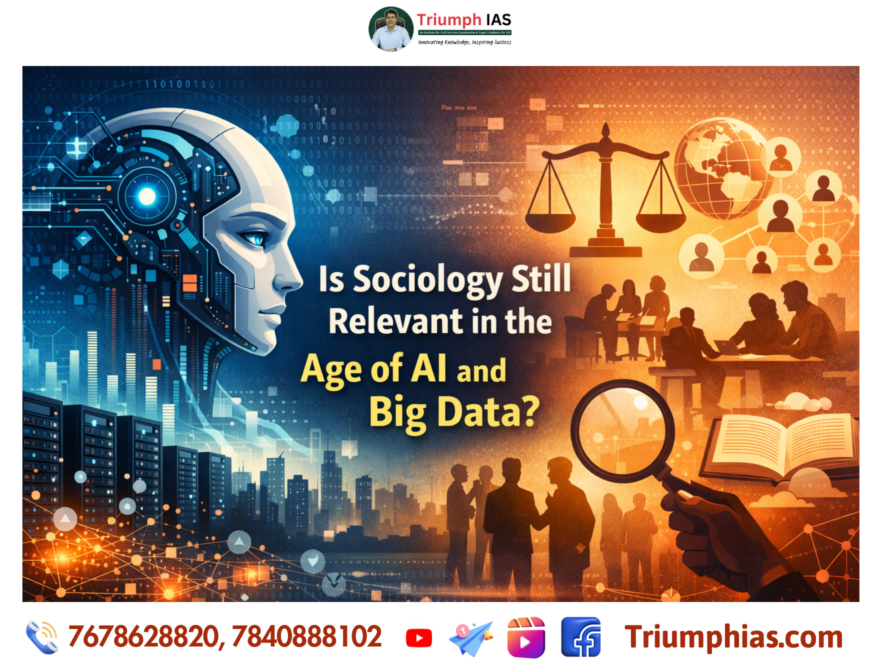
Is Sociology Still Relevant in the Age of AI and Big Data?
(Relevant for Sociology Optional (Paper I) , Sociology Optional (Paper II), GS Paper IV (Ethics) , Essay Paper)
IntroductionThe 21st century is often described as the age of Artificial Intelligence (AI), Big Data, algorithms, and automation. From predictive policing and facial recognition to social media algorithms and digital surveillance, data-driven technologies increasingly shape human behaviour, governance, and social relations. In such a context, a crucial question arises: Is Sociology still relevant in the age of AI and Big Data? Contrary to the belief that data and algorithms can replace social understanding, sociology is not only relevant—it is indispensable for interpreting, regulating, and humanising technological transformation.
1. Limits of Big Data: Why Numbers Alone Are Not EnoughBig Data excels at identifying patterns, correlations, and trends, but it often fails to explain meaning, context, and power relations.
Thus, sociology complements Big Data by offering interpretive depth, moving beyond correlation to causation and meaning. 2. Algorithmic Bias and Social InequalityAI systems are not neutral. They often reproduce and amplify existing social inequalities related to:
Sociology helps reveal how biased datasets, institutional structures, and power asymmetries get embedded into algorithms. Without sociological insight, AI risks becoming a tool of systemic exclusion rather than social progress. 3. Surveillance, Privacy, and the Changing Nature of PowerThe expansion of data collection has transformed the nature of power and governance:
Sociology critically examines how consent, autonomy, privacy, and citizenship are reshaped in digital societies. It raises ethical questions that technology alone cannot answer. 4. Work, Automation, and the Future of EmploymentAI-driven automation is restructuring labour markets:
Sociology analyses how technological change affects class structure, labour relations, social mobility, and dignity of work. It also questions the assumption that technological efficiency automatically leads to social welfare. 5. Social Media, Identity, and Digital CommunitiesDigital platforms are redefining identity formation and social interaction:
Sociology studies how technology reshapes collective consciousness, public discourse, and social movements, revealing the social consequences of digital communication beyond technical metrics. 6. Sociology as a Guide for Ethical and Inclusive AIIn an age dominated by technological optimism, sociology provides:
Public policy, governance, and democratic accountability require sociological knowledge to ensure that AI serves human values rather than market or state power alone.
ConclusionFar from being obsolete, sociology is more relevant than ever in the age of AI and Big Data. While technology explains patterns, sociology explains people, power, inequality, and meaning. Without sociology, AI risks becoming socially blind; with sociology, technology can become socially responsible, inclusive, and humane. |

UPSC Civil Services (Sociology Optional)– Mains Question
Big Data and Artificial Intelligence have transformed social life, but they cannot replace sociological understanding.”
Critically examine this statement. (250 words)
To Read more topics, visit: www.triumphias.com/blogs
Read more Blogs:
Sociological Imagination vs WhatsApp University: Sociology and Common Sense Today
One comment