
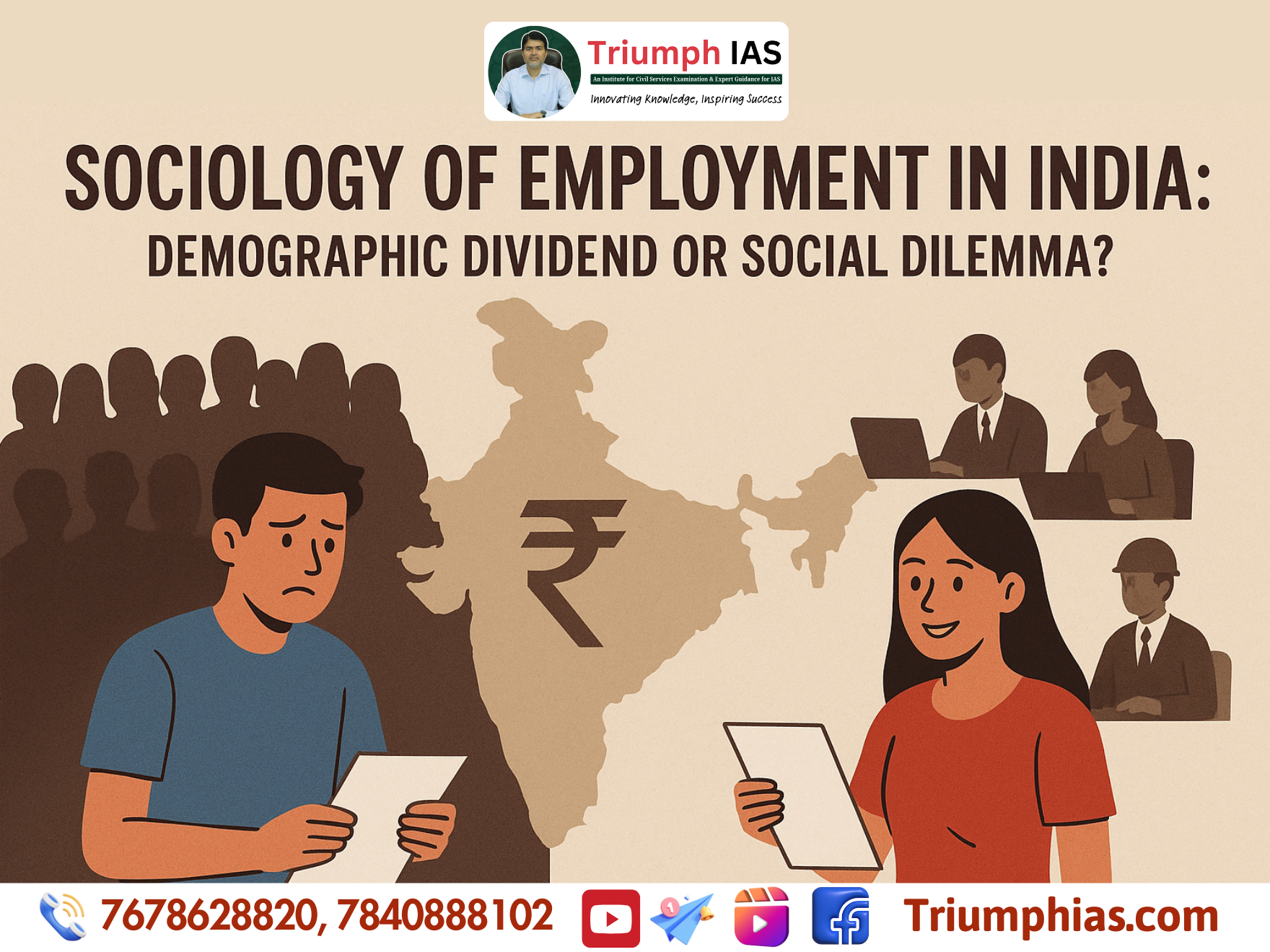
Sociology of Employment in India: Demographic Dividend or Social Dilemma?
(Relevant for Sociology Paper 1: works and Economic Life)
Sociology of Employment in India“Employment is not just an economic activity — it is a reflection of social structures, institutions, and power relations.” As India stares at the opportunity — and risk — of a demographic dividend, the urgency of addressing its employment challenge is growing. The Confederation of Indian Industry (CII) recently called for a Unified National Employment Framework, arguing that fragmented labour schemes, mismatched skills, and poor female labour participation could derail India’s development vision for Viksit Bharat by 2047. While policymakers view this as an economic issue, a sociologist sees something more profound: a mirror of India’s social inequalities, institutional silences, and structural contradictions. Work and Social Integration: What Durkheim Would SayIndia is expected to add 133 million workers by 2050, making up nearly 18% of the global workforce. But without jobs, this demographic bulge could lead to instability — a phenomenon Émile Durkheim warned against in his theory of anomie.
➤India’s shift to informal, gig-based work challenges the functional integration of labour in society and risks producing alienation, instability, and inequality. Caste, Class and Labour Stratification: Bourdieu Meets BéteilleDespite state efforts, access to jobs remains structurally unequal.
“It is not just about what you know, but how you present what you know.” This explains widespread graduate unemployment and credential inflation — especially among OBC, SC, and rural youth — who lack the “soft skills” or networks to enter high-paying jobs. ➤ India’s employment crisis isn’t just about a lack of jobs, but about who gets what kind of job, reflecting deep-rooted caste-class inequalities. Gendered Labour and Patriarchy: Walby’s Dual Systems in IndiaDespite rising education levels, India’s Female Labour Force Participation Rate (FLFPR) remains below 35% (PLFS 2024). This contradiction between education and employment highlights structural patriarchy.
Even when women “enter” the workforce, they’re often pushed into informal, low-paid, or invisible jobs. ➤ Female exclusion from the labour force is not just a choice or economic issue, but a structural and cultural problem rooted in public-private patriarchy. Gig Work, Urban Distress, and the “Precariat”India’s urban labour market is witnessing a silent transformation:
British sociologist Guy Standing calls this new class the “precariat” — workers who have:
“The precariat is not just economically insecure — it is politically volatile and socially excluded.” These workers lack collective bargaining rights and often don’t even know who their real employer is — a shift Manuel Castells predicted in his theory of the Network Society. ➤ The gig economy is creating new class divisions, changing the moral economy of labour, and replacing the security of traditional employment with algorithmic control. State, Labour, and Neoliberalism: Miliband’s CritiqueIndia’s employment programmes — like Skill India, PLI, and Labour Codes (2020) — are aimed at efficiency and reform. But from a neo-Marxist perspective, they may reveal the state’s bias towards capital. Ralph Miliband, in The State in Capitalist Society, argued that even democratic states often serve the interests of the ruling class. In India:
➤ The Indian state’s labour strategy may reflect a neoliberal shift, privileging capital over labour under the guise of “ease of doing business.” Data and Governance: The Foucaultian LensIndia’s employment data is fragmented, outdated, and often politicised. Without evidence-based insights, policy suffers. French thinker Michel Foucault’s concept of “governmentality” tells us that modern states govern not through force, but through knowledge systems — data, classifications, categories. But in India:
A Unified Labour Observatory, as proposed, could act as a “data panopticon” — allowing the state to better monitor and manage workforce shifts. ➤ Without robust data, the governance of labour remains blind — both in protecting rights and measuring success. A Sociologically Informed Way ForwardTo address India’s employment challenge sociologically, we must go beyond economics:
Conclusion: Jobs as the New Social ContractIndia’s employment challenge is not just about matching supply and demand — it’s about reimagining the role of work in society. Work is about identity, dignity, and integration. When large sections of society — women, rural youth, marginalised castes — remain excluded, the very promise of development is hollow. To truly achieve Viksit Bharat by 2047, India must make jobs the centre of economic and social policy, informed not only by markets — but by sociology. |
To Read more topics, visit: www.triumphias.com/blogs
Read more Blogs:
Female Labour Force Participation in India: A Sociological Critique Beyond Numbers
Robert K Merton Manifest and Latent Functions: A Detailed Analysis