
Counting India: A Sociological Interpretation of the 8th Economic Census and the 2027 Population Census
(Relevant for Sociology Paper 1: Research methods and Analysis and Politics and Society)
|
India’s plan to conduct its 8th Economic Census (EC) in 2027, immediately after the two-phase Population Census of 2026–27, marks a significant moment in the nation’s statistical and developmental landscape. While these exercises are often framed as technical or administrative, a sociological lens reveals their deeper implications: the politics of counting, the construction of economic reality, the visibility of social groups, and the evolving relationship between the state and its citizens. The Economic Census, first held in 1977, counts all establishments involved in production or distribution of goods and services. The upcoming 8th EC will generate data for the Statistical Business Register (SBR)—a unified database of enterprises across India. Meanwhile, the 2027 Population Census, the 16th since 1872, will offer India’s most detailed demographic picture, capturing housing, migration, literacy, language, religion, employment, caste categories (SC/ST), and fertility. Together, these two exercises amount to a comprehensive mapping of society—socially, demographically, and economically. And this is where sociology steps in: counting is never neutral. It is a way through which societies create categories, identities, and hierarchies. Weber and the Modern State: Rationalisation Through CountingMax Weber saw bureaucracy as the defining feature of modern governance—characterised by accuracy, calculability, documentation, and control. Both the Population Census and Economic Census are expressions of this process of rationalisation. The planned Statistical Business Register (SBR) takes Weber’s “iron cage of rationality” to a new level:
For Weber, this makes the state more capable—but also more intrusive. As enterprises become “legible,” the state gains unprecedented informational power. The Census transforms complex social and economic life into quantifiable categories, allowing governance through numbers. Weber would both appreciate the efficiency and warn of the risks: societies shaped by excessive documentation may sacrifice human spontaneity and cultural complexity at the altar of administrative order. Durkheim: Mapping Social Solidarity in a Complex SocietyÉmile Durkheim believed that modern societies are held together by organic solidarity—cooperation across specialised roles in an interdependent economy. The Economic Census, by capturing the distribution and diversity of enterprises, reveals precisely this underlying structure of interdependence. The Population Census, meanwhile, captures the social morphology of the nation: demographic composition, linguistic communities, caste distributions, urban-rural divides. For Durkheim, such data is not only about counting but understanding the health of the collective conscience. Questions he would ask include:
Both censuses help diagnose whether Indian society is moving toward cohesion or conflict. Marx: Economic Census and the Visibility of Class RelationsKarl Marx would approach the 8th Economic Census differently. For him, economic structures reveal the core of social power. He would ask:
The EC’s focus on establishments could unintentionally prioritise capital (enterprises) over labour (workers). Marx would argue that without worker-centred data, the Census risks naturalising capitalist relations rather than questioning them. The Population Census also has Marxian significance: it maps the masses not merely as individuals but as members of socio-economic classes whose lives are shaped by material conditions. Census categories such as literacy, employment, household amenities, and migration reveal patterns of inequality that Marx considered fundamental to understanding capitalist societies. Foucault: The Census as a Technology of Power and Knowledge
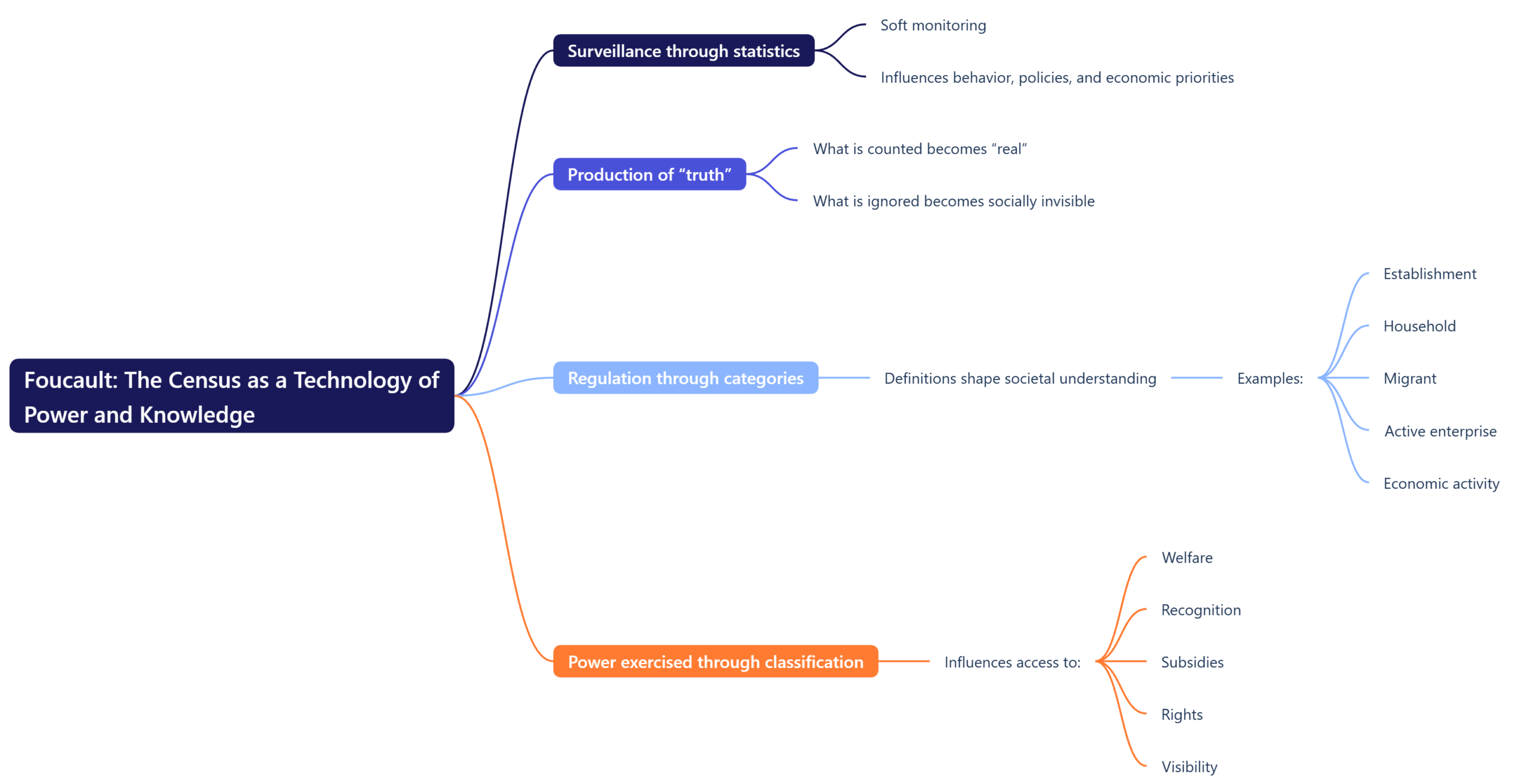
Michel Foucault saw censuses as quintessential tools of governmentality—technologies through which states manage populations by producing knowledge about them. For Foucault, the upcoming censuses reflect:
Not coercive surveillance, but the soft monitoring of populations to shape behaviours, policies, and economic priorities.
What the Census counts becomes “real.” What it ignores becomes socially invisible.
By defining “establishment,” “household,” “migrant,” “active enterprise,” or “economic activity,” the Census shapes how society understands itself.
Classifications influence access to welfare, recognition, subsidies, rights, and visibility. Thus, the Population and Economic Censuses are not merely descriptive; they are performative—creating new social realities. Bourdieu: Census Categories as Social ConstructsPierre Bourdieu would argue that census categories are embedded in power structures. Even the definition of “enterprise” or “household” reflects the state’s view of legitimate economic behaviour. He would point to how:
The state’s categories become the “official” categories of thought, shaping how society perceives itself.
The EC maps economic capital directly, but cultural and social capitals remain hidden beneath numbers.
By aggregating enterprises under certain codes, the Census shapes which sectors are prioritised for development. Thus, for Bourdieu, the Census is both a reflection and instrument of the state’s symbolic power. Amartya Sen: Capabilities, Data, and Human DevelopmentAmartya Sen reframes development not in terms of income but in terms of capabilities—the freedoms people have to lead meaningful lives. Census data is fundamental to capability analysis. The Population Census captures:
The Economic Census reveals:
Sen would argue that these datasets, if used responsibly, can advance human development policies—but only if the numbers are interpreted with justice and equity in mind. Conclusion: Counting as a Sociological EventIndia’s 2027 Census exercises—both Economic and Population—are not merely administrative milestones. They are sociological events that shape how India understands itself, governs itself, and imagines its future. From Weber’s bureaucratic rationality to Marx’s class analysis, from Durkheim’s social solidarity to Foucault’s governmentality, from Bourdieu’s classification power to Sen’s capability lens, these censuses:
In counting itself, India is not just measuring society—it is actively shaping the social world that will emerge in the decades to come. |
To Read more topics, visit: www.triumphias.com/blogs
Read more Blogs:
When Genetics Meets Governance: Thalassemia, Contaminated Blood, and Social Inequalities in India
Manual Scavenging in India: Caste, Labour, and the Sociology of State Failure
One comment