Introduction
Wealth inequality is often discussed in economic terms, but at its core, it is a sociological phenomenon. The recent G20 report reveals that India’s top 1% increased their wealth by 62% since 2000, highlighting not just economic concentration but social stratification, reproduction of elite power, and structural barriers that shape life chances.
Sociology allows us to go beyond numbers: it examines how social hierarchies, cultural norms, and institutional structures perpetuate inequality and influence everyday life, political participation, and social mobility.
Wealth Inequality as Social Stratification
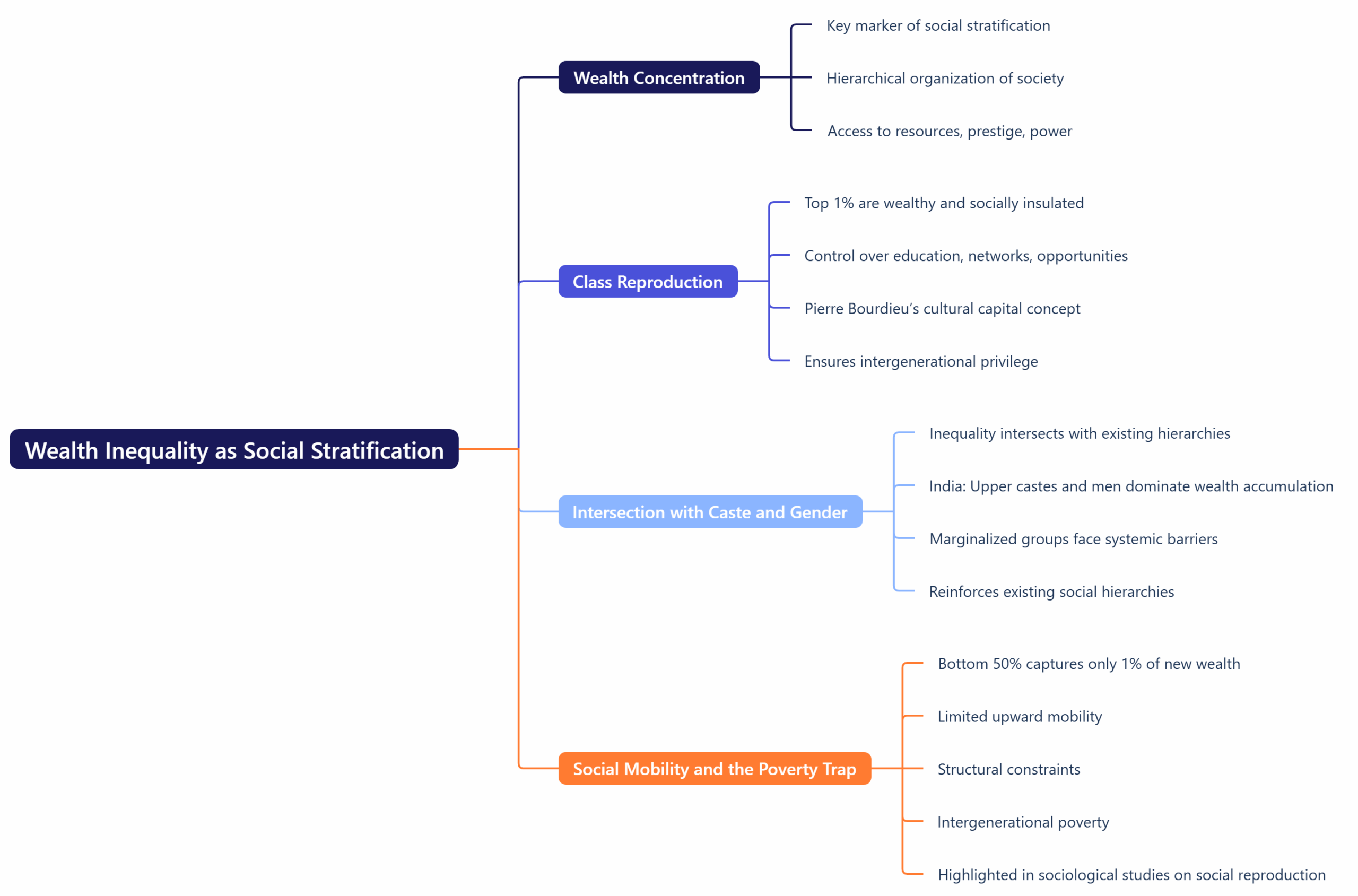
Wealth concentration is a key marker of social stratification, where society is organized hierarchically based on access to resources, prestige, and power.
- Class Reproduction
- The top 1% are not only wealthy but socially insulated, controlling education, networks, and opportunities.
- Pierre Bourdieu’s concept of cultural capital explains how elite families transmit advantages through elite schools, professional networks, and cultural knowledge, ensuring intergenerational privilege.
- Intersection with Caste and Gender
- Inequality interacts with existing social hierarchies. In India, upper castes and men dominate wealth accumulation, while marginalized castes, women, and minorities face systemic barriers in property ownership, inheritance, and economic opportunities.
- Wealth inequality thus reinforces pre-existing social hierarchies rather than creating purely meritocratic outcomes.
- Social Mobility and the Poverty Trap
- The bottom 50% of the population capturing only 1% of new wealth reflects limited upward mobility.
- Structural constraints such as unequal access to quality education, nutrition, and healthcare keep large populations trapped in intergenerational poverty, a concept highlighted in sociological studies on social reproduction.
Wealth and Power: Political and Cultural Implications
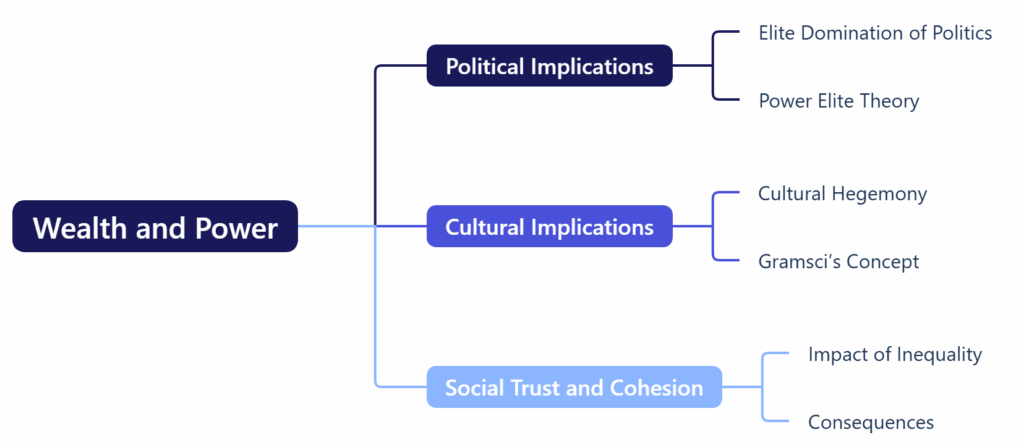
- Elite Domination of Politics
- Concentrated wealth translates into political influence, through campaign funding, lobbying, and shaping policies.
- C. Wright Mills’ theory of the power elite shows how economic elites dominate institutions, creating rules that maintain inequality.
- Cultural Hegemony
- Wealthy groups often shape social norms, tastes, and values, influencing media, consumer culture, and education curricula.
- Antonio Gramsci’s idea of cultural hegemony explains how elite ideas become dominant, making inequality appear “natural” or justified.
- Social Trust and Cohesion
- Extreme inequality erodes trust, as the majority perceive institutions as favoring the rich.
- Social fragmentation arises, increasing conflict, resentment, and societal tension.
Inequality and Everyday Life
Sociologically, inequality manifests in daily interactions, opportunities, and life experiences:
- Health and Nutrition: Malnutrition and food insecurity reflect structural violence, where social arrangements harm those at the bottom.
- Education: Unequal access to quality education creates symbolic violence, limiting the ability of disadvantaged groups to compete on equal footing.
- Urban Segregation: Wealthy neighborhoods are segregated from poorer areas, reinforcing social distance and reducing cross-class interactions.
Global Context and Indian Society
The G20 findings show that inequality is global but locally mediated:
- In India, rapid economic liberalization and globalization have benefited the elite disproportionately, while historical caste and gender hierarchies amplify social exclusion.
- Wealth is both an economic and symbolic resource, granting the elite influence over lifestyle, politics, and cultural production.
Sociology teaches that policies alone (taxes, social spending) are necessary but insufficient; addressing inequality requires structural social reforms, cultural change, and the dismantling of entrenched hierarchies.
Towards a Sociologically-Informed Response
- Reducing Structural Barriers
- Reform education, land ownership, and employment systems to reduce structural inequality.
- Empowering Marginalized Groups
- Focus on women, lower castes, and minorities, ensuring access to social, cultural, and economic capital.
- Redistribution of Cultural Capital
- Encourage broad access to elite networks, mentorship, and social mobility programs.
- Participatory Democracy
- Ensure marginalized populations influence policymaking to counter elite capture of institutions.
Conclusion
India’s top 1% growing wealth by 62% is not merely an economic statistic—it is a mirror of social stratification, power inequality, and cultural hegemony. Sociologically, inequality shapes who we are, how we interact, and which opportunities we can access. Addressing it requires structural, cultural, and political interventions that redistribute not only wealth but also social power, networks, and opportunities.
Inequality is thus both a social and moral issue, calling for a society that prioritizes equity, social justice, and intergenerational fairness.
|

2 comments