Introduction
Social stratification in India is a deeply entrenched phenomenon that shapes access to power, privilege, and resources. Rooted historically in the caste system, it has evolved to include economic class, gender, religion, and regional disparities. For aspirants, understanding social stratification is crucial not only from a sociological theory perspective but also for analyzing contemporary inequalities and social justice movements.
What is Social Stratification?
Social stratification refers to the hierarchical arrangement of individuals in a society based on factors like caste, class, ethnicity, gender, and occupation. It results in differential access to resources, power, and life opportunities.
Forms of Social Stratification in India

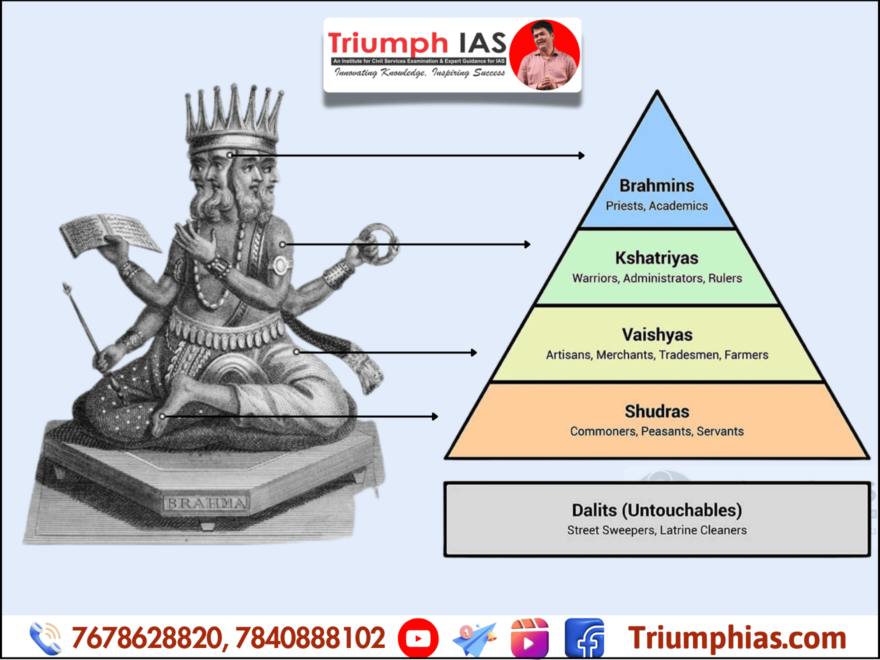
- Caste-Based Stratification: Caste is the most rigid and historically deep-rooted form of social stratification in India. Based on the varna and jati systems, it assigns individuals a social status by birth. It dictates occupation, marriage, and social interactions, often leading to exclusion and discrimination, especially for Dalits and lower castes. Despite constitutional safeguards, caste still influences access to education, jobs, and social mobility.
- Class-Based Stratification: Class stratification is based on economic factors such as income, wealth, education, and occupation. Unlike caste, class allows for upward and downward mobility. However, in India, caste and class often intersect, with marginalized castes frequently trapped in lower economic classes due to historical deprivation. Economic liberalization has also widened the gap between the rich and poor, especially in urban areas.
- Gender-Based Stratification: Patriarchy institutionalizes gender-based inequality in Indian society. Women often face restricted access to resources, lower wages, and limited decision-making power, both in public and private spaces. The gender divide becomes more severe when intersected with caste and class, as seen in the experiences of Dalit or tribal women who face triple marginalization.
- Religious Stratification: India’s multi-religious society experiences stratification along religious lines, with minority communities, particularly Muslims, often facing socio-economic and political marginalization. Disparities in literacy, employment, and housing—along with periodic communal tensions—reveal structural barriers to equal opportunity based on religion.
- Ethnic and Tribal Stratification: Adivasis and tribal communities form another layer of stratification. Often geographically isolated, they face exclusion in terms of education, health, land rights, and political representation. Many belong to the category of Particularly Vulnerable Tribal Groups (PVTGs), living in extreme poverty and disconnected from mainstream development.
- Regional Stratification: Inter-state disparities in development have created regional stratification in India. States like Kerala and Tamil Nadu fare better in health and education indicators, while BIMARU states lag behind. This uneven development fuels migration, regional tensions, and demands for statehood and autonomy in underdeveloped regions.
- Age-Based Stratification: Age also creates stratification in Indian society. Youth face challenges like unemployment and lack of political voice, while the elderly often suffer from neglect, poverty, and lack of healthcare. Age-based roles and expectations limit both young and old in their social participation and access to resources.
- Disability-Based Stratification: Persons with disabilities are another marginalized group, often excluded from mainstream education, employment, and social life. Physical inaccessibility, social stigma, and inadequate policy implementation reinforce their marginalization, despite protective legislation like the Rights of Persons with Disabilities Act, 2016.
Sociological Analysis
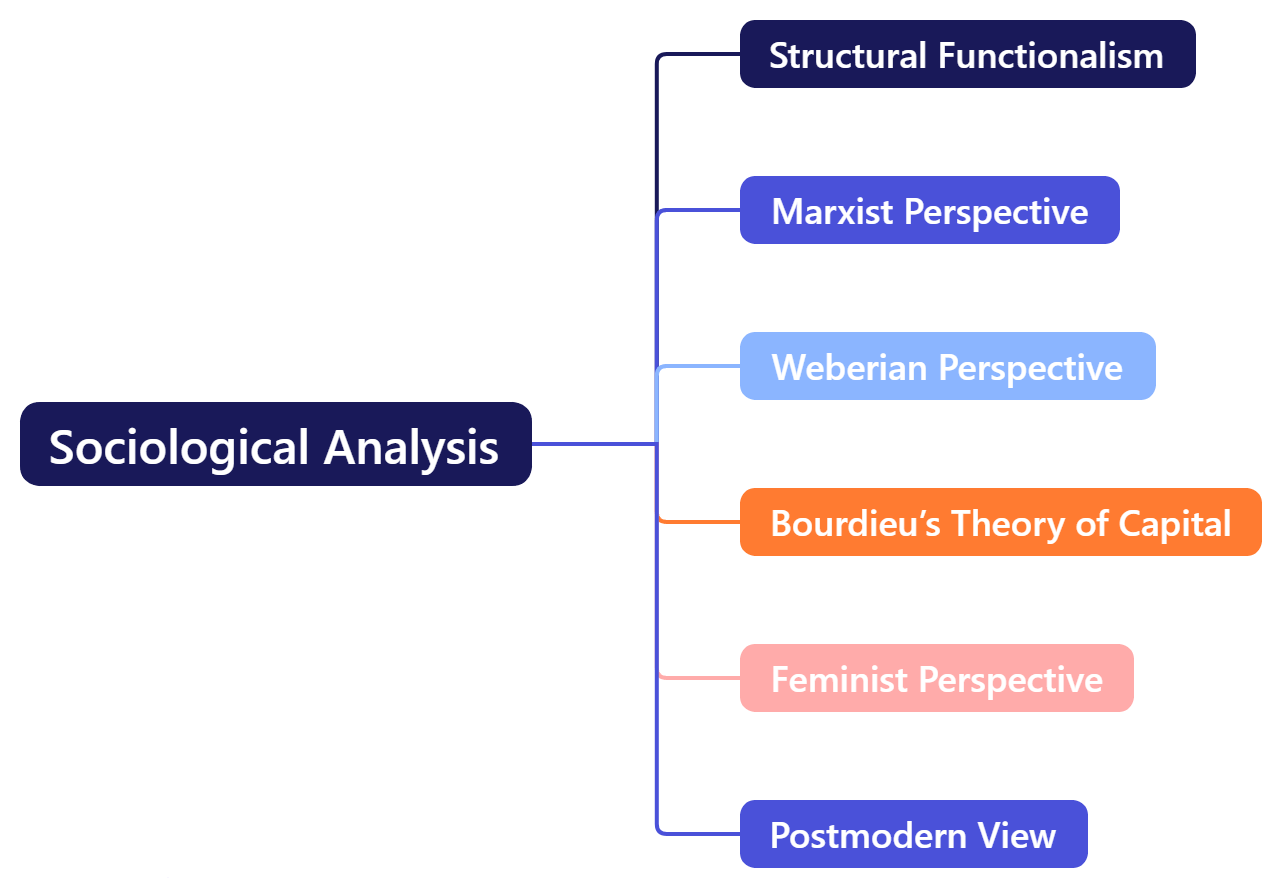
- Structural Functionalism: Emile Durkheim and Talcott Parsons viewed social stratification as a necessary mechanism to maintain social order. In the Indian context, the caste system historically functioned as a division of labor, assigning roles that ensured societal stability. However, this perspective often overlooks the deep social injustices and rigidity of caste-based inequality.
- Marxist Perspective: Karl Marx saw stratification as a result of class conflict, where the ruling class controls the means of production and exploits the working class. In India, R. Desai applied this idea to show how caste-based oppression overlaps with class exploitation—landless Dalits working in bonded labor are both economically and socially marginalized, reinforcing structural inequality.
- Weberian Perspective: Max Weber extended the idea of stratification beyond economic class to include status and power. In India, a caste group may achieve economic mobility but still face social exclusion. For instance, upwardly mobile Dalits often encounter status discrimination in housing or marriage despite improved incomes or education.
- Bourdieu’s Theory of Capital: Pierre Bourdieu argued that cultural, social, and economic capital is a key to understanding inequality. In India, elite access to English-medium schools, urban coaching centers, and professional networks reinforces privilege across generations. This helps explain why formal equality does not always lead to real social mobility.
- Feminist Perspective: Feminist thinkers like Sylvia Walby and Indian scholars such as Bina Agarwal highlight how gender intersects with caste and class. Dalit and tribal women often face a triple burden—gender subordination, caste discrimination, and economic exploitation. For example, they are underrepresented in politics, excluded from property rights, and overrepresented in informal work.
- Postmodern View: Postmodern theorists argue that stratification is no longer fixed but constantly reshaped by globalization, media, and identity politics. In India, the rise of caste-based political mobilization, social media activism, and urban migration has made social identities more negotiable, yet inequality remains persistent in newer forms like the digital divide and urban gentrification.
Current Affairs
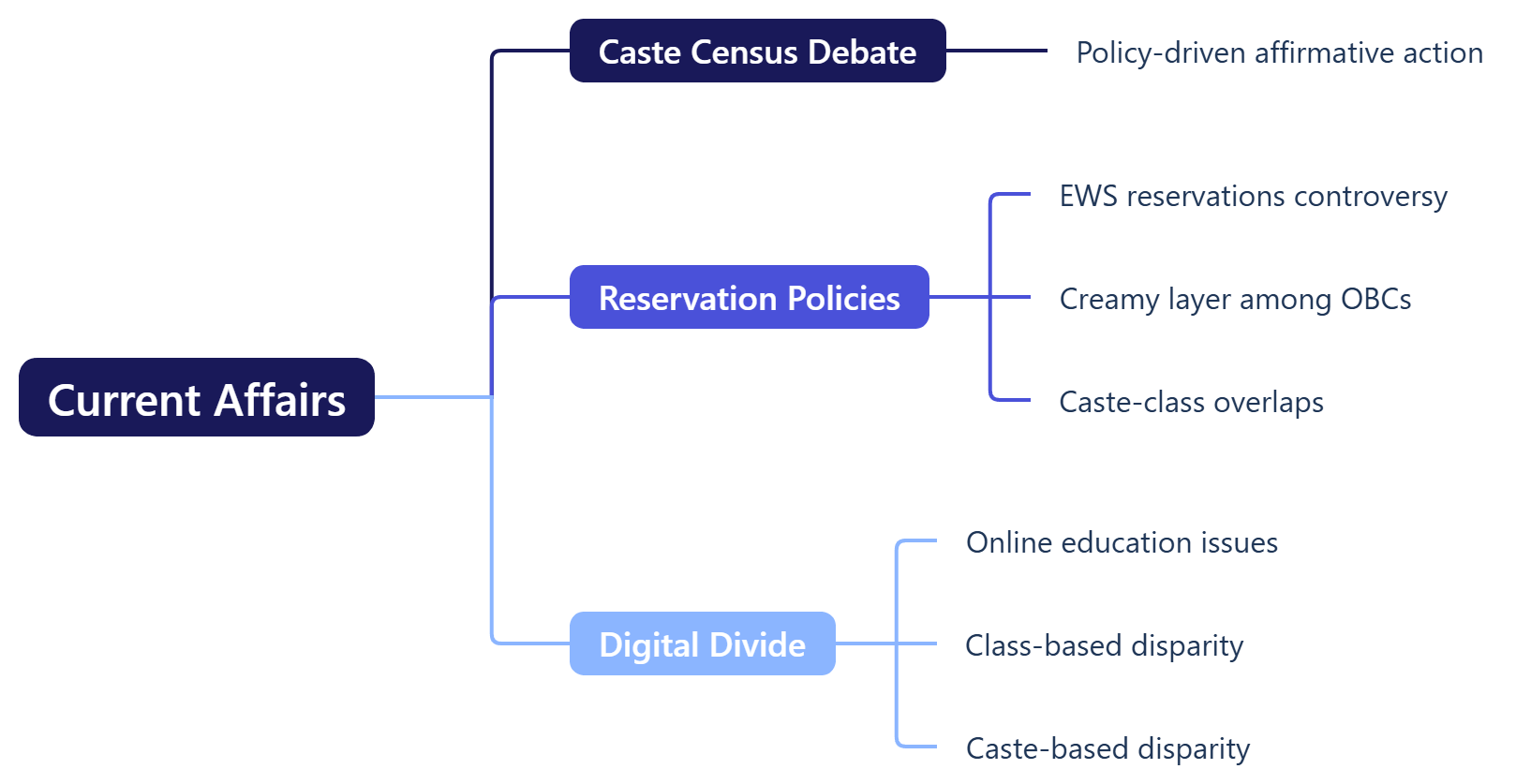
- Caste Census Debate: The demand for a caste-based census is seen as a move toward policy-driven affirmative action.
- Reservation Policies: Controversies over EWS reservations and the creamy layer among OBCs highlight the evolving nature of caste-class overlaps.
- Digital Divide: Online education during COVID-19 exposed the class and caste-based digital gap.
Conclusion
While India has witnessed transformations through democracy, technology, and economic reforms, structural inequalities continue to shape everyday life. Caste and class are not relics of the past—they are dynamic forces constantly restructured by political and economic change. For aspirants, recognizing the interconnected nature of stratification is essential to critically engage with issues like poverty, exclusion, and development.
PYQs
Paper I
- How do sociologists explain the persistence of social stratification in modern society? Discuss with reference to any two theoretical perspectives. (2023)
- Discuss the concept of social mobility. How far caste and class affect social mobility in contemporary India? (2022)
- Compare and contrast the functionalist and conflict perspectives on social stratification. (2020)
- Examine the relationship between caste and class in India. (2018)
- Distinguish between class and status. How far are they relevant in understanding the social mobility in Indian society? (2017)
- What is Weber’s theory of social stratification? How is it different from Marx’s theory? (2016)
- Discuss the concept of social exclusion and its application in understanding caste inequality in India. (2015)
- Critically examine the concept of caste as a system of social stratification. (2014)
Paper II
- Explain the emergence of middle classes in India and its impact on social stratification. (2023)
- How has the intersection of caste and gender led to multiple layers of oppression for Dalit women in India? (2022)
- What are the factors responsible for the continuity of caste in modern India? (2021)
- Discuss the changing nature of caste and class in India. (2020)
- Examine the nature of stratification systems in Indian society with special reference to caste, class, and gender. (2019)
- Explain how caste-based inequalities manifest in access to education and employment in contemporary India. (2018)
- Assess the impact of economic liberalization on caste and class dynamics in India. (2017)
- Analyze the concept of ‘dominant caste’ and its relevance in contemporary Indian rural society. (2016)
- How do caste and class interact in Indian urban society? Illustrate with suitable examples. (2015)
- Write a note on the role of caste in electoral politics in India. (2014)
|


One comment