Introduction
Why is it that women around the world, especially in India, spend hours cooking, cleaning, and caregiving—yet this labor remains invisible in our economic system? The answer lies in the deeply embedded sexual division of labor—a social arrangement where men and women are assigned different types of work based on gendered assumptions rather than merit or choice.
This blog explores how the sexual division of labor has evolved in India, why it persists despite modern reforms, and what sociological perspectives can help us understand and challenge it.
What Is Sexual Division of Labor?
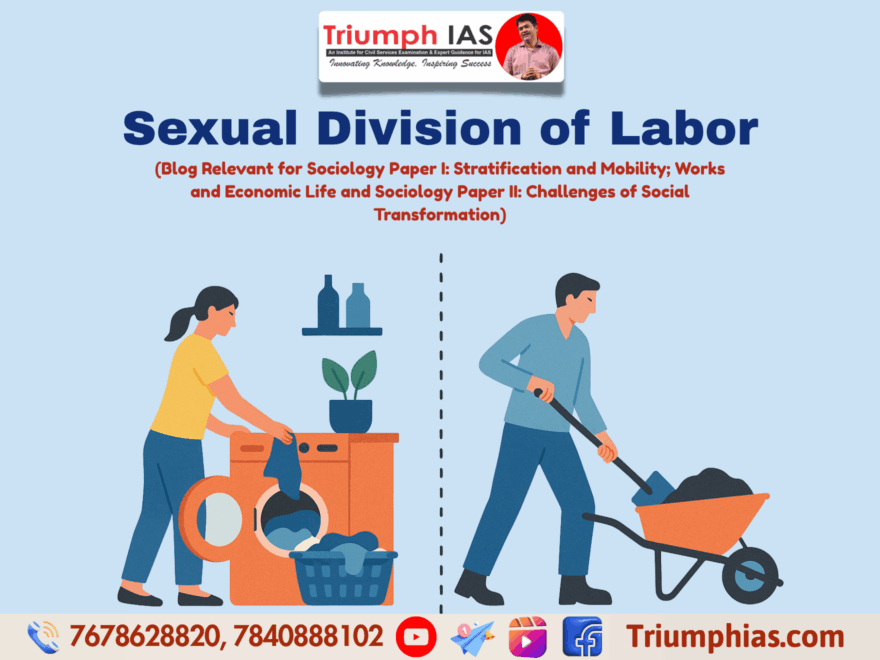
The sexual division of labor refers to the societal practice of assigning men and women to different types of tasks. It stems from traditional gender roles:
- Men are associated with public, paid, and productive work.
- Women are linked to private, unpaid, and reproductive labor (domestic work, child-rearing, and caregiving).
Though biology plays no deterministic role, the perception of women as “natural” caregivers continues to influence employment trends, household dynamics, and policy structures.
How Sexual Division of Labor Manifests in India

In Homes
- Women cook, clean, take care of children and elders.
- This work is unpaid and undervalued.
- NSSO’s Time Use Survey (2019) shows that women spend nearly 5 hours daily on unpaid domestic chores, while men spend less than 2 hours.
In Labor Markets
- Women are concentrated in caregiving jobs—nurses, domestic workers, teachers.
- Men dominate technology, manufacturing, engineering, and leadership roles.
- Women face the “glass ceiling” and are underrepresented in higher-paying sectors.
In Agriculture
- Women perform 60–70% of agricultural labor but own only 13% of agricultural land.
- They are rarely recognized as “farmers” despite being the backbone of rural economies.
Impact of Gendered Labor Division
- Reinforces Economic Inequality: Women’s unpaid labor subsidizes capitalist economies but is excluded from GDP.
- Limits Women’s Autonomy: Economic dependence on men curtails women’s mobility, decision-making, and access to education.
- Restricts National Growth: India’s Female Labor Force Participation Rate (FLFPR) remains low (approx. 33% as per PLFS 2023) due to domestic burdens.
- Distorts Policy Planning: When unpaid work isn’t counted, policies fail to allocate budgets for care infrastructure (childcare centers, elder care).
Sociological Analysis:

Talcott Parsons (Functionalism)
- Assigned instrumental roles to men and expressive roles to women in the family.
- Argued this division supports social stability.
- Critique: Justifies gender inequality and ignores women’s potential beyond domesticity.
Marxist Feminism
- Asserts that women’s unpaid labor sustains the reproduction of labor power for capitalism.
- Capitalism and patriarchy work together to exploit domestic and emotional labor.
- Sociologist A.R. Desai emphasized capitalist structures in reinforcing women’s exploitation in India.
Radical Feminism
- Focuses on patriarchy as the root of women’s oppression.
- Sees domestic roles and motherhood as institutional tools for control.
- Advocates for structural and cultural revolution beyond economic change.
Intersectionality (Crenshaw)
- Points out that gender inequality intersect with caste, class, religion, and ethnicity.
- A Brahmin woman in urban India and a Dalit woman in rural Bihar face different forms of gendered labor expectations.
Contemporary Examples in India
COVID-19 Pandemic
- Women’s domestic burdens increased during lockdowns.
- Reports showed a “shadow pandemic” of unpaid labor, especially for working mothers.
Urban Gig Economy
- Platforms like UrbanClap (Urban Company) employ beauticians and domestic workers—majority women.
- Despite flexibility, women still juggle domestic roles and face limited upward mobility.
Domestic Workers’ Rights Movement
- Rising demand for formalization and protection for domestic workers in urban India.
- Sexual harassment, wage theft, and lack of contracts are major issues.
Case Study:
Kudumbashree is a women-led poverty eradication initiative that empowers women through microcredit, collective farming, and entrepreneurship. It has allowed many women to break the cycle of unpaid domestic labor and participate in decision-making processes. It demonstrates how collective organization and state support can challenge gendered labor divisions.
Sexual Division of Labor in Rural India
- In tribal and Dalit households, women often work in brick kilns, farms, MGNREGA, and still manage domestic chores.
- Lack of sanitation, water access, and health facilities increases the time women spend on household work.
Sexual Division of Labor and the Indian Legal-Policy Framework
| Policy/Law |
Gender Focus |
Limitation |
| Maternity Benefit Act |
Paid leave for women in formal sector |
Ignores informal sector workers |
| POSH Act (2013) |
Protection against workplace harassment |
Doesn’t cover domestic spaces |
| NREGA (2005) |
Equal pay and reservation for women |
Implementation varies regionally |
| Time Use Survey |
Recognizes unpaid work in data |
No linkage with policy formulation |
Solutions and Way Forward

Recognition of Unpaid Labor
- Include unpaid work in GDP through satellite accounts.
- Regular Time Use Surveys to monitor gender disparities.
Redistribution of Labor
- Promote shared responsibilities through paternity leave and workplace flexibility.
- Incentivize men’s participation in caregiving.
Redefining Work
- Value caregiving and emotional labor as economically productive.
- Promote sectors like elder care, early childhood education, etc., with gender-neutral hiring.
Empowerment through Education and Digital Tools
- Skill training in rural areas to reduce dependence on traditional gendered work.
- Use digital literacy to expand income-generation options for women.
Conclusion
The sexual division of labor is not simply about who does what; it reflects how power operates in society. It sustains economic growth on the backs of unpaid, undervalued labor while preserving gender hierarchies. As India seeks to modernize, recognizing and reimagining this division is essential for building an inclusive, equitable future.
PYQs
Paper I
- “Discuss the social consequences of the sexual division of labor.” (2020)
- “What are the sociological explanations for gender discrimination in the labor market?” (2017)
Paper II
- “Explain the interplay between patriarchy and economic structures in shaping gender inequality.” (2016)
- “Discuss the role of culture in sustaining traditional gender roles in India.” (2019)
|