
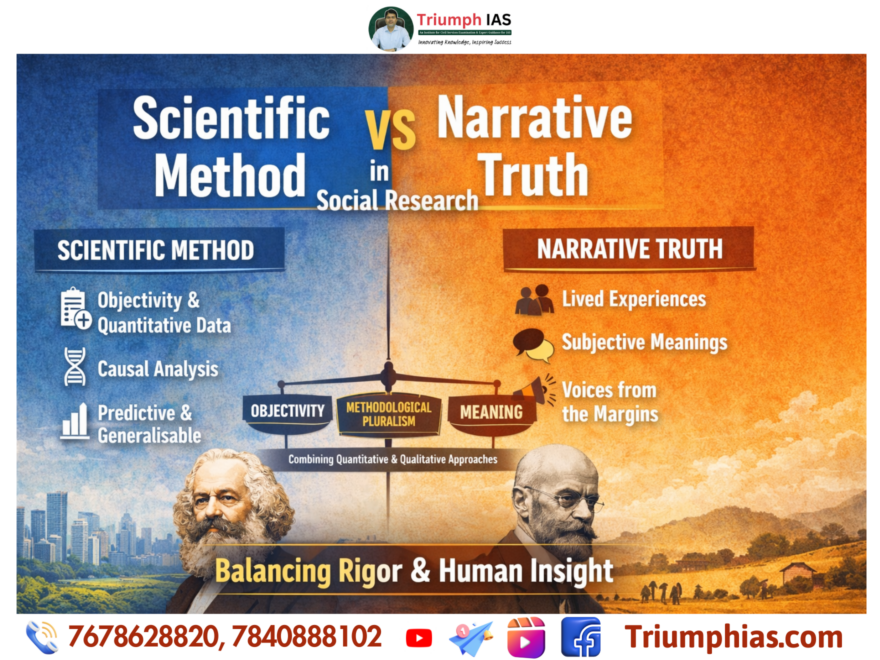
Scientific Method vs Narrative Truth in Social Research
(Relevant for Sociology Paper 1, Paper 2, Society [GS] )
IntroductionSocial reality is complex, layered, and deeply embedded in meanings, symbols, and lived experiences. Sociology, as a discipline, has long debated the most appropriate way to study this reality. At the heart of this debate lies a methodological tension between the scientific method, which seeks objectivity, generalisation, and causal explanation, and narrative truth, which prioritises subjective meanings, lived experiences, and contextual understanding. This methodological dualism is not merely academic; it shapes how societies are studied, policies are framed, and voices are either amplified or silenced. Scientific Method in Social ResearchThe scientific method in sociology draws inspiration from the natural sciences. It emphasises empiricism, objectivity, replicability, and causal analysis. Early sociologists such as Émile Durkheim argued that social facts should be treated as “things” that exist independently of individual consciousness. Quantitative tools like surveys, statistics, and experiments aim to uncover patterns, correlations, and laws governing social life. From a positivist perspective, this method enhances predictive capacity, ensures value neutrality, and supports policy formulation based on measurable indicators such as poverty rates, literacy levels, or demographic transitions. In governance and development planning, the scientific method provides scalability and comparability across regions and time periods—features crucial for state intervention. However, critics argue that excessive reliance on this method risks reductionism, overlooking emotions, meanings, and everyday struggles that cannot be easily quantified. Narrative Truth and Interpretive SociologyIn contrast, narrative truth emerges from interpretivist and phenomenological traditions, focusing on how individuals construct and interpret social reality. Thinkers like Max Weber emphasised verstehen—empathetic understanding of social action from the actor’s point of view. Narrative methods such as life histories, ethnography, oral testimonies, and case studies seek depth rather than breadth. Narrative truth does not claim universal generalisation. Instead, it values contextual validity, subjective authenticity, and voices from the margins—including women, Dalits, tribal communities, and migrants. In postcolonial and feminist sociology, narrative approaches challenge dominant “official statistics” by revealing how power structures shape whose knowledge counts as truth. Yet, narrative truth faces criticism for limited generalisability, researcher bias, and challenges in verification. Methodological Debate: Objectivity vs MeaningThe debate between scientific method and narrative truth reflects a deeper epistemological question: Can social reality be studied like natural phenomena, or does it require interpretive understanding? Positivists prioritise explanation (erklären), while interpretivists emphasise understanding (verstehen). In contemporary sociology, this binary is increasingly seen as false. Modern sociological research advocates methodological pluralism, where quantitative data is complemented by qualitative narratives. For example, while statistical data may reveal rising unemployment, narratives explain how unemployment is experienced differently across caste, gender, and region. Contemporary Relevance and SynthesisIn an era of big data, algorithmic governance, and evidence-based policymaking, the scientific method remains indispensable. Simultaneously, movements for social justice, identity recognition, and participatory governance underscore the importance of narrative truth. The synthesis of both approaches enhances sociological imagination, making research both rigorous and humane. ConclusionScientific method and narrative truth should not be seen as competing epistemologies but as complementary lenses. While the scientific method provides structure, reliability, and policy relevance, narrative truth restores agency, meaning, and ethical sensitivity to social research. A mature sociology integrates both—capturing patterns without erasing people, and stories without losing structure. UPSC Civil Services Mains – Sociology Optional Question“Critically examine the tension between scientific objectivity and narrative truth in social research. How can methodological pluralism address this challenge?” |
To Read more topics, visit: www.triumphias.com/blogs
Read more Blogs:
Non-Positivist Methods and Lived Experiences of Marginalised Groups
Objectivity in Sociology in the Age of Ideology and Media Trials
2 comments