

Samagra Shiksha Through a Sociological Lens: What India’s Schooling Reforms Reveal About Society, Power, and Equity
(Relevant for Sociology Paper 1: Social change in Modern Society)
|
The Union government’s recent clarification that States will receive pending Samagra Shiksha funds only after fulfilling conditions—such as utilisation certificates, audit reports, State share contributions, and compliance with the National Education Policy (NEP) 2020—has invited debate across policy circles. While this seems administrative, a sociological reading uncovers deeper concerns about power relations, structural inequality, and competing visions of education in India. Samagra Shiksha, launched in the 2018–19 Union Budget, integrates three earlier schemes—Sarva Shiksha Abhiyan (SSA), Rashtriya Madhyamik Shiksha Abhiyan (RMSA), and Teacher Education (TE). It covers pre-school to Class 12, emphasizing holistic development, inclusion, and improved learning outcomes. Funding is shared between Centre and States in varying ratios, reflecting differential economic capacity. Yet beyond policy structures, Samagra Shiksha is a mirror reflecting how Indian society understands education: as a public good, a tool for social mobility, and a site where inequalities are reproduced and resisted. Durkheim and the Social Function of Schooling
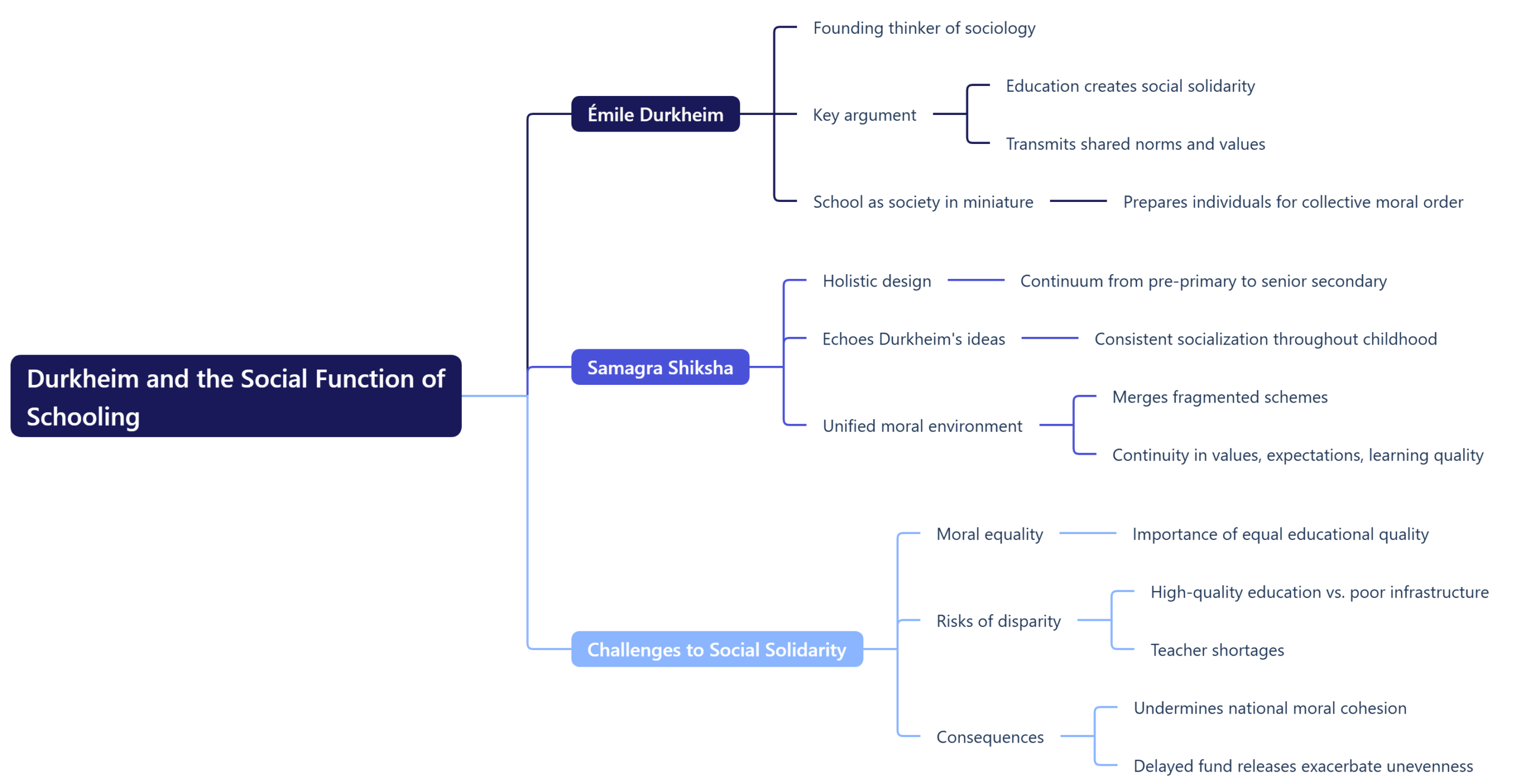
Émile Durkheim, one of the founding thinkers of sociology, argued that education serves a crucial function: creating social solidarity and transmitting shared norms and values. In his view, the school is society in miniature, preparing individuals to enter the collective moral order. Samagra Shiksha’s holistic design—treating schooling from pre-primary to senior secondary as a continuum—echoes Durkheim’s idea that socialisation must be consistent across the growing child’s life. By merging previously fragmented schemes, the programme attempts to create a unified “moral environment,” where students experience continuity in values, expectations, and learning quality. However, Durkheim also warned that societies must ensure moral equality. When some children experience high-quality education while others struggle with poor infrastructure or teacher shortages, it undermines the moral cohesion of the nation. Delayed fund releases may therefore intensify unevenness, challenging the very social solidarity that education aims to build. Bourdieu: How Educational Reforms Intersect With Social ReproductionPierre Bourdieu helps us understand education not merely as a liberating force but also as a system that often reproduces social inequalities. His concepts of cultural capital and habitus reveal how students from privileged backgrounds naturally fit into the norms of schooling, while those from marginalised communities struggle. Samagra Shiksha explicitly aims to reduce social and gender gaps and ensure equity. But Bourdieu would ask:
The scheme’s alignment with NEP 2020, which emphasises experiential and multidisciplinary learning, may partially address Bourdieu’s concerns by broadening what counts as “legitimate knowledge.” But without consistent teacher training, community participation, and resource equity, schools may continue to reflect and reproduce existing hierarchies. Bourdieu would likely warn that conditional funding could widen gaps if financially weaker states struggle to meet bureaucratic requirements—thus limiting access to quality schooling precisely where it is needed the most. Paulo Freire and the Question of Agency
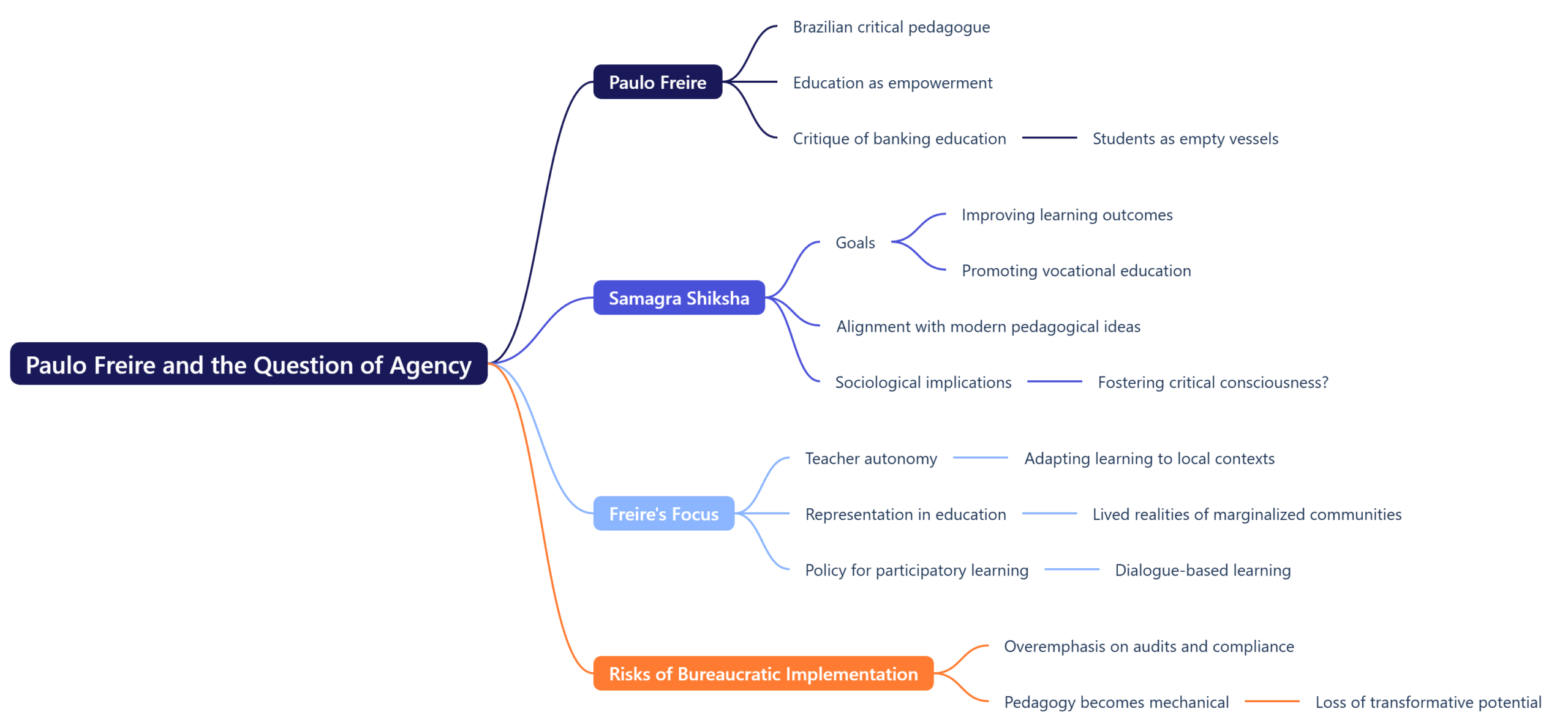
Paulo Freire, the Brazilian critical pedagogue, argued that education should empower learners to question and transform their world—not merely absorb information. He critiqued “banking education,” where students are treated as empty vessels. Samagra Shiksha’s goals—such as improving learning outcomes and promoting vocational education—align with modern pedagogical ideas. But sociologically, we must ask: does the system foster critical consciousness? Freire would focus on:
If implementation becomes overly bureaucratic (with heavy emphasis on audits and compliance), Freire would warn that pedagogy may become mechanical rather than transformative. Bernstein on Language, Curriculum, and InequalityBasil Bernstein’s theory of linguistic codes—elaborated and restricted codes—helps us see how language shapes educational outcomes. Middle-class children often come with linguistic capital that matches school expectations, while working-class or rural children may struggle not because of ability, but because of linguistic mismatch. Samagra Shiksha’s emphasis on foundational literacy and multilingual education (aligned with NEP 2020) can help bridge this linguistic divide. Bernstein would likely applaud such attempts but also remind us that curriculum structures themselves carry power. Who decides what knowledge is valuable? Whose language becomes the medium? Conditional funding may inadvertently prioritise measurable outputs over deeper linguistic inclusivity—something that Bernstein would critique as narrowing the curriculum in ways that disadvantage already marginalised groups. Ivan Illich’s Radical Critique of Institutionalised EducationIvan Illich, known for his book Deschooling Society, questioned the very idea of formal schooling, arguing that institutions often limit creativity and reinforce social stratification. He advocated for learning webs and community-based alternative systems. While Samagra Shiksha is firmly rooted in strengthening formal schooling, Illich’s ideas remain relevant sociologically. For example:
Illich would argue that when policy becomes too rigid, it risks serving the institution more than the learner. Amartya Sen and Education as CapabilityAmartya Sen’s Capability Approach reframes education not merely as a service but as a tool that expands people’s freedoms and life choices. From his perspective, Samagra Shiksha aligns well with the goal of enhancing capabilities—especially through its focus on equity, inclusion, and access. But Sen would also highlight that capability expansion requires both resources and agency. Delays in fund release—especially in poorer states—may curtail children’s substantive freedoms by limiting:
Thus, educational justice requires not only policy design but timely resource delivery. Federalism, Power, and the Sociology of the StateThe funding pattern—90:10 for Northeastern/Himalayan states, 60:40 for others, 100% for UTs—reflects what sociologists call asymmetric federalism, acknowledging unequal starting points. However, when fund release depends heavily on compliance with central conditions, questions arise about the balance of power between Centre and States. Using sociological theories of the state (from Weber to contemporary political sociology), we can interpret this as a negotiation over authority, legitimacy, and bureaucratic control. States with weaker administrative capacity may be disproportionately penalised, perpetuating unequal development—an issue that contradicts the ethos of cooperative federalism. Conclusion: The Sociological Stakes of an Educational ProgrammeSamagra Shiksha is not just an educational reform; it is a window into how India negotiates inequality, power, identity, and federal relations. From Durkheim’s moral cohesion to Bourdieu’s reproduction of inequality, from Freire’s liberatory pedagogy to Sen’s capabilities, sociological thinkers remind us that schooling is deeply political. The debate over fund release is thus not merely technical. It raises fundamental questions:
A sociologically informed approach to Samagra Shiksha demands not just compliance and auditing, but a deeper commitment to justice, inclusion, and the lived realities of India’s children. |
To Read more topics, visit: www.triumphias.com/blogs
Read more Blogs:
Mahaparinirvan Diwas and the Sociological Legacy of Dr. B.R. Ambedkar
Justice in Slow Motion: A Sociological Analysis of India’s Judicial Pendency Crisis