
Sailing Ahead: India Maritime Vision and Strategy
(Relevant for GS paper-2, Government Policies and Intervention)
|
India, with a vast coastline stretching over 7,500 km, a rich maritime history, and a strategic position in the Indian Ocean Region (IOR), is emerging as a key maritime power. In recent years, India’s maritime focus has significantly intensified, driven by evolving geopolitical dynamics, maritime trade imperatives, and national security concerns. The maritime domain now lies at the heart of India’s strategic, economic, and diplomatic vision. This blog explores India’s maritime trajectory, highlighting recent developments, challenges, and the way forward—crucial for UPSC aspirants studying internal and external security, economy, and foreign policy. India Maritime SignificanceIndia location at the crossroads of major east-west trade routes in the Indian Ocean gives it both an opportunity and responsibility. Over 90% of India’s trade by volume and 70% by value is carried through maritime routes. Furthermore, India’s Exclusive Economic Zone (EEZ) spans over 2.3 million square kilometers, rich in marine resources, energy reserves, and biodiversity. Strategic Initiatives and Policy Framework
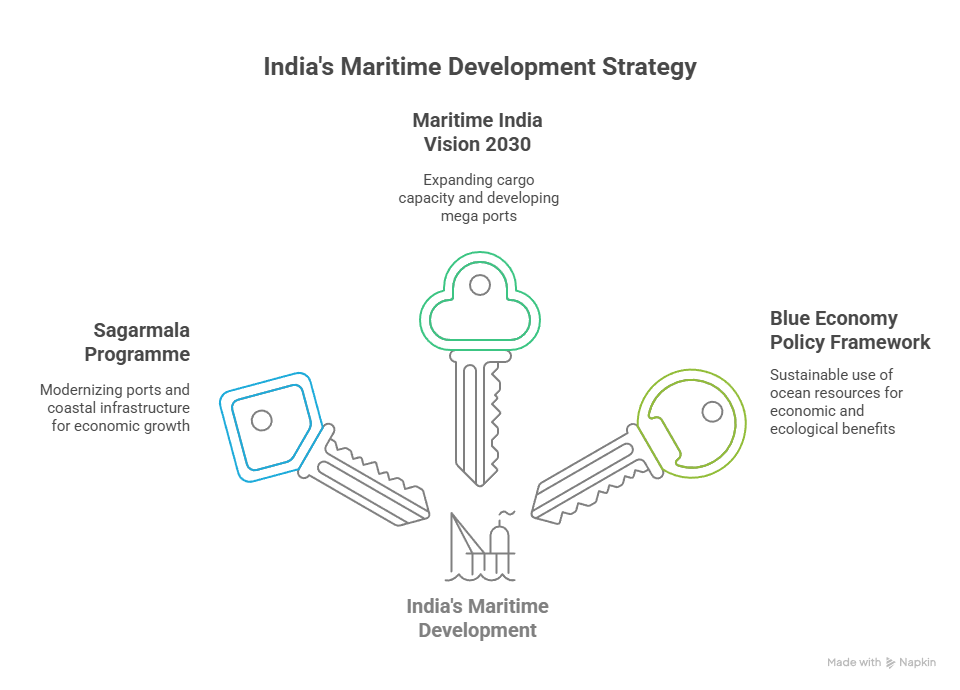
Sagarmala ProgrammeLaunched in 2015, the Sagarmala Programme is a flagship initiative aimed at modernizing India’s ports, developing coastal infrastructure, and boosting port-led economic development.
Maritime India Vision 2030Unveiled in 2021, this roadmap envisions:
Blue Economy Policy FrameworkIndia is formulating its Blue Economy Policy, focusing on sustainable use of ocean resources for economic growth, improved livelihoods, and ecosystem health. The policy aligns with SDG 14 (Life Below Water) and involves sectors like:
Naval Modernization and Maritime SecurityIndian Navy’s ExpansionIndia is steadily strengthening its naval capacity, transitioning from a buyer’s navy to a builder’s navy. As of 2025:
Mission-Based Deployments (MBDs)The Indian Navy maintains continuous presence in key maritime chokepoints such as the:
These deployments are aimed at maintaining maritime domain awareness, deterring piracy, and ensuring freedom of navigation. Information Fusion Centre – Indian Ocean Region (IFC-IOR)Established in 2018, the IFC-IOR in Gurugram collaborates with over 40 partner countries and multinational agencies to enhance maritime domain awareness and facilitate real-time information sharing for security and humanitarian operations. India Maritime DiplomacyIndia’s maritime outreach complements its vision of Security and Growth for All in the Region (SAGAR). The doctrine emphasizes:
Key Maritime Partnerships
These partnerships reinforce India’s position as a net security provider in the IOR. Maritime Challenges
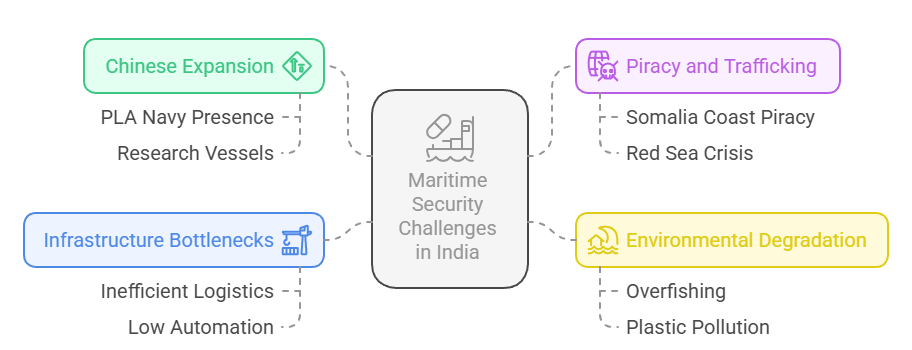
Despite progress, India faces significant challenges in its maritime journey: Chinese Expansion
Piracy and Trafficking
Environmental Degradation
Infrastructure Bottlenecks
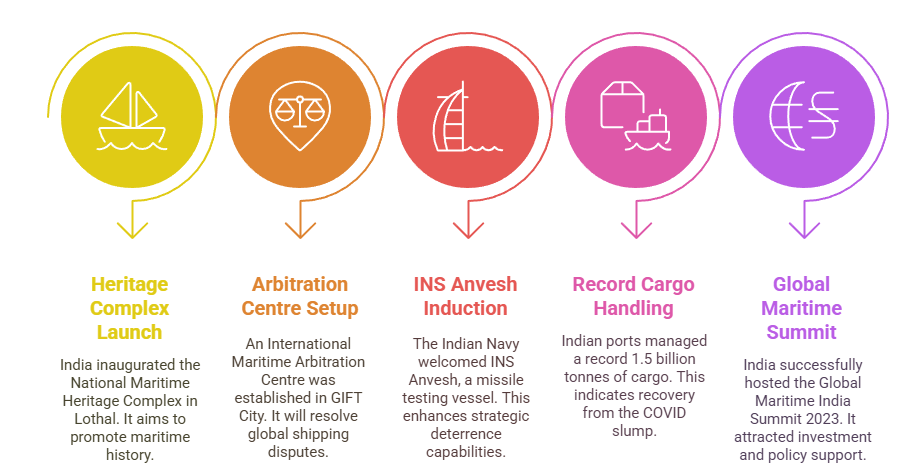
Recent Developments (2024–2025)
Way ForwardIndia maritime strategy must evolve to match the complexities of modern geopolitical, environmental, and economic realities. Some key focus areas include:
ConclusionNavigating India’s maritime path requires an integrated approach that combines security, sustainability, and strategy. As India aspires to become a leading Indo-Pacific power, its maritime domain will play a pivotal role in shaping its economic trajectory, global influence, and regional stability. With visionary policies, robust diplomacy, and naval modernization, India is poised to reclaim its maritime legacy and emerge as a strong maritime nation in the 21st century. |
To Read more topics, visit: www.triumphias.com/blogs