Introduction
The Dalit movement in post-independence India is a powerful socio-political force that emerged from centuries of caste-based oppression. The movement has significantly influenced State policies, constitutional provisions, and the broader discourse on social justice and affirmative action. Anchored in Ambedkarite ideology, the Dalit movement has transformed from a fight for basic dignity into a well-organized campaign for political power, economic justice, and social equality.
Historical Background
- Pre-Independence Legacy: Under the leadership of Dr. B.R. Ambedkar, the groundwork was laid for constitutional safeguards and Dalit consciousness.
- Post-Independence Shift: The movement evolved from reformist struggles to mass-based mobilization via political parties, civil society movements, and cultural assertion.
Key State Policies Influenced by the Dalit Movement
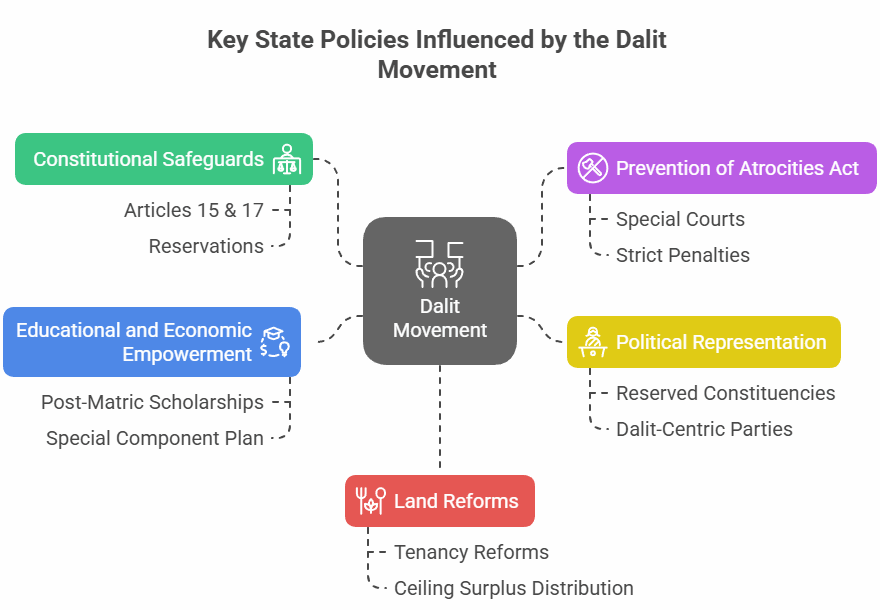
- Constitutional Safeguards: The Dalit movement, particularly led by Dr. B.R. Ambedkar, was instrumental in embedding Articles 15 and 17 in the Indian Constitution, which prohibit caste-based discrimination and abolish untouchability. It also ensured the introduction of reservations in education, public employment, and legislatures to provide Dalits equal opportunities and political voice.
- Scheduled Castes and Scheduled Tribes (Prevention of Atrocities) Act, 1989: Persistent activism by Dalit groups against caste-based violence led to the enactment of this stringent legislation. The Act provided for special courts, speedy trials, and strict penalties for atrocities against Dalits and Adivasis, aiming to deter caste-based crimes and ensure justice.
- Political Representation: Dalit assertion ensured constitutional provisions like reserved constituencies (Articles 330–334) for Scheduled Castes. Movements also paved the way for Dalit-centric political parties such as the Bahujan Samaj Party (BSP), which influenced State policy discourse by focusing on caste equity and social justice.
- Educational and Economic Empowerment: Dalit mobilization contributed to welfare programs like Post-Matric Scholarships, Ashram schools, and Skill Development Schemes that addressed historical educational disadvantages. The Special Component Plan (SCP) allocated funds for Dalit economic upliftment, particularly in rural and semi-urban areas.
- Land Reforms and Redistribution: Dalit-led groups like the Dalit Panthers demanded access to land, pressuring governments to focus on land redistribution, tenancy reforms, and ceiling surplus distribution. Although implementation remains inconsistent, these movements influenced agrarian policy narratives.
Recent Developments
- NEP 2020: Criticized for lack of focused affirmative action for Dalits.
- Digital Dalit Movements (e.g., #DalitLivesMatter) raised awareness globally.
- SC rulings on reservations in promotions: Prompted protests, influencing legal reviews.
Sociological Analysis
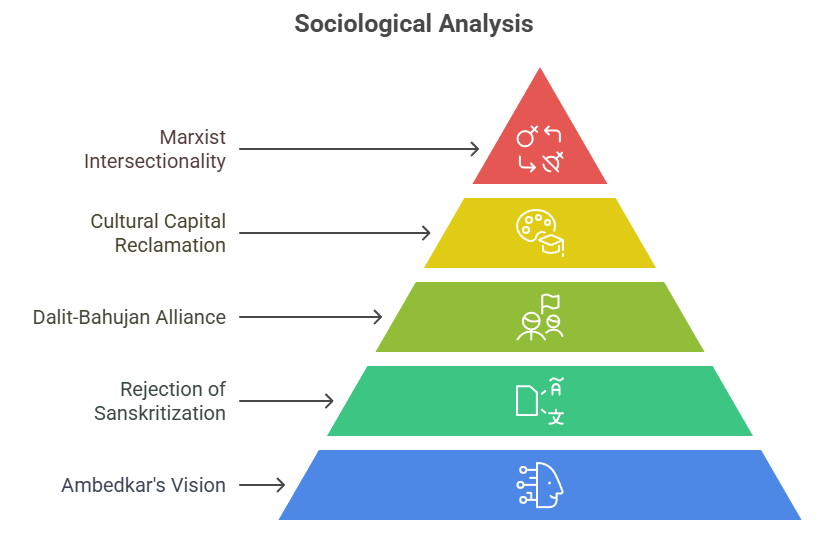
- Dr. B.R. Ambedkar’s Perspective: Ambedkar saw caste as a graded inequality system and advocated State-driven social engineering to dismantle it. He emphasized legal and institutional change over symbolic gestures to achieve true social justice.
- Sanskritization: M.N. Srinivas theorized that lower castes often emulated upper-caste lifestyles (Sanskritization). However, the Dalit movement rejected this path, instead asserting their own cultural and political identity without validation from dominant castes.
- Dalit-Bahujan Discourse: Gail Omvedt highlighted the autonomous political and cultural agency of Dalits, arguing for a Dalit-Bahujan alliance to challenge Brahmanical dominance. She viewed Dalit movements as radical democratic transformations.
- Cultural Capital: Pierre Bourdieu’s Cultural Capital noted that Dalits, historically denied access to education, language, and elite networks, lacked cultural capital. The movement’s focus on education, political representation, and symbolic assertion is an effort to reclaim both cultural and social capital.
- Marxist Perspective: From a Marxist lens, A.R. Desai framed the Dalit struggle as intersecting class and caste oppression, where economic exploitation reinforces social exclusion. Thus, the movement aligns with broader anti-capitalist and anti-feudal struggles.
Challenges Ahead
- Bureaucratic resistance to SC/ST Act implementation.
- Tokenism in representation without policy transformation.
- Caste-based violence still prevalent in rural India (e.g., 2024 Rajasthan Dalit lynching case).
- Dalit women face intersectional discrimination.
Way Forward
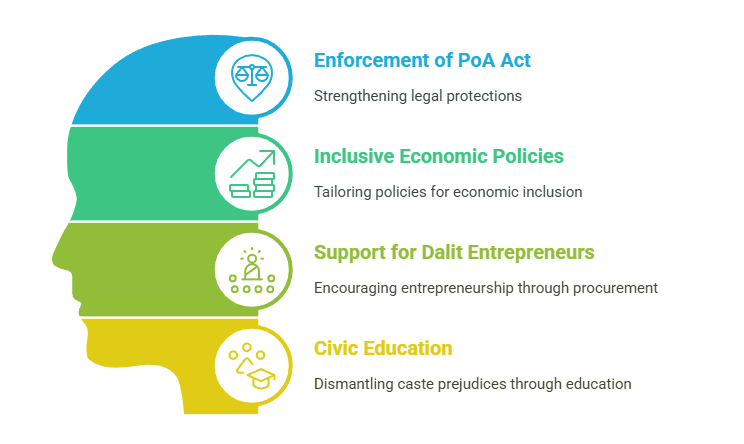
- Stronger enforcement of laws like PoA Act.
- Inclusive economic policies tailored to SC communities.
- Support for Dalit entrepreneurs through affirmative procurement.
- Civic education to dismantle caste prejudices at the grassroots.
Conclusion
The Dalit movement has fundamentally reshaped India’s post-independence policy architecture by pushing the State to recognize caste as a central axis of inequality. While constitutional guarantees laid the foundation, grassroots Dalit mobilization ensured their implementation and expansion. Moving forward, intersectional and inclusive policy-making must be prioritized to fulfill the constitutional promise of social justice and equality.
PYQs
Paper I
- Discuss B.R. Ambedkar’s approach to the annihilation of caste. (2014)
- Explain the significance of caste in contemporary Indian society and analyze it from the perspective of M.N. Srinivas. (2015)
- Explain the concept of ‘graded inequality’ in the caste system as explained by Dr. B.R. Ambedkar. (2018)
Paper II
- Discuss the impact of caste-based social movements on public policy-making in India. (2015)
- Examine the role of the Dalit Panthers in bringing radical consciousness among Dalits in post-independence India. (2016)
- What is the significance of the Dalit assertion in contemporary India? (2017)
- Evaluate the effectiveness of constitutional and legal safeguards for Scheduled Castes in India. (2018)
- Explain how the Dalit-Bahujan discourse has transformed the Indian political landscape. (2019)
- Write a note on the changing nature of caste inequalities and atrocities in India. (2020)
- Discuss the role of Dalit movements in shaping modern Indian society. (2021)
- Discuss the relevance of Ambedkar’s ideology in the light of contemporary Dalit movements. (2022)
- Analyze the role of caste in electoral mobilization in recent decades. (2023)
|