Introduction
In every democracy, political life is not just shaped by elections, political parties, and legislatures, but also by pressure groups. These groups, also called interest groups, represent specific sections of society and attempt to influence decision-making. The question arises: are they a threat to democracy because of their vested interests, or are they a necessary element of democracy that strengthens representation and accountability?
This debate is especially important in India, where UPSC Sociology syllabus topics such as Politics and Society, pressure groups, democracy, civil society, and political mobilization overlap with current affairs.
What Are Pressure Groups?
Pressure groups are organized associations that seek to influence public policy without directly contesting elections. They operate through lobbying, petitions, media campaigns, strikes, or negotiations. For example:
- Business groups like FICCI and CII influence economic policies.
- Trade unions like INTUC or AITUC push for workers’ rights.
- Social movements like Anna Hazare’s anti-corruption campaign mobilized citizens.
- Caste/community organizations like Jat or Patidar groups demand reservations.
They form part of civil society, mediating between the state and citizens.
Sociological Analysis
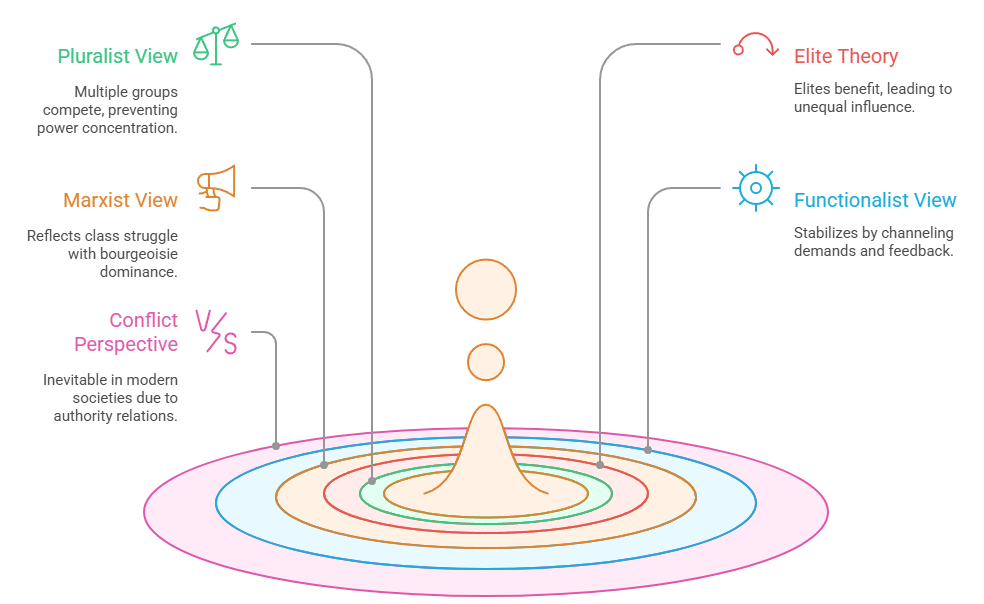
- Pluralist View (Dahl, Truman): Democracy flourishes when multiple groups compete, preventing concentration of power.
- Elite Theory (Mosca, Mills): Pressure groups benefit elites, leading to unequal influence.
- Marxist View (A.R. Desai in Indian context): Pressure groups reflect class struggle, with bourgeoisie dominating policymaking.
- Functionalist View (Parsons, Easton): They perform stabilizing functions by channeling demands and feedback into the political system.
- Conflict Perspective (Dahrendorf): Pressure groups are inevitable in modern societies, where authority relations create continuous struggles.
Pressure Groups as a Necessary Element of Democracy
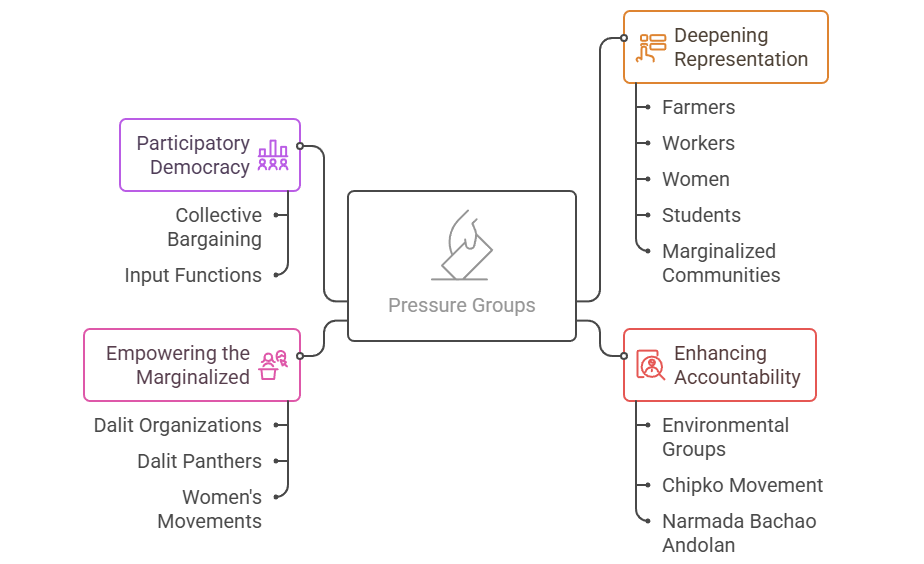
- Deepening Representation: Political parties cannot represent all micro-level interests. Pressure groups fill this gap by voicing concerns of farmers, workers, women, students, and marginalized communities. This enhances pluralism, a concept emphasized by Robert Dahl, where democracy thrives through multiple centers of power.
- Enhancing Accountability: Pressure groups act as watchdogs, scrutinizing government decisions. For instance, environmental groups like the Chipko Movement or Narmada Bachao Andolan compelled the state to reconsider projects that displaced people. This resonates with Habermas’s public sphere, where citizens hold the state accountable.
- Empowering the Marginalized: Groups such as Dalit organizations (e.g., Dalit Panthers) or women’s movements have challenged entrenched inequalities. This is aligned with Antonio Gramsci’s concept of counter-hegemony, where subordinate classes use associations to resist domination.
- Participatory Democracy: Beyond elections, democracy needs continuous participation. Pressure groups channel people’s grievances, transforming individual frustrations into collective bargaining. This strengthens what Parsons called the “input functions” of a political system.
Pressure Groups as a Threat to Democracy
- Elite Domination: According to C. Wright Mills’ elite theory, pressure groups are often dominated by powerful business or caste elites. For example, corporate lobbying in India’s telecom or mining policies has raised questions about crony capitalism.
- Fragmentation of National Interest: Pressure groups often push narrow sectional interests over the broader national good. Reservation agitations by different caste groups sometimes disrupt law and order, threatening Durkheim’s idea of social solidarity.
- Undue Influence on Policy: Groups with resources—money, media access, organizational strength—often capture the policy agenda. Olson’s logic of collective action suggests that smaller, organized groups (like industrial lobbies) are more effective than larger, diffuse groups (like consumers). This creates policy bias.
- Weakening Elected Institutions: When pressure groups bypass parliamentary debate through protests, blockades, or coercive tactics, they undermine representative institutions. This “street politics” can distort democratic decision-making.
The Indian Context
In India, pressure groups reflect sociological realities such as caste, class, region, religion, and language. For example:
- Farmers’ movements (e.g., 2020–21 protests against farm laws) showed how pressure groups can mobilize peacefully, influencing policy reversal.
- Caste-based mobilizations (e.g., Gujjar, Jat, Patidar movements) highlight identity politics shaping state policy.
- Environmental groups have pushed for sustainable development, reflecting the conflict between livelihood needs vs. environmental protection.
While they often challenge the state, they also give voice to diverse sections of society that might otherwise remain unheard.
Current Relevance
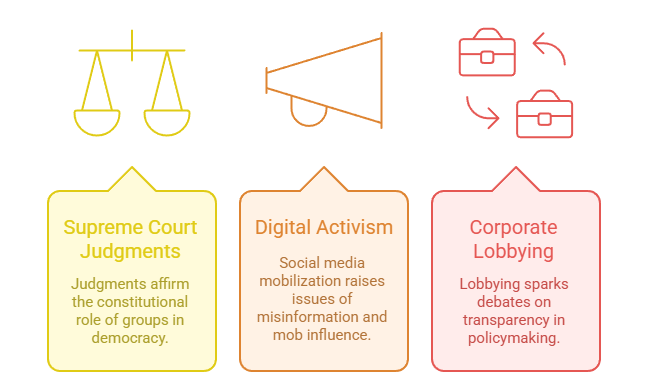
- Supreme Court judgments on protests and right to dissent affirm the constitutional role of groups in democracy.
- Digital activism and social media mobilization (g., #MeToo, environmental campaigns) are the new forms of pressure groups, raising issues of misinformation and mob influence.
- Corporate lobbying in AI, telecom, and data regulation has sparked debates on transparency in policymaking.
Balancing the Two Roles
The key issue is not whether pressure groups are inherently good or bad, but how they are regulated and integrated within democratic processes.
Strengthening the Positive Role
- Legal recognition and transparency in lobbying.
- Institutional mechanisms like Parliamentary committees to hear group concerns.
- Encouraging marginalized groups through capacity building.
Minimizing the Negative Role
- Limits on corporate funding and opaque lobbying.
- Ensuring peaceful, constitutional methods of protest.
- Strengthening representative institutions so that street-level agitations don’t bypass parliamentary processes.
Conclusion
Pressure groups are both a threat and a necessity. They are a necessary element because they pluralize democracy, amplify voices of the marginalized, and hold governments accountable. But they can become a threat when dominated by elites, fragmented along identity lines, or when they bypass representative institutions.
As Rajni Kothari noted in his work on Indian politics, democracy is not only about institutions but about the active participation of social forces. Pressure groups embody this reality. Instead of viewing them as dangers, democracies must learn to harness them through transparency, inclusiveness, and institutional checks.
Paper 1:
- “Distinguish between Political Parties and Pressure Groups.” (2014)
- “Examine the dynamics of pressure groups in multi‑party political system.” (2017)
- “Examine the role of pressure groups in parliamentary democracy.” (2022)
- Are pressure groups a threat to or a necessary element of democracy? Explain with suitable illustrations.(2025)
Paper 2:
- “Discuss the role of pressure groups in strengthening democracy.” (2022)
- “Illustrate with examples the role of pressure groups in the formulation of social policies.” (2022)
|